In the ancient kingdom nestled among the mist-covered mountains of Laos, where the Mekong River carved its eternal path through the land and where spirits dwelled in every grove and stream, there stood a palace that housed a treasure beyond measure. This was not gold or jewels, but something far more precious a sacred drum whose rhythm was the very heartbeat of the kingdom. When it sounded, the rice grew abundant, the rains came in their season, and harmony flowed through the land like water through terraced fields.
The drum had been blessed by the ancestors and watched over by the phi, the guardian spirits who protected the balance between the seen and unseen worlds. Its beat marked festivals and royal ceremonies, births and harvests. The people knew its voice as children know their mother’s lullaby.
Click to read all East Asian Folktales — including beloved stories from China, Japan, Korea, and Mongolia.
But one morning, as dawn painted the sky in shades of rose and amber, the drummers came to perform the sunrise ceremony and found themselves struck silent with horror. The drum would not sound. No matter how they struck it, no music emerged the sacred drumbeat had been stolen, drawn out of the instrument as if by invisible hands. The palace fell into confusion. Without the drum’s blessing, the kingdom’s harmony would unravel like thread from a torn cloth.
It was Prince Khuang who witnessed what others had missed. The night before, he had been unable to sleep, troubled by strange dreams sent by the ancestral spirits. From his window, he had seen it, a bird of impossible beauty, its feathers blazing with golden light that outshone the moon itself. The creature had descended to the palace courtyard, and in its presence, the sacred drum had fallen silent. Then the golden bird had taken flight, soaring toward the eastern mountains, carrying with it something invisible yet vital the drum’s sacred voice.
The prince knew with certainty that this was no ordinary bird. In a land where the boundaries between the physical and spirit worlds were as thin as morning mist, such a creature could only be a messenger, a test, or perhaps both.
Without hesitation, Prince Khuang prepared for a journey. He sought counsel from the palace monks, who burned incense and read the omens in smoke patterns that curled toward the heavens. The signs were clear but cryptic: the prince must pursue the golden bird alone, guided by virtue and aided by respect for the spirits. His courage would be tested, his humility measured, and only if found worthy would he restore what was lost.
As the first light of dawn touched the mountain peaks, Prince Khuang set forth. He carried little a simple traveler’s pack, a bamboo water container, and offerings for the phi he would surely encounter. His royal robes he left behind, dressing instead in the plain clothes of a common wanderer. Pride, the monks had warned him, would be his greatest enemy on this path.
The forests he entered were unlike any near the palace. Ancient trees rose like pillars supporting the sky, their trunks wrapped in vines thick as a man’s arm. The canopy above filtered the sunlight into shifting patterns of green and gold. Here, the phi were strong he could feel their presence in the way the air grew heavy, in the whispers that seemed to come from nowhere and everywhere at once.
At a massive banyan tree that marked the forest’s heart, Prince Khuang paused to make offerings. He placed rice balls and flowers at the tree’s roots, bowing with genuine reverence. As he did, an old woman appeared as if from the air itself. Her eyes held the ageless quality of those who existed between worlds.
“Why do you journey here, young man?” she asked, her voice like rustling leaves.
Prince Khuang did not announce his royal status. “I seek a golden bird that has taken something precious from my home. I must find it and restore what was lost.”
The old woman surely a phi in human guise studied him carefully. “Many princes have walked these paths,” she said. “Most demanded. You asked. Most took. You offered first.” She pointed toward a barely visible trail winding deeper into the forest. “Follow the path where the sunlight never quite reaches. But remember what you seek may not be what you think you seek.”
The prince thanked her and continued on. Days passed as he traveled through realms that seemed to exist outside ordinary time. He crossed rivers where nagas water serpents dwelled beneath the surface, their scales glimpsed briefly in the current. At each crossing, he spoke respectfully to the water spirits, requesting permission before wading through. Some travelers, he knew, had vanished in these rivers, pulled down by offended phi for their presumption.
In the mountains, where clouds clung to the peaks like celestial scarves, Prince Khuang encountered guardian beings of stone and mist. Some appeared as ancient warriors, others as animals with knowing eyes. To each, he showed proper respect, explaining his quest without arrogance, accepting their riddles and challenges with patience.
The higher he climbed, the more the physical world seemed to thin, revealing the spirit realm beneath like a second landscape overlaid upon the first. He saw villages that existed in twilight, populated by beings who were neither fully alive nor completely departed. He witnessed sacred groves where the trees themselves seemed conscious, watching his passage with silent judgment.
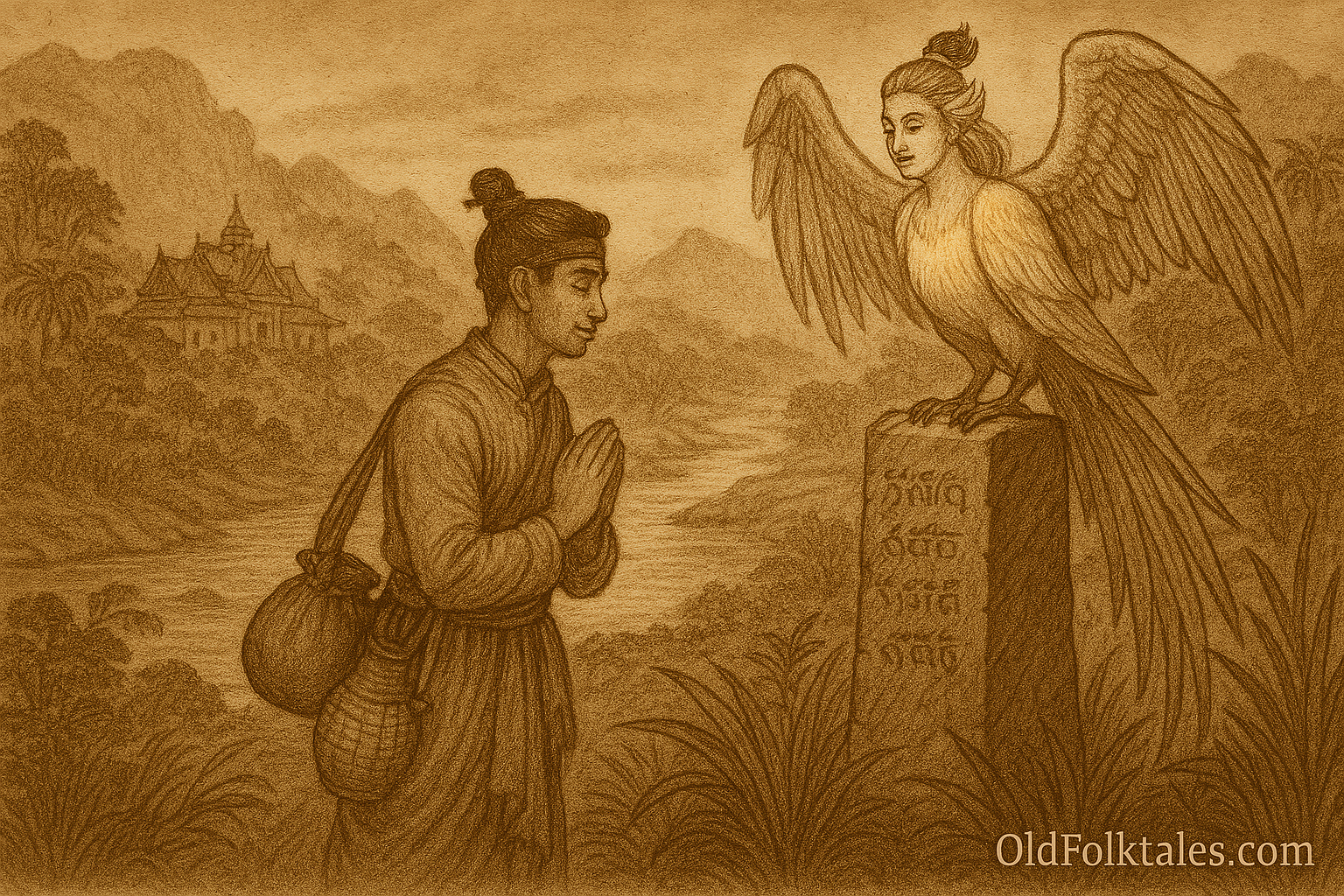
Finally, after a journey that might have been days or weeks time moved strangely in these high places Prince Khuang reached a plateau where the sky seemed close enough to touch. There, perched atop a standing stone carved with ancient prayers, sat the golden bird.
It was even more magnificent up close, each feather seeming to contain liquid sunlight. Its eyes, when they fixed upon the prince, held an intelligence that was unmistakably divine.
“You have come far, Prince Khuang,” the bird spoke, its voice like bells and wind chimes. “Though you dressed as a commoner, your royal bearing shows in your determination. Tell me why I should return what I have taken?”
The prince’s first instinct was to demand, to assert his authority. But the journey had changed him. He had seen too much, learned too much about the proper relationship between mortals and the divine.
“I cannot tell you why you should,” Khuang replied honestly, bowing low. “I can only tell you why I ask. The drum’s heartbeat brings harmony to my people. Without it, they suffer. I have traveled far not to claim what is mine by right, but to learn what was wrong that caused you to take it.”
The golden bird’s feathers ruffled, catching the mountain light. “At last,” it said, “a prince who seeks to learn rather than to command.”
In that moment, the bird’s form began to shift and change, growing larger, more luminous. It transformed into a celestial being of extraordinary grace a messenger from the heavens, part of the great dharma that governed all existence.
“The drum fell silent because your kingdom had grown proud,” the celestial being explained. “The people forgot to honor the phi who sustain the land. The nobles forgot gratitude. Even the drum’s keepers grew complacent, performing rituals without reverence. You were chosen to be tested, Prince Khuang. Your journey was not truly about finding me, but about rediscovering humility, respect, and proper relationship with the spirits who share this world.”
The being gestured, and suddenly the sacred drumbeat resonated in the air around them not as sound, but as feeling, as vibration, as the fundamental rhythm that connected all things.
“You have proven yourself worthy. You offered before taking. You asked before demanding. You honored every phi you encountered, making proper offerings even when you did not have to. You sought to understand rather than to conquer.”
The celestial messenger touched Prince Khuang’s forehead with one radiant wing. “Return to your kingdom. The drum’s voice has already been restored. But take this wisdom with you: the heartbeat of a kingdom is not kept in an instrument of wood and hide, but in the hearts of those who remember that we are all mortal and spirit, noble and common, human and phi part of one great harmony.”
When Prince Khuang descended from the mountains, he found the kingdom transformed. News of the drum’s restored voice had spread, but more importantly, people spoke of change of renewed respect for offerings, of monks teaching the old ways with new fervor, of nobles serving rather than commanding.
The sacred drum sounded once more, its rhythm pure and strong. But now, everyone who heard it understood what Prince Khuang had learned in his journey: that harmony is not given but earned, not demanded but cultivated through courage, humility, and respect for all the beings seen and unseen who share this world.
Click to read all Southeast Asian Folktales — featuring legends from Thailand, Indonesia, Vietnam, and the Philippines.
The Moral Lesson
The tale of Prince Khuang and the golden bird teaches that true leadership requires humility, and that harmony cannot be maintained through pride or complacency. The story reminds us that the divine tests us not with impossible tasks but with opportunities to demonstrate our values. When we approach the world both its physical and spiritual aspects with genuine respect rather than entitlement, with the desire to understand rather than to control, we restore balance not just in our surroundings but within ourselves. The drum’s heartbeat returns when we remember that we are participants in a greater harmony, not masters of it.
Knowledge Check
Q1: What was stolen from Prince Khuang’s kingdom and why was it so important?
A: The sacred drumbeat the drum’s divine voice was stolen by a golden bird. The drum was crucial because its rhythm was the kingdom’s heartbeat, bringing harmony, abundant harvests, timely rains, and spiritual balance to the land and people.
Q2: Who was the golden bird in the Lao legend and what was its true purpose?
A: The golden bird was actually a shape-shifting celestial messenger testing Prince Khuang’s virtue. It took the drum’s voice to create a journey that would test the prince’s courage, humility, and respect for spirits, ultimately teaching the kingdom an important lesson.
Q3: What are the phi in Lao culture and how did Prince Khuang interact with them?
A: The phi are guardian spirits inhabiting forests, rivers, mountains, and sacred places in Lao animist tradition. Prince Khuang showed proper respect by making offerings, asking permission before crossing territories, accepting their challenges with patience, and honoring their presence throughout his journey.
Q4: Why did the celestial being steal the sacred drumbeat from the kingdom?
A: The kingdom had grown proud and complacent people forgot to honor the phi, nobles lost their gratitude, and even the drum’s keepers performed rituals without genuine reverence. The theft was a test and a lesson to restore proper humility and respect.
Q5: How does this Lao tale blend animist and Buddhist beliefs?
A: The story combines animist elements (phi spirits, guardian beings in nature, offerings to spirits) with Buddhist concepts (dharma, celestial messengers, virtue testing, the importance of humility) to create a moral framework that reflects the syncretic religious culture of Laos.
Q6: What qualities did Prince Khuang demonstrate that proved him worthy?
A: Prince Khuang showed humility by dressing as a common traveler, courage by undertaking the dangerous journey alone, respect by honoring every phi with proper offerings, wisdom by asking and listening rather than demanding, and genuine desire to understand the reason for the loss rather than simply reclaiming what was taken.
Source: Adapted from Lao oral literature as documented in Patrice Lionel’s Lao Folktales
Cultural Origin: Laos, Southeast Asia (Lao Epic Cycle and Oral Tradition)