In the verdant heart of the Malay Peninsula, where thick jungle canopies sheltered winding rivers and ancient trees whispered secrets to the wind, there flowed a river known as Sungai Kebun. Its waters ran crystal clear over smooth stones, reflecting the dappled sunlight that filtered through the emerald leaves above. This river was no ordinary waterway locals spoke of it in hushed, reverent tones, for it was a place where the veil between the earthly realm and the celestial kingdom grew thin.
The villagers who lived nearby had long heard tales of supernatural beings who visited sacred places under the cover of darkness or in the hushed hours of dawn. Yet few had ever witnessed such wonders with their own eyes. That was until the day when whispers began to spread through the kampung about an extraordinary sight at Sungai Kebun.
Click to read all East Asian Folktales — including beloved stories from China, Japan, Korea, and Mongolia.
It began when a farmer, returning home earlier than usual from his fields, caught a glimpse of something that made his breath catch in his throat. Through the curtain of hanging vines and flowering bushes, he saw a figure of such ethereal beauty that he questioned whether his eyes deceived him. A maiden bathed in the river’s gentle current, her skin luminous as moonlight, her hair cascading like dark silk down her back. But it was her garment ah, her garment! that truly marked her as no earthly woman. It lay draped upon the riverbank, shimmering with an otherworldly radiance, woven from threads that seemed to capture starlight itself.
The farmer’s heart pounded as he realized what he was witnessing: a Puteri Kayangan, a celestial princess from the heavenly realms above. She had descended to bathe in the pure waters of Sungai Kebun, as spirits sometimes did in places of natural sanctity.
Word of this miraculous appearance spread swiftly through the village. Curious villagers began to visit the river at dawn and dusk, hiding among the foliage, hoping to catch a glimpse of the heavenly maiden. They watched in silent awe as she appeared, always at twilight, moving with a grace that seemed to defy the laws of the earthly world.
Among these observers was a young man named Awang, strong and handsome but cunning in his desires. Unlike the others who watched with respectful wonder, Awang’s mind turned to darker thoughts. He became consumed with the idea of possessing the celestial maiden, of making her his wife. Night after night, he plotted, until finally, a plan took shape in his mind.
One evening, as the sky burned orange and purple with sunset, Awang concealed himself near the riverbank with particular care. He watched as the Puteri Kayangan descended once more, setting aside her magical garment before stepping into the cool embrace of the water. Her movements were like poetry, each gesture an expression of pure joy and freedom. She sang softly, a melody so sweet it made the birds fall silent to listen.
With his heart hammering against his ribs, Awang crept forward and seized the shimmering garment. The fabric felt strange in his hands light as spider silk yet somehow substantial, warm despite the evening chill, and alive with an energy that made his fingers tingle. He clutched it tightly and retreated into the shadows.
When the maiden emerged from the water and discovered her celestial garment missing, her expression transformed from serene contentment to desperate panic. Without this sacred cloth, she could not return to her home in the heavens. She searched frantically along the riverbank, calling out in a language that sounded like wind chimes and flowing water. Her distress was palpable, her celestial radiance dimming with each passing moment.
Finally, Awang stepped from his hiding place, the garment bundled in his arms. The maiden’s eyes widened as she saw what he held. “Please,” she said, her voice carrying the weight of infinite sadness, “return what is mine. Without it, I am trapped in this world, separated from my home, my family, my true nature.”
But Awang’s desire had blinded him to her suffering. He made his proposal: he would return the garment only if she agreed to become his wife. Trapped and powerless, seeing no other path before her, the Puteri Kayangan reluctantly consented. What choice did she have? She was bound to the earth, unable to ascend to her rightful place among the stars.
The marriage was arranged, and to the village, it seemed a fortunate match. Awang had gained a wife of incomparable beauty, and the celestial maiden, now called simply “Puteri” by the villagers, settled into her earthly life. She bore Awang’s presence with quiet dignity, fulfilling her duties as a wife. To observers, she seemed accepting of her fate, even content. But those who looked closely could see the distant longing in her eyes whenever she gazed at the evening sky, and hear the catch in her breath when birds took flight above the trees.
Years passed. The couple’s life continued in an uneasy balance. Puteri proved to be an exemplary wife skilled, gracious, and patient. Yet there always remained something untouchable about her, a part of her spirit that remained forever beyond Awang’s reach. He had hidden her celestial garment carefully, keeping it locked away where he believed she would never find it, the key to her freedom held captive by his possessive love.
But secrets have a way of revealing themselves, particularly those born of deception. One day, while cleaning their home, Puteri discovered the hidden chamber where Awang had concealed her garment. The moment her fingers touched the familiar, radiant fabric, something awakened within her a memory of who she truly was, of the freedom that had been stolen from her, of the sky that was her birthright.
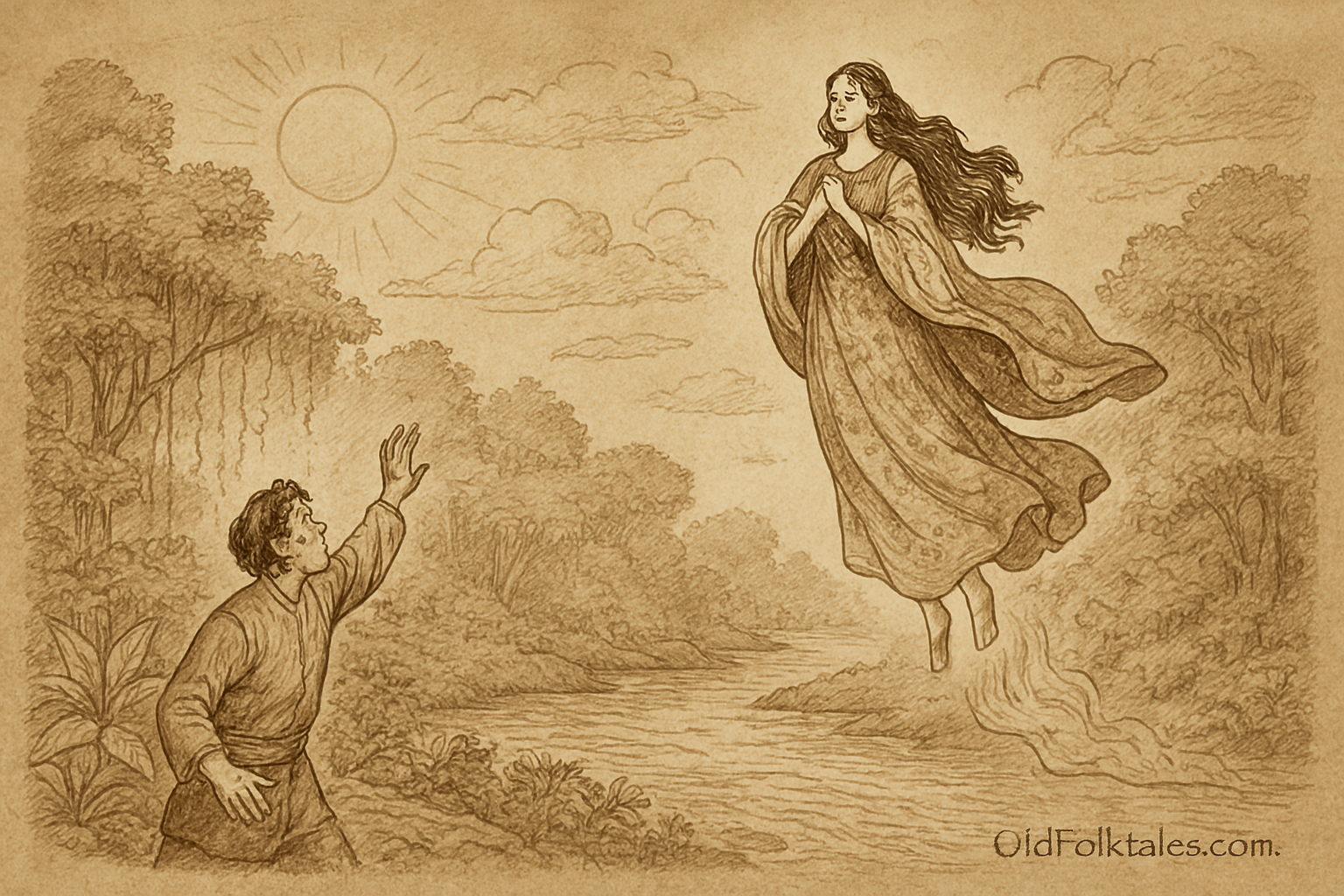
She did not hesitate. She did not pause to say farewell. The trust between them had been broken from the very beginning, built on a foundation of theft and coercion rather than genuine love and respect. Wrapping herself in her celestial garment, Puteri felt its power flowing through her once more. Her feet lifted from the earthly ground, and she began to rise, ascending like a star returning to its place in the firmament.
Awang returned home to find his house empty and his secret chamber open. He ran to Sungai Kebun, the place where he had first seen her, and looked up at the darkening sky. There, growing smaller with each moment, he saw the figure of his wife, returning to the heavenly realm from which she had come. He called out to her, his voice breaking with regret and loss, but she did not look back.
The Puteri Kayangan’s return to the celestial kingdom was not the end of the story, however. From that day forward, the villagers noticed changes at Sungai Kebun. The river seemed to possess a new awareness, a watchful quality. Those who approached it with respect and pure hearts found the waters as welcoming as ever, but those who came with selfish intentions or sought to take without giving found the river inhospitable, its currents treacherous, its banks unwelcoming.
The elders of the village understood the message: the celestial maiden had left behind a boundary, a set of unspoken rules that governed the sacred river. Sungai Kebun was to be respected, never exploited. Its gifts were to be received with gratitude, never taken by force. And the spirits who visited it should they ever appear again were to be honored from a distance, never trapped or possessed.
Awang lived the rest of his days alone, a cautionary figure in the village, a man who had grasped too tightly at something never meant to be held.
Click to read all Southeast Asian Folktales — featuring legends from Thailand, Indonesia, Vietnam, and the Philippines.
The Moral Lesson
This tale teaches us that true relationships cannot be built on deception, coercion, or the violation of another’s autonomy. Awang’s theft of the celestial maiden’s garment represents the broader human tendency to possess and control that which should be respected and allowed its freedom. Love obtained through manipulation is not love at all, but imprisonment. The story reminds us to honor boundaries whether between people, between humanity and nature, or between the earthly and spiritual realms. What we take by force will never truly be ours, and sacred spaces, beings, and relationships must be approached with reverence, not conquest. Genuine connection requires consent, trust, and the freedom to choose.
Knowledge Check
Q1: Who is Puteri Kayangan in Malaysian folklore?
A: Puteri Kayangan is a celestial maiden or heavenly princess from the spirit realm who descends to earth to bathe in sacred rivers. She represents divine beauty, purity, and the connection between the earthly and celestial worlds in Malay mythology.
Q2: What is the significance of the celestial garment in the story?
A: The celestial garment is Puteri Kayangan’s means of returning to the heavenly realm. It symbolizes her true identity, her freedom, and her divine nature. Without it, she is trapped on earth, making it a powerful symbol of autonomy and the consequences of theft.
Q3: Why is Sungai Kebun considered a sacred place?
A: Sungai Kebun is portrayed as a liminal space where the boundary between the earthly and spiritual worlds is thin, allowing celestial beings to visit. Its purity and natural beauty make it a site where supernatural encounters can occur, representing sacred natural spaces in Malay culture.
Q4: What does Awang’s action of stealing the garment represent?
A: Awang’s theft represents the violation of consent, autonomy, and sacred boundaries. His action symbolizes possessive desire, the attempt to control others through deception, and the disrespect of spiritual and personal sovereignty themes central to the story’s moral lesson.
Q5: What lesson does the story teach about relationships and consent?
A: The story emphasizes that genuine relationships must be built on mutual respect, honesty, and freely given consent. Forced marriages or relationships based on coercion, manipulation, or theft cannot create true happiness or connection, and will ultimately fail when the truth is revealed.
Q6: What cultural values does this Malaysian folktale preserve?
A: The tale preserves values central to Malay culture: respect for nature and sacred spaces, the importance of maintaining boundaries between human and spirit worlds, the value of consent and personal autonomy, and the consequences of violating trust and spiritual laws.
Source: Adapted from traditional Malay folklore and oral storytelling traditions of Peninsular Malaysia, as documented in various collections of Southeast Asian mythology and Malay supernatural tales.
Cultural Origin: Malay folklore, Peninsular Malaysia, Southeast Asia.