In the golden age of the Malay kingdoms, when sultans ruled with wisdom passed down through generations and the court glittered with silks and ceremony, there lived a young prince named Raja Muda. He was the eldest son of the Sultan, beloved by the people for his gentle nature and respected by the court for his intelligence and fair judgment. His future seemed as bright as the tropical sun that rose each morning over the palace towers.
Raja Muda had been raised according to the highest principles of royal conduct. His father had taught him that a ruler’s first duty was justice, his mother had instilled in him compassion for the weak, and his teachers had trained him in both the arts of war and the subtleties of statecraft. He was, by all accounts, everything a future sultan should be: brave without being reckless, kind without being weak, and wise beyond his years.
Click to read all East Asian Folktales — including beloved stories from China, Japan, Korea, and Mongolia.
But within the palace walls, not everyone celebrated the young prince’s virtues. The Sultan had a younger brother, a man named Tengku Mahmud, whose heart had long ago been poisoned by jealousy and ambition. He watched his nephew’s popularity grow with increasing bitterness, knowing that when the Sultan passed, Raja Muda would ascend the throne, forever closing the path to power that Tengku Mahmud secretly craved.
Tengku Mahmud was cunning and patient. He understood that direct opposition to the beloved prince would be futile, so instead, he wove his plots in shadows, nurturing his scheme like a gardener tends a poisonous plant. He waited for the perfect moment to strike, and when it came, he seized it with ruthless efficiency.
The opportunity arose during the annual tribute ceremony, when vassal states brought their offerings to the Sultan. Among the treasures presented that year was a magnificent ceremonial kris, its wavy blade forged by a legendary smith and its hilt encrusted with precious stones. The Sultan, delighted with this gift, ordered it placed in the royal treasury, a room to which only he and Raja Muda held keys.
That very night, the kris vanished.
When the theft was discovered the next morning, the palace erupted in chaos. The Sultan was furious, not merely at the loss of a valuable object, but at the insult to his authority and the breach of sacred trust. Guards were questioned, servants interrogated, but no trace of the weapon could be found.
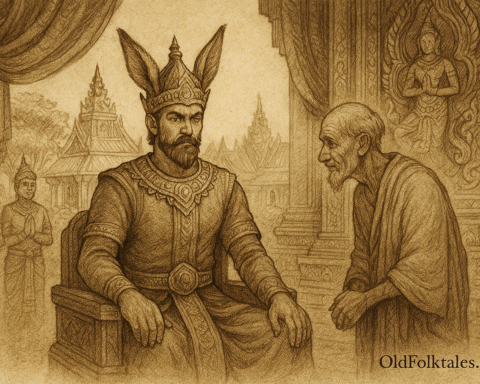
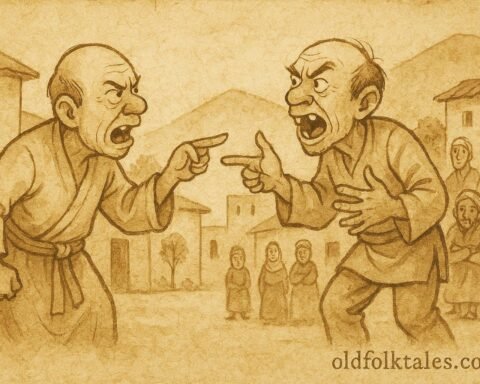
It was Tengku Mahmud who, with false reluctance and carefully crafted sorrow, approached the Sultan with devastating news. He had, he claimed, seen someone leaving the treasury in the dark hours before dawn. The figure had been cloaked, but Tengku Mahmud had recognized the distinctive royal walk, the height and build. Though it pained him deeply to say so, the person he had seen could only have been Raja Muda.
“Brother,” Tengku Mahmud said, his voice thick with feigned grief, “I wish I could say otherwise, but I saw what I saw. The young prince was where he should not have been, at an hour that raises questions. I speak only because justice demands truth, no matter how bitter.”
The Sultan’s face turned to stone. Other courtiers, carefully placed by Tengku Mahmud over the years, came forward with additional “evidence”: they had noticed the prince admiring the kris with unusual intensity, had heard him speak of needing funds for some unnamed purpose, had observed suspicious behavior. Each piece of false testimony was small enough to seem credible, yet together they painted a damning picture.
Raja Muda’s protests of innocence were drowned in the tide of accusation. He begged his father to believe him, swore by everything sacred that he had not taken the kris, pleaded for time to prove his innocence. But the Sultan, blinded by anger and betrayal, saw only a beloved son who had disappointed him beyond measure.
“If you are innocent,” the Sultan declared, his voice cold as winter rain, “then let time and God reveal the truth. But for now, the evidence speaks against you, and justice must be served. The penalty for theft from the royal treasury is severe, and not even my son can escape it.”
The sentence was pronounced in the great hall before the assembled court. Raja Muda would have his hands severed as punishment for his crime. He would then be cast out from the kingdom, forbidden to use his title or claim any royal privilege. The young prince stood silent as the judgment was read, tears streaming down his face, not from fear of pain but from the agony of his father’s lost trust.
The punishment was carried out at dawn. Raja Muda was led to the courtyard where justice was dispensed. He did not struggle or cry out when the blade fell, severing first his right hand and then his left. The physical pain was immense, but it paled beside the wound to his heart. As the stumps were bound to stop the bleeding, Raja Muda looked up at the palace windows where he knew his father watched. Even in that moment of supreme suffering, he felt no hatred, only a deep, abiding sorrow.
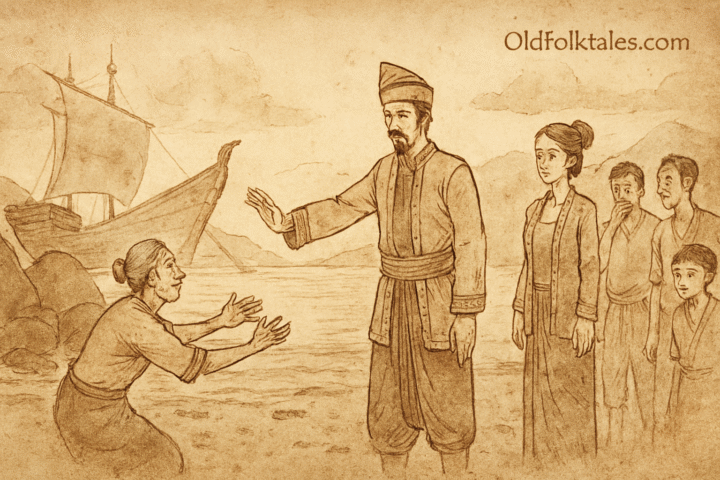
He was placed in a small boat with minimal provisions and pushed out to sea, exiled from the only home he had ever known. As the current carried him away from the shore, Raja Muda, now Raja Si Kudung (the One Armed King, though he was king of nothing but his own broken body), whispered a prayer: “If I am innocent, let truth be revealed. If I am guilty, let me bear this punishment with patience. Either way, let me never lose my faith in justice.”
For days, Raja Si Kudung drifted, helpless without hands to row or steer. He survived on rainwater and the small amount of food left in the boat, though eating and drinking without hands was a cruel challenge. Fever from his wounds made him delirious, and more than once he longed for death to end his suffering.
But on the seventh day, the boat washed ashore on a small island. An old hermit, a holy man who had withdrawn from the world to live in contemplation and prayer, found the prince barely alive on the beach. The hermit’s name was Tok Sheikh, and his eyes, though aged, could see beyond the physical world into the realm of truth and spirit.
“You carry great pain but no guilt,” Tok Sheikh observed as he tended to Raja Si Kudung’s wounds. “Tell me your story, young one.”
Raja Si Kudung, weakened but grateful for the kindness, related everything that had happened. Tok Sheikh listened carefully, nodding occasionally, his weathered face grave with understanding.
“Your uncle’s evil has cost you dearly,” the hermit said when the tale was done. “But I see in you a spirit that remains unbroken, a heart that holds no bitterness despite every reason for it. This purity will be rewarded, though the path ahead remains difficult.”
Under Tok Sheikh’s care, Raja Si Kudung’s wounds healed, though his hands, of course, could not be restored by mortal means. The hermit taught him to survive with his disability, to use his teeth and the stumps of his arms with surprising effectiveness. But more importantly, he taught the young prince patience, deeper wisdom, and unshakeable faith in divine justice.
Months passed, then a year. Raja Si Kudung helped Tok Sheikh as best he could, fetching water by carrying vessels between his stumps, tending the small garden with improvised tools, and learning the ways of spiritual contemplation. His suffering had refined him, burning away any traces of youthful pride or naivety, leaving behind a core of pure integrity and compassion.
One night, as Raja Si Kudung prayed in the moonlight, his stumps suddenly began to glow with a soft, golden light. He watched in amazement as new flesh began to grow, bones extending, muscles forming, skin covering. Within minutes, his hands had been completely restored, perfect and whole as if they had never been severed.
Tok Sheikh, witnessing this miracle, smiled with deep satisfaction. “The divine sees all truth,” he said quietly. “Your innocence has been acknowledged by powers beyond the mortal realm. Now you must return and reclaim what was stolen from you, not through vengeance, but through the revelation of truth.”
Meanwhile, in the distant kingdom, Tengku Mahmud’s rule as regent (for the old Sultan had died of grief over his son’s betrayal) had brought nothing but misery. Taxes had increased, justice had become arbitrary and cruel, and the people whispered longingly of the kind prince they had lost. The stolen kris had been found in Tengku Mahmud’s own chambers, discovered by accident by a servant, but the regent had silenced the witness with threats and gold.
When Raja Si Kudung returned to the kingdom, appearing before the palace gates with his hands miraculously restored and Tok Sheikh beside him as witness, the people gathered in amazement. Word spread like wildfire: the exiled prince had returned, transformed and vindicated by divine intervention.
Tengku Mahmud, confronted with the miracle of the restored hands and the testimony of those whose consciences could no longer bear their false witness, finally confessed his crimes. The true story emerged: how he had stolen the kris himself and planted evidence against his nephew, how he had orchestrated the web of lies, how his ambition had destroyed an innocent man.
The people demanded justice, and it was served. Tengku Mahmud was stripped of all titles and exiled, sent away in the same small boat that had carried his nephew. Raja Si Kudung, now truly Raja as his father’s rightful heir, ascended to the throne he had been denied.
But the suffering he had endured had changed him profoundly. He ruled with a wisdom and compassion born of personal anguish. He established new laws to protect the falsely accused, created systems to verify evidence before punishment, and always remembered what it felt like to be powerless and wronged. His people prospered under his just reign, and his story was told for generations as a reminder that innocence, patience, and moral integrity will ultimately triumph over deception and cruelty.
Click to read all Southeast Asian Folktales — featuring legends from Thailand, Indonesia, Vietnam, and the Philippines.
The Moral Lesson
The legend of Raja Si Kudung teaches us that true innocence and moral integrity cannot be destroyed by false accusations or unjust punishment. Patience and faith in divine justice, even in the face of extreme suffering, are virtues that transform and strengthen the soul. The story emphasizes that enduring hardship with grace rather than bitterness leads to ultimate vindication and restoration. It also warns that those who use deception to gain power will eventually be exposed, as truth has a way of revealing itself over time. Most importantly, the tale reminds us that suffering, when borne with dignity and without losing one’s moral compass, can refine a person into a wiser and more compassionate leader.
Knowledge Check
Q1: Who is Raja Muda in the Malaysian legend of Raja Si Kudung? A: Raja Muda is the young prince and eldest son of the Sultan who is falsely accused of theft by his ambitious uncle. He represents innocence wrongly punished and the virtue of maintaining moral integrity despite extreme suffering. His transformation into Raja Si Kudung (the One Armed King) and eventual restoration demonstrates the triumph of patience and divine justice over human cruelty.
Q2: Why does Tengku Mahmud falsely accuse Raja Muda? A: Tengku Mahmud, the Sultan’s younger brother, falsely accuses Raja Muda because of jealousy and ambition for the throne. As the Sultan’s brother, he knows that once Raja Muda becomes Sultan, his own path to power will be permanently blocked. His false accusation represents how envy and ambition can corrupt even family bonds and lead to devastating injustice.
Q3: What is the significance of Raja Muda losing his hands? A: The loss of Raja Muda’s hands represents the extreme injustice he suffers and his complete powerlessness and vulnerability. Hands symbolize capability, agency, and the ability to shape one’s destiny, so their removal strips him of everything except his internal moral character. This severe punishment tests whether his virtue is superficial or deeply rooted in his true nature.
Q4: Who is Tok Sheikh and what role does he play in the story? A: Tok Sheikh is a holy hermit who rescues Raja Si Kudung and provides physical healing, spiritual guidance, and witness to his innocence. He represents divine wisdom and compassion, recognizing truth that others miss. His care and teachings help the prince endure suffering without becoming bitter, preparing him for his eventual restoration and wise rule.
Q5: How are Raja Si Kudung’s hands miraculously restored? A: Raja Si Kudung’s hands are miraculously restored through divine intervention after he demonstrates unwavering patience, maintains his moral integrity despite suffering, and continues to pray with faith in ultimate justice. The restoration represents divine acknowledgment of his innocence and serves as irrefutable proof to others that he was wrongly accused, making his vindication undeniable.
Q6: What does this Malaysian folk tale teach about justice and leadership? A: This tale teaches that true justice requires careful verification of evidence and protection for the accused, as even trusted testimony can be false. It shows that leaders who have experienced suffering become more compassionate and wise rulers. The story emphasizes that moral integrity and patience under injustice are more valuable than immediate vindication, and that suffering endured with dignity ultimately leads to restoration and righteous authority.
Cultural Origin: Malaysia and the broader Malay world of Southeast Asia.