In the golden age of old Burma, when kings ruled from jeweled palaces and the Irrawaddy River carried ships laden with silk and spices, there existed a society sharply divided by birth and status. Nobles lived in grand teak mansions with carved pillars and gilded roofs, their lives filled with poetry, music, and courtly refinement. Common villagers dwelled in simple bamboo houses, their days devoted to farming rice paddies and fishing the fertile rivers that sustained the kingdom.
In one such village lived a young man named Shin Mwe Lon. He was neither wealthy nor of noble birth, possessing nothing of material value except a small plot of land that yielded just enough rice to feed himself and his aging mother. His clothes were simple homespun cotton, his hands calloused from work, his back bent from years of labor under the tropical sun. Yet despite his humble circumstances, Shin Mwe Lon possessed qualities that wealth could not purchase: a heart full of kindness, unwavering integrity, and a spirit that remained gentle despite life’s hardships.
Click to read all East Asian Folktales — including beloved stories from China, Japan, Korea, and Mongolia.
Not far from his village stood the grand estate of a noble family, their compound enclosed by high walls and guarded by gates adorned with intricate carvings. Within those walls lived Min Nanda, the family’s only daughter, renowned throughout the region for her extraordinary beauty and graceful refinement. Her name, which meant “Joyful Princess,” suited her perfectly, for she carried herself with a natural dignity that inspired admiration in all who saw her.
Young nobles from distant provinces came bearing expensive gifts, hoping to win Min Nanda’s hand in marriage. They arrived on fine horses, dressed in silk robes embroidered with gold thread, speaking eloquent words learned from tutors and poets. Yet Min Nanda found their courtship hollow, sensing that they desired not her but the prestige her family name would bring them.
Shin Mwe Lon first saw Min Nanda at the village temple during the full moon festival of Thadingyut, when people of all stations gathered to light oil lamps and offer prayers. She moved through the crowd with her attendants, placing her lamp among the thousands that transformed the temple grounds into a constellation of earthly stars. In that moment, illuminated by lamplight and moonbeam, she seemed to Shin Mwe Lon like a celestial being who had descended to walk among mortals.
He knew immediately that he loved her, though he recognized the absurdity of such feelings. What could a poor farmer offer a noble lady? What right did he have to even dream of such an impossible match? Yet love, once kindled, does not easily extinguish itself for practical reasons.
Unlike the wealthy suitors who bombarded Min Nanda with declarations and gifts, Shin Mwe Lon never dared approach her directly. Instead, he found small ways to express his devotion from a respectful distance. When the path to the temple needed repair, he worked through the night to lay smooth stones so her delicate feet would not touch mud. When the mango tree she favored for shade showed signs of disease, he secretly treated it with herbal remedies learned from his grandmother. When thieves threatened the village market where her servants shopped, he organized a watch of young men to maintain safety.
Min Nanda began to notice these quiet acts of service. She observed the suddenly improved path, the healthier tree, the safer marketplace, and when she inquired about who was responsible, people mentioned Shin Mwe Lon’s name with respect and gratitude. Curious about this humble man who served without seeking recognition or reward, she arranged to encounter him at the village well one morning.
“You are Shin Mwe Lon,” she said when they met, her voice carrying the musical quality of someone educated in the classical arts.
He bowed deeply, hardly daring to look at her face. “I am, my lady. How may I serve you?”
“Everyone speaks of your kindness and your service to our community. Yet you never seek acknowledgment or payment. Why do you do these things?”
Shin Mwe Lon’s honesty would not allow him to dissemble. “Because making others’ lives better brings me joy, my lady. And because…” he paused, gathering courage, “because seeing you happy is reward enough for any effort I might make.”
Min Nanda studied him carefully, seeing past his worn clothes and humble bearing to the genuine nobility of his character. “Walk with me,” she invited, and to the shock of her attendants and the village gossips, she spent the next hour in conversation with the farmer, discovering in him a wisdom and gentleness that none of her wealthy suitors had ever demonstrated.
This encounter began an unlikely friendship. Min Nanda would occasionally visit the village, always finding reasons to speak with Shin Mwe Lon, asking his opinion on matters both trivial and profound. Her parents noticed but did not interfere, trusting their daughter’s judgment and perhaps seeing something in the humble farmer that impressed even them.
But not everyone viewed this friendship with approval. Among Min Nanda’s rejected suitors was a man named Maung Phyu, who possessed considerable wealth and social standing but whose pride had been wounded by her rejection. Worse still, he had dabbled in forbidden arts, learning dark magic from practitioners who dwelt in the remote mountains where civilized law did not reach.
Consumed by jealousy and humiliation, Maung Phyu devised a terrible plan. If he could not win Min Nanda through legitimate courtship, he would take her by force using supernatural means. He enlisted the help of a powerful sorcerer who agreed, for a substantial price, to cast a spell that would compel Min Nanda to leave her family and come to Maung Phyu’s distant estate where her family could not rescue her.
The sorcerer performed his dark ritual on a moonless night, calling upon spirits that should not be summoned, making offerings that should not be made. A malevolent force descended upon Min Nanda’s household, manifesting as shadows that moved with unnatural purpose and whispers that spoke from empty air. The household guards could not fight what they could not see, and the family’s Buddhist amulets and protective prayers seemed powerless against magic this dark and determined.
Min Nanda felt the spell’s pull like iron chains wrapped around her will, compelling her feet to move toward the gate, urging her mind to forget resistance. Her attendants screamed for help, her parents rushed to restrain her, but some force stronger than physical bonds drew her inexorably toward the darkness beyond the compound walls.
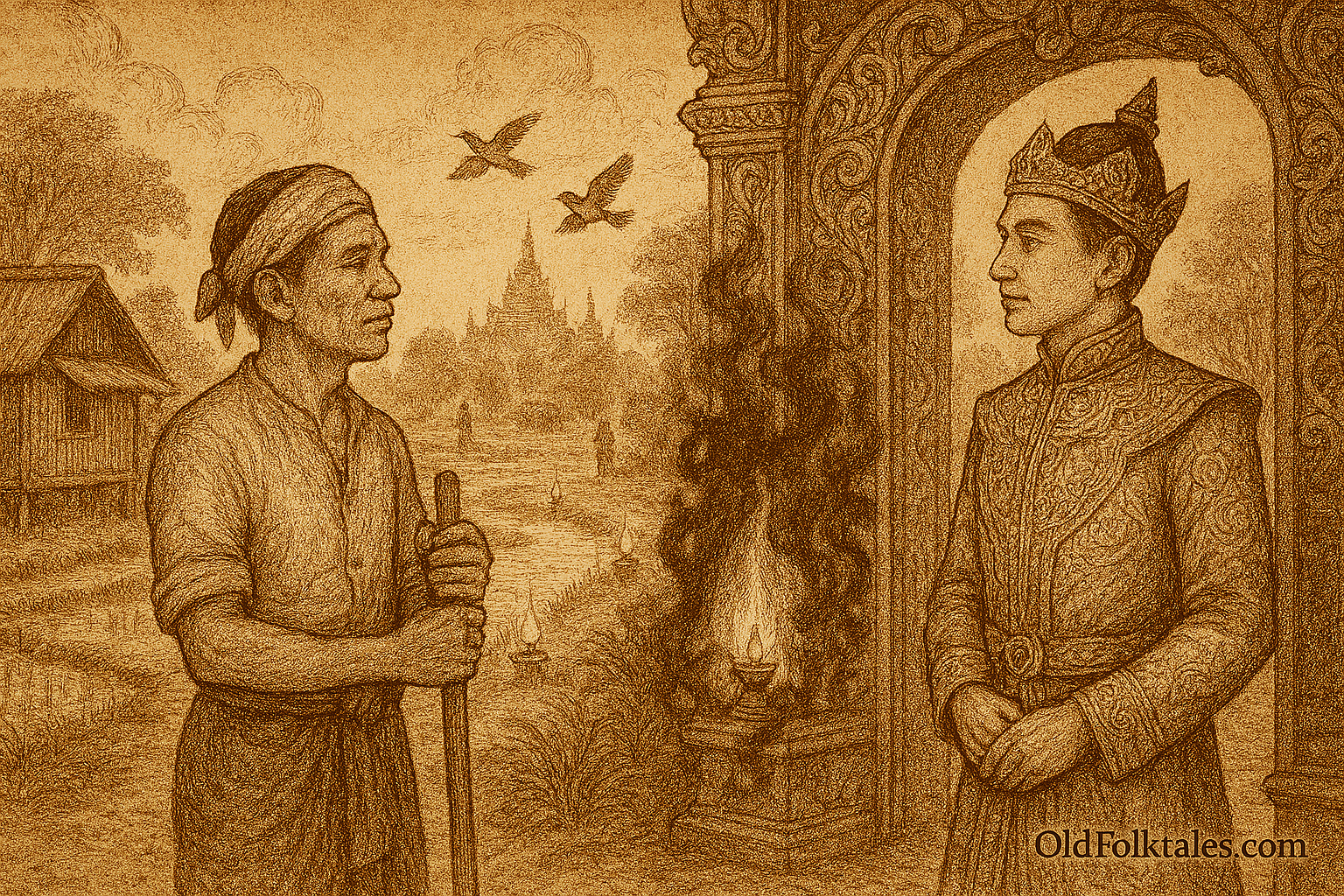
Shin Mwe Lon was working in his rice field when he heard the commotion from the noble estate. He dropped his tools and ran toward the sound, arriving to find the household in chaos and Min Nanda walking toward the gate with a glazed expression, fighting against the spell but losing the battle.
He had no weapons, no magic, no training in combat. He had only his courage and his love. Without hesitation, he positioned himself in Min Nanda’s path, blocking the gate.
“My lady,” he called to her, his voice cutting through the supernatural haze. “Remember yourself. Remember who you are. Don’t let this darkness claim you.”
The spell’s power turned its attention toward him, and Shin Mwe Lon felt pressure like crushing weight attempting to move him aside. Shadows gathered around him, whispering promises of pain if he did not step away. But he had faced hardship all his life hunger, loss, exhaustion, disappointment and had never allowed them to break his spirit. He would not break now.
He began to recite the verses from the Dhammapada that his mother had taught him as a child, ancient words of wisdom and protection that had guided Buddhist hearts for centuries. The words seemed to create light where there had been only darkness, pushing back against the malevolent force.
“Better than a thousand hollow words is one word that brings peace,” he chanted, his voice growing stronger. “Better than a thousand hollow verses is one verse that brings peace. Better than a hundred years lived in vice, without contemplation, is one day lived in virtue and in meditation.”
The sorcerer, observing from a distance through his dark arts, realized that this simple farmer possessed something his magic could not overcome: absolute purity of intention powered by genuine love and unwavering moral courage. Such qualities create their own kind of magic, older and more powerful than any spell.
The shadows began to dissipate. The unnatural whispers faded. The compulsion loosening its grip on Min Nanda’s will. She stumbled forward, and Shin Mwe Lon caught her, holding her steady as consciousness fully returned to her eyes.
“What happened?” she whispered, trembling.
“Dark magic attempted to claim you,” Shin Mwe Lon explained gently. “But it could not succeed. Your own strength and the protection of dharma were too powerful.”
Min Nanda’s father, who had witnessed everything, approached Shin Mwe Lon with new understanding. Here was a man who possessed no wealth, no status, no powerful connections yet when his daughter faced danger, this humble farmer had not hesitated to risk everything to protect her. What greater proof of worth could any parent desire?
The sorcerer and Maung Phyu, realizing their plan had failed and fearing legal consequences, fled the region. The royal authorities were notified, and warrants were issued for their arrest, though they were never found. Some said they had fled to neighboring kingdoms; others whispered that the dark spirits they had summoned had turned on them for failing to deliver what was promised.
In the days that followed, Min Nanda’s family investigated Shin Mwe Lon’s character thoroughly, speaking with everyone who knew him. Every person testified to his integrity, kindness, and selfless service to the community. The family recognized that this man, though lacking wealth and noble lineage, possessed something far more valuable: true nobility of spirit.
When her father suggested that perhaps Shin Mwe Lon would make a suitable husband, Min Nanda smiled. “I knew his worth long before this night, Father. I have been waiting only for you to see what I already knew that the truest nobility comes not from birth but from character, not from wealth but from the richness of one’s heart.”
Shin Mwe Lon was formally invited to present himself as a suitor. Though he arrived in his simple clothes with no gifts except his honest heart, he was received with honor. When he asked permission to marry Min Nanda, her father agreed, recognizing that his daughter’s happiness and safety mattered more than social conventions.
The wedding was celebrated throughout the village and the noble estate alike, bringing together people of all stations in recognition of a union that transcended social barriers. Shin Mwe Lon did not become noble by marriage he remained himself, humble and hardworking but he was recognized as noble in the ways that truly mattered.
Min Nanda and Shin Mwe Lon lived in happiness, their marriage founded on mutual respect, genuine affection, and shared values. They proved to all who knew them that love based on character rather than status, on courage rather than wealth, on kindness rather than power, creates the strongest and most enduring bonds.
And when their children asked their mother why she had chosen a poor farmer when she could have married a prince, she would smile and say, “Because your father proved that true worth cannot be measured in gold or titles. When I needed protection, the wealthy suitors were nowhere to be found, but your father stood before darkness itself without hesitation. That is nobility. That is worth. That is why I chose him, and why I would choose him again every day for the rest of my life.”
Click to read all Southeast Asian Folktales — featuring legends from Thailand, Indonesia, Vietnam, and the Philippines.
The Moral Lesson
This Burmese folktale teaches that true worth comes from character, courage, and kindness rather than social status or material wealth. Shin Mwe Lon’s humble origins did not diminish his nobility of spirit, while Maung Phyu’s wealth and status could not compensate for his corrupt character. The story emphasizes that genuine love recognizes inner qualities over external circumstances, and that courage in service of others reveals more about a person’s value than any title or treasure. Birth determines where we start in life, but character determines who we truly are.
Knowledge Check
Q1: What made Shin Mwe Lon different from Min Nanda’s other suitors?
A: Unlike the wealthy nobles who courted Min Nanda for prestige and openly displayed their gifts and eloquence, Shin Mwe Lon served the community quietly without seeking recognition. His acts of kindness were genuine and selfless, motivated by love rather than ambition, and he possessed authentic humility and integrity that the other suitors lacked.
Q2: How did Min Nanda discover Shin Mwe Lon’s worth?
A: Min Nanda noticed the improvements around the village the repaired temple path, the healthy mango tree, the safer marketplace and learned that Shin Mwe Lon was responsible for these acts of service. When she spoke with him directly, she recognized his wisdom, gentleness, and genuine nobility of character that transcended his humble social status.
Q3: What was Maung Phyu’s plan to claim Min Nanda?
A: Maung Phyu, a rejected suitor consumed by jealousy and wounded pride, hired a sorcerer to cast a dark spell that would compel Min Nanda to leave her family against her will and come to his distant estate. He used forbidden magic because he could not win her heart through legitimate means.
Q4: How did Shin Mwe Lon break the sorcerer’s spell?
A: Shin Mwe Lon confronted the dark magic with moral courage and pure intention, reciting verses from the Dhammapada, the Buddhist sacred text. His genuine love for Min Nanda and his unwavering virtue created a spiritual power that the sorcerer’s dark magic could not overcome, breaking the spell and freeing her.
Q5: Why did Min Nanda’s father approve of Shin Mwe Lon as a husband?
A: Min Nanda’s father recognized that when his daughter faced real danger, the wealthy suitors were absent while Shin Mwe Lon risked everything to protect her. After investigating his character and finding universal testimony to his integrity and kindness, the father understood that true nobility comes from character rather than birth or wealth.
Q6: What cultural values does this Burmese folktale emphasize?
A: The story reflects Buddhist values of inner virtue over external status, the importance of moral courage and selfless service, and the understanding that genuine love recognizes character rather than social position. It also emphasizes that true nobility is demonstrated through actions and integrity rather than inherited through birth or acquired through wealth.
Source: Adapted from Folklore and Fairy Tales from Burma, a collection preserving traditional Burmese stories that reflect the cultural values and moral teachings of Myanmar’s Buddhist heritage.
Cultural Origin: Burmese folklore, Myanmar (Burma), Southeast Asia