At the edge of a village where cultivated fields met untamed forest, there lived a boy called Si Anak Yatim, which simply meant “the orphaned child.” He had no other name, for his parents had died when he was so young that no one remembered what they had called him. The fever that took them had swept through the village years ago, leaving many families grieving, but none as alone as this small boy who had no relatives to take him in.
The villagers, though not heartless, were not particularly generous either. They gave the orphan boy a small, dilapidated hut at the very edge of the settlement, near the boundary where human habitation yielded to the wild forest. It was the kind of dwelling no one else wanted: too isolated, too close to the trees where spirits were known to dwell, too far from the community’s protective center.
Click to read all East Asian Folktales — including beloved stories from China, Japan, Korea, and Mongolia.
“It’s better than nothing,” the village headman had said, as if offering charity rather than abandoning a child to near wilderness. “If you work hard, you can survive.”
And so Si Anak Yatim did survive, though barely. He was perhaps eight or nine years old, small for his age from years of inadequate food, but possessed of a gentle spirit and respectful nature that his hardships had not managed to embitter. Each day, he would venture into the forest to gather whatever he could find: wild fruits, edible roots, mushrooms that grew on fallen logs, and occasionally small fish from the stream that wound through the trees.
He survived, but he was always hungry, always tired, and profoundly lonely. The village children were not cruel to him, but neither did they befriend him. He was different, set apart by circumstance and location. He existed on the margin of community life, neither fully included nor completely cast out.
What the villagers did not know, and what Si Anak Yatim himself only gradually came to understand, was that his isolated hut stood near the territory of the orang halus, the invisible beings who dwelled in the forest. These were not demons or ghosts but a different order of existence entirely, spirits of nature who occupied the same space as humans but were rarely seen and even more rarely acknowledged.
The orang halus had watched the orphan boy from the moment he arrived at the forest’s edge. They saw how he struggled to survive, how he wept quietly at night when he thought no one could hear, how he treated the forest with instinctive respect even though no one had taught him the proper protocols.
Unlike the village adults who tramped through the forest taking what they wanted without acknowledgment or thanks, Si Anak Yatim moved through the trees differently. When he picked fruit, he always left some on the branch. When he gathered mushrooms, he spoke soft words of gratitude to the forest itself. When he took water from the stream, he poured a little back as offering, though he did not fully understand why the gesture felt necessary.
These small acts of respect did not go unnoticed by the orang halus. One evening, as Si Anak Yatim returned to his hut carrying a meager collection of forest foods, he found something unexpected on his doorstep: a small bundle of the finest fruits, perfectly ripe and arranged with care on a banana leaf.
He looked around, bewildered. Who would have brought this? The village children would not venture this far, and adults certainly would not waste such good fruit on an orphan. Yet here it was, undeniably real and unexplained.
“Thank you,” he said aloud to whoever might be listening. “Whoever you are, thank you for your kindness.”
From that day forward, small gifts appeared regularly. Not every day, and never in such abundance as to seem unnatural, but enough to ease the constant edge of hunger that had been Si Anak Yatim’s companion for years. Sometimes it was food, sometimes useful items: a sturdy rope appeared when his was fraying, a sharp knife materialized when his had become dangerously dull, a warm blanket emerged just as the rainy season began.
Si Anak Yatim never saw his benefactors, but he felt their presence. Sometimes he heard laughter in the forest, light and musical, that did not sound quite human. Sometimes he felt gentle hands guiding him away from dangerous areas or toward particularly good foraging spots. Once, when he slipped near a steep ravine, he felt invisible hands catch and steady him.
He spoke to his unseen helpers as if they were friends. “Good morning,” he would say upon waking. “I hope you slept well.” When he returned from foraging, he would share his day’s experiences aloud, describing what he had seen and learned. And always, always, he expressed gratitude for every gift, every bit of help, every moment of companionship in his lonely existence.
The orang halus, who had watched countless humans pass through their forest over generations, were charmed by this orphan child. His respectful nature and genuine gratitude were so different from the entitled taking they usually witnessed. They increased their help, not just leaving gifts but actively assisting him. When he planted a small garden behind his hut, the vegetables grew with miraculous speed and vigor. When he set snares for small game, they always seemed to catch something. When he fell ill with fever, he woke to find medicinal herbs arranged beside his sleeping mat, along with instructions whispered in dreams about how to prepare them.
As the years passed, Si Anak Yatim prospered in his modest way. His garden flourished, his traps were always successful, and his small hut became comfortable and well maintained. He grew from a skinny boy into a healthy young man, and though he remained at the forest’s edge, somewhat apart from the village, he was no longer desperately poor.
The villagers noticed the change. “How does that orphan boy manage so well?” they whispered among themselves. “He has no family to help him, yet he always has enough. There must be a secret to his success.”
Some attributed it to luck, others to hidden skill, but a few began to suspect the truth. Old Pak Salleh, who remembered more of the old ways than most, watched Si Anak Yatim carefully and saw the signs: the unnatural abundance of his garden, the way forest creatures seemed unafraid of him, the occasional shimmer in the air near his hut that suggested invisible presences.
“The boy has befriended the orang halus,” Pak Salleh told a gathering of villagers. “The forest spirits help him because he treats them with respect. This is a gift that cannot be earned through cleverness alone, only through genuine humility and gratitude.”
But instead of learning the lesson that Si Anak Yatim’s experience offered, several villagers saw only opportunity. If the orang halus could be convinced to help one person, why not others? Why not the entire village? Imagine the prosperity if all their gardens grew like the orphan’s, if all their traps were as successful!
A group of villagers approached Si Anak Yatim with false friendliness. “You’ve done so well for yourself,” they said with practiced smiles. “You must share your secret. How do you get the forest spirits to help you? What rituals do you perform? What offerings do you make?”
Si Anak Yatim felt uncomfortable with their interest but tried to explain honestly. “I don’t perform rituals. I simply treat the forest with respect. I take only what I need, I express gratitude for what I receive, and I speak to the orang halus as I would speak to friends. It’s not a trick or a technique; it’s a relationship built on mutual respect.”
But the villagers heard only what they wanted to hear. They decided to approach the forest themselves, to demand that the orang halus provide the same help to them. After all, they reasoned, they were more important than an orphan boy. They had families to feed, positions to maintain. Surely the spirits would recognize their greater worth.
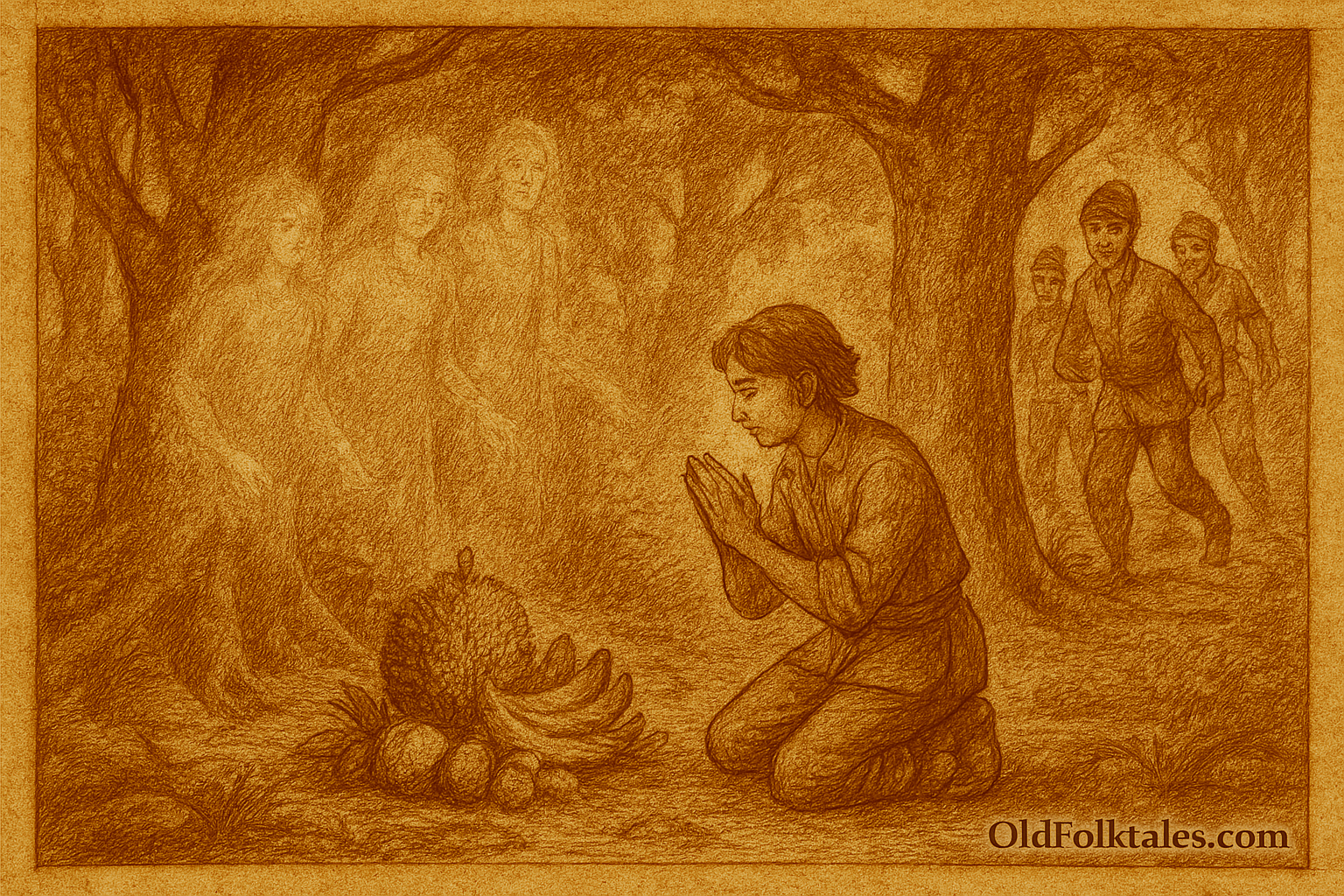
They entered the forest in a group, carrying elaborate offerings they had hurriedly prepared. But their attitude was all wrong. They did not approach with humility but with expectation, not with gratitude but with entitlement.
“Orang halus!” they called out loudly, disturbing the forest’s peace. “We know you’re here! We demand that you help us as you help the orphan boy! We deserve your assistance too!”
The forest fell silent in a way that felt ominous. No birds sang, no insects chirped. The air itself seemed to withdraw, offended by their presumption.
One of the men, emboldened by the silence which he mistook for submission, stepped forward and shouted again. “Did you hear us? We’re not asking; we’re telling you! Help us, or we’ll cut down these trees and drive you out!”
It was the worst thing he could have said, and the reaction was immediate. The wind rose suddenly, not the normal breeze but something that felt angry and purposeful. The carefully arranged offerings were scattered and blown away. The villagers felt invisible hands pushing them, not gently but forcefully, back toward the village. Some stumbled and fell, others ran in panic, but all retreated from the forest feeling they had made a terrible mistake.
That evening, Si Anak Yatim returned to his hut to find it as it had been years ago: empty of gifts, bare of the small comforts that had accumulated. His garden, which had been thriving that morning, looked suddenly ordinary. The sense of friendly presence he had grown accustomed to was gone, replaced by a profound absence that made his heart ache.
He understood immediately what had happened. The villagers’ greed and disrespect had offended the orang halus so deeply that they had withdrawn not just from the presumptuous villagers but from him as well. The relationship built over years had been destroyed in a single afternoon by others’ arrogance.
Si Anak Yatim wept that night, not from fear of returning to poverty but from the loss of companionship. The orang halus had been his only friends, his only family, and now they were gone.
But as the sun set and darkness settled over the forest, Si Anak Yatim made a decision. He would not become bitter. He would continue to treat the forest with respect, continue to express gratitude, continue to honor the unseen world even if it no longer responded. Because the right behavior should not depend on reward, and respect should not be conditional on receiving benefits.
He walked to the forest’s edge and spoke into the darkness. “I understand why you’ve withdrawn. The villagers were wrong to approach you with demands and threats. I don’t ask that you return, but I want you to know that I will always be grateful for the years of help and friendship you gave me. I will continue to respect your space and honor your presence, even if I never sense you again. Thank you for everything.”
A long silence followed his words. Then, so faint he almost missed it, he heard a whisper on the wind: “We know your heart, Si Anak Yatim. We will watch from afar. But trust, once broken, is difficult to restore. Perhaps in time, when the village learns what you already understand, things might change. But that time is not now.”
Si Anak Yatim returned to his hut, and life became harder again. But he never forgot the lesson: that relationships with the unseen world, like all meaningful relationships, require genuine respect, humility, and gratitude rather than manipulation or entitlement. And he carried that wisdom with him throughout his life, a gift more valuable than any material help could ever be.
Click to read all Southeast Asian Folktales — featuring legends from Thailand, Indonesia, Vietnam, and the Philippines.
The Moral Lesson
The legend of Si Anak Yatim dan Orang Halus teaches us that relationships with spiritual forces cannot be built on manipulation or entitlement but only on genuine humility, respect, and gratitude. Benefits that come from such relationships are gifts rather than payments and can be withdrawn when respect is violated. The story emphasizes that approaching the unseen world with demands or threats is not only ineffective but actively destructive, harming both the demanders and those who had built proper relationships. Most importantly, the tale reminds us that right behavior should continue even when it no longer brings tangible rewards, for integrity is its own value independent of benefits received.
Knowledge Check
Q1: Who is Si Anak Yatim in this Malaysian folk tale? A: Si Anak Yatim, meaning “the orphaned child,” is a young boy whose parents died from fever, leaving him alone with no relatives to care for him. He lives in an isolated hut at the forest’s edge and survives through gathering forest resources. His character represents the vulnerable who have nothing but their own character and behavior, demonstrating how respect and humility can earn spiritual assistance when human society fails to provide support.
Q2: What are the orang halus in Malaysian folklore? A: The orang halus, meaning “invisible people” or “subtle beings,” are nature spirits who inhabit forests and exist alongside humans but are rarely seen. They are not demons or ghosts but a different order of spiritual existence, guardians of natural spaces who observe human behavior and respond to respect or disrespect. They represent the unseen spiritual dimension of the natural world that traditional cultures believe requires acknowledgment and proper relationship.
Q3: How does Si Anak Yatim attract the orang halus’s help? A: Si Anak Yatim attracts help through instinctive respect for the forest: leaving some fruit on branches, speaking words of gratitude, making small offerings even without understanding why, and treating the forest space with reverence. He later speaks to the invisible helpers as friends, shares his experiences with them, and expresses sincere gratitude for every gift. His behavior is genuine rather than calculated, which is precisely why it earns spiritual assistance.
Q4: Why do the villagers fail to gain the orang halus’s help? A: The villagers fail because they approach with entitlement rather than humility, making demands rather than requests, threatening to cut down trees rather than showing respect, and seeking to manipulate the spirits for personal gain rather than building genuine relationships. Their attitude of superiority and greed offends the orang halus so deeply that the spirits withdraw not only from the presumptuous villagers but also from Si Anak Yatim, whose proper relationship has been contaminated by others’ disrespect.
Q5: What happens after the orang halus withdraw their help? A: After the spirits withdraw, Si Anak Yatim loses the material assistance and companionship he had enjoyed, returning to a harder life. However, he maintains his respectful behavior toward the forest despite receiving no tangible benefits, demonstrating that his integrity was genuine rather than transactional. The spirits acknowledge this from afar but indicate that trust, once broken by the community, takes time to restore.
Q6: What does this story teach about relating to the spiritual world in Malaysian culture? A: This Malaysian legend teaches that relationships with spiritual beings must be built on genuine respect, humility, and gratitude rather than demands, entitlement, or attempts at manipulation. The story emphasizes that spiritual assistance is a gift earned through proper attitude and behavior, not a transaction that can be controlled. It reflects traditional Southeast Asian beliefs that the unseen world responds to character and sincerity, and that approaching spirits with arrogance or greed destroys not only the opportunity for help but also harms existing positive relationships.
Source: Adapted from Malaysian oral folklore traditions.
Cultural Origin: Malaysia, Southeast Asia.