In a village where the Brunei River wound its way through dense tropical forest, there lived a young man whose reputation was known to everyone, though not in the way one would wish to be remembered. His name was Karim, but the villagers had long since begun calling him Si Pemalas, which means “the lazy one.” The nickname was not spoken with affection but with a mixture of frustration and disappointment, for Si Pemalas was perhaps the most idle young man anyone had ever encountered.
While other youths his age rose with the sun to help their fathers fish or farm, Si Pemalas would remain in bed until midday, emerging only when his stomach’s complaints became impossible to ignore. While his peers learned carpentry, weaving, and the various skills needed for self sufficiency, Si Pemalas would lounge in the shade, watching others work while he contributed nothing. His parents had tried everything: encouragement, scolding, bribing, and threatening, but nothing could motivate their son to lift a finger beyond what was absolutely necessary for his immediate comfort.
Click to read all East Asian Folktales — including beloved stories from China, Japan, Korea, and Mongolia.
“That boy would starve before he’d cook his own rice,” his mother would sigh to the neighbors.
“He’d die of thirst before he’d walk to the river for water,” his father would add with equal exasperation.
What made Si Pemalas’s situation bearable for him was that people, out of pity or habit, continued to provide for him. His mother still cooked his meals. His sisters still washed his clothes. Neighbors still invited him to share their food when they saw him wandering by at mealtimes. He had learned that if he waited long enough and looked pathetic enough, someone would always take care of whatever he needed.
“Why should I exhaust myself with work,” he would reason to himself, “when others are willing to do things for me? That’s their choice, and I’m simply accepting their generosity.”
But as Si Pemalas approached his twentieth year, the village’s patience began wearing dangerously thin. His father, now elderly and unable to work as he once had, felt shame each time neighbors asked when his son would start contributing to the household. His mother grew weary of cooking for a grown man who gave nothing in return. And his contemporaries, now establishing their own families and livelihoods, had no respect for someone who remained perpetually dependent like a child.
The breaking point came when a group of young men from the village planned a trading expedition to a distant settlement. The journey would take several weeks, passing through dense jungle and along challenging river routes. It was an opportunity for young men to prove themselves, to learn about trade and navigation, and to return with goods and stories that would enhance their standing in the community.
Si Pemalas heard about the expedition and, seeing an opportunity for adventure without effort, asked to join.
The leader of the group, a capable young man named Hamid, was skeptical. “This is not a pleasure trip, Karim. Everyone must contribute. We’ll need to paddle for hours each day, make camp, hunt and gather food, and protect each other from dangers. Can you commit to doing your share?”
“Of course,” Si Pemalas replied easily. “I’m not a child. I can handle whatever is required.”
Against their better judgment, swayed by Si Pemalas’s confident assurances and his parents’ pleading that the journey might finally mature their son, the group agreed to let him join.
The expedition began well enough. The first day, Si Pemalas contributed minimally but enough to avoid complaint. But by the second day, his true nature reasserted itself. When it was his turn to paddle, he claimed his arms were sore. When asked to help set up camp, he said he had twisted his ankle. When food needed to be prepared, he suddenly felt ill.
The other young men quickly realized they had made a mistake. Not only was Si Pemalas failing to contribute, but his constant excuses and complaints were dragging down the group’s morale and slowing their progress.
Hamid tried reasoning with him. “Karim, we’re all tired. We all have aches and pains. But we push through because we depend on each other. You must do your part.”
“I will, I will,” Si Pemalas would promise, but his efforts, when they materialized at all, were so halfhearted as to be useless.
After a week of this, the group’s patience finally snapped. They had reached a dense section of jungle where trails forked in multiple directions. Si Pemalas had fallen asleep during the afternoon rest, exhausted despite doing virtually no work.
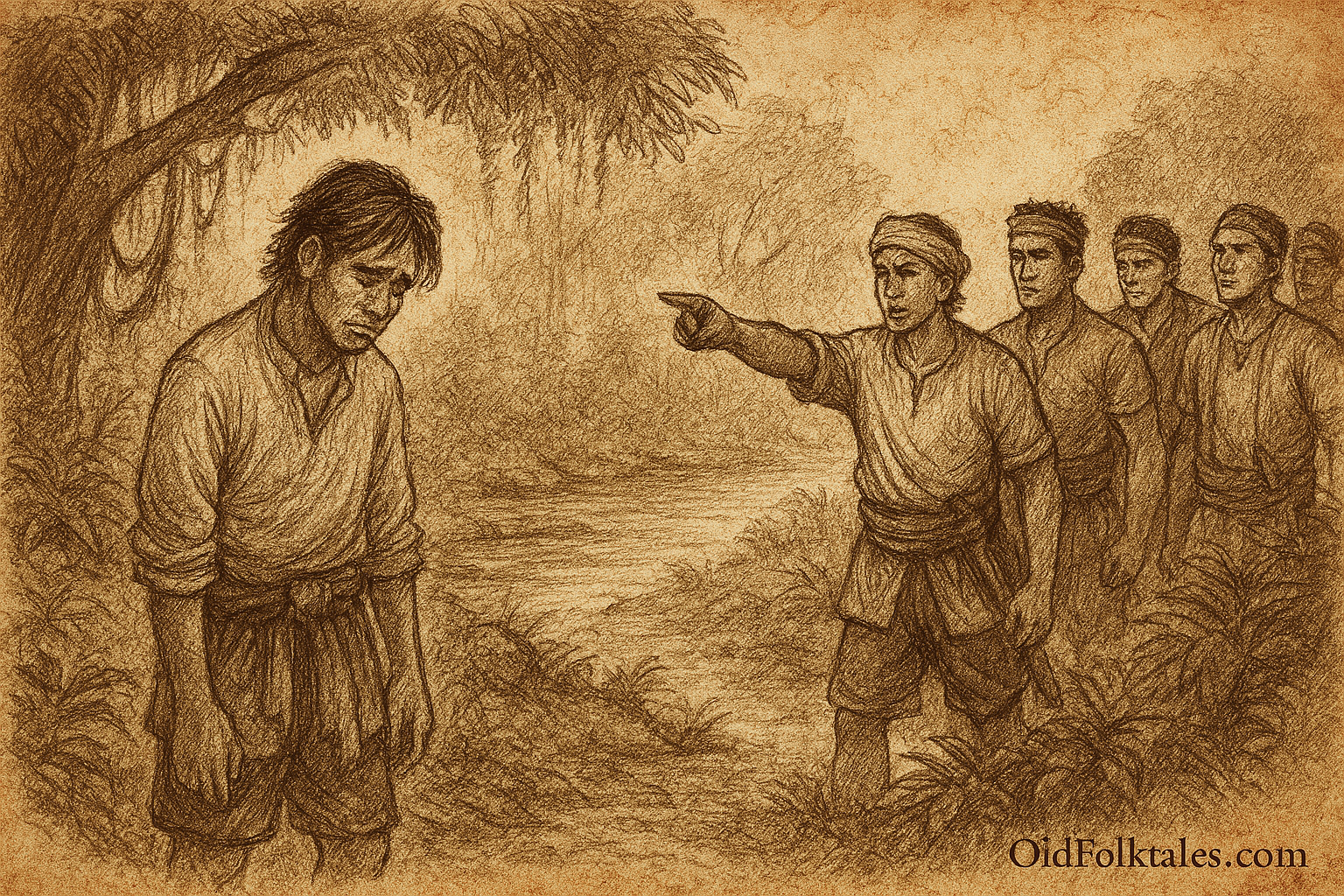
Hamid gathered the others and spoke in low, serious tones. “We cannot continue carrying this burden. Si Pemalas endangers us all with his refusal to contribute. I propose we leave him here. It sounds harsh, but perhaps necessity will teach him what kindness could not.”
Some protested, worried about leaving anyone alone in the jungle, but others agreed that Si Pemalas had been given every chance to change and had refused each one. They left him supplies: a knife, some dried fish, a small pot, and a flint for making fire. They marked the trail they were taking, ensuring he could follow if he chose. Then, as Si Pemalas slept, they quietly departed.
When Si Pemalas woke several hours later, the sun was already setting. He called out for his companions, but only the jungle sounds answered. Panic rose in his chest as he realized what had happened. They had abandoned him.
His first reaction was indignation. How dare they! After he had agreed to join their expedition, after he had traveled all this way, they simply left him? The injustice of it consumed him as he sat alone in the darkening forest.
But as night fell completely and strange sounds echoed through the trees, indignation gave way to fear. Si Pemalas had never spent a night alone, had never had to fend for himself without someone else handling the difficult tasks. For the first time in his life, there was no one to cook for him, no one to protect him, no one to solve his problems.
That night was the longest of his life. Every sound seemed like a predator approaching. The darkness felt oppressive and alive with threat. He barely slept, jumping at every rustle and crack in the undergrowth.
By morning, hungry and exhausted, Si Pemalas faced a choice. He could try to follow the marked trail and catch up with the group, arriving to beg for their mercy and tolerance. Or he could strike out on his own, learning to survive by necessity rather than choice.
Pride, perhaps the only thing Si Pemalas possessed in abundance, made the decision for him. He would not crawl back to them defeated. He would prove he could survive, that he was not as useless as they believed.
The first days were brutal. Si Pemalas had to learn through painful trial and error what others had been taught gradually with guidance. He burned his food, cut himself with the knife, failed repeatedly to start fires, and went hungry more often than not. He walked until his feet blistered, got lost multiple times, and suffered from insect bites and minor infections.
But something remarkable happened as the days turned into weeks. Each failure taught him something. Each difficulty overcome built confidence. He learned to identify edible plants by carefully watching what animals ate. He discovered that bamboo could be fashioned into useful tools. He found that patience and observation were better hunters than rushed desperation.
For the first time in his life, Si Pemalas felt the satisfaction of solving his own problems, of eating food he had caught and prepared himself, of building shelter with his own hands. The work that had once seemed impossibly burdensome now became a source of pride. Each skill mastered was a victory, each day survived was an achievement.
Months passed. The young man who had been called Si Pemalas transformed in both body and spirit. His soft, idle frame became lean and strong. His hands, once smooth and uncalloused, grew tough and capable. His mind, once occupied only with avoiding effort, now constantly solved problems and planned ahead.
He eventually found his way to a different village, one that knew nothing of his reputation. There, he introduced himself simply as Karim and offered his labor in exchange for shelter and food. The villagers, impressed by his work ethic and skills, welcomed him. He helped build houses, taught younger men survival techniques he had learned, and earned respect through consistent contribution.
When news traveled between villages, as it always does, Karim heard that the trading expedition had long since returned to his home. He decided it was time to return as well, not to reclaim his old life but to show what he had become.
His arrival shocked everyone who knew him. Gone was the idle youth who avoided all effort. In his place stood a capable young man whose bearing spoke of self sufficiency and earned confidence. His parents wept with joy and relief. His former peers regarded him with new respect, amazed at the transformation.
Hamid approached him cautiously. “Karim, I… we abandoned you. I have carried guilt about that decision, wondering if we had condemned you.”
Karim smiled. “You gave me the greatest gift possible: the necessity to change. I needed to be stripped of all support, all comfort, all the easy paths I had relied upon. Only then could I discover my own capability. I hold no grudge; I offer only gratitude.”
From that day forward, Karim became a valued member of the community. He married, raised children, and taught them the lessons he had learned: that capability comes from doing, that satisfaction comes from effort, and that true independence requires the discipline to work even when no one is watching or praising.
And when people spoke of him, they no longer called him Si Pemalas. That name belonged to a person who no longer existed, replaced by someone who had learned that fortune changes not through luck or others’ generosity, but through the hard earned growth that comes from facing challenges we cannot avoid and discovering strengths we never knew we possessed.
Click to read all Southeast Asian Folktales — featuring legends from Thailand, Indonesia, Vietnam, and the Philippines.
The Moral Lesson
The legend of Si Pemalas yang Bertukar Nasib teaches us that true transformation requires removing the safety nets that enable dependent behavior. Self discipline and responsibility cannot be learned through comfort but only through necessity and struggle. The story emphasizes that personal growth happens when we are forced to confront our own limitations and discover capabilities we never developed because others always intervened.
Knowledge Check
Q1: Who is Si Pemalas in this Bruneian folk tale? A: Si Pemalas, whose real name is Karim, is a young man known throughout his village as “the lazy one” because of his complete refusal to work or contribute to household or community. He represents people who have learned to manipulate others’ kindness to avoid personal responsibility. His character demonstrates how enabling behavior from family and community can prevent necessary personal development and maturity.
Q2: Why do the other young men abandon Si Pemalas in the jungle? A: The expedition group abandons Si Pemalas because despite his promises to contribute, he consistently refuses to do his share of paddling, camping, food preparation, or any other necessary work. His constant excuses and complaints drag down morale and endanger the group’s success. The abandonment represents the breaking point where enabling behavior stops and natural consequences begin, forcing accountability.
Q3: What immediate reactions does Si Pemalas have upon being abandoned? A: Si Pemalas initially feels indignation and anger at what he perceives as unfair treatment, believing he is the victim of injustice. However, as night falls and he faces the reality of being completely alone and vulnerable, his indignation transforms into fear and eventually into the recognition that he must either change or perish. This emotional progression shows the stages of accepting personal responsibility.
Q4: How does Si Pemalas transform during his time alone? A: Through painful trial and error, Si Pemalas learns survival skills including fire making, food gathering, tool crafting, and shelter building. Each failure teaches a lesson, and each success builds confidence. The physical labor transforms his soft body into a strong, capable one, while the mental challenges develop problem solving abilities and work ethic. His transformation is comprehensive, affecting body, mind, and character.
Q5: What does Si Pemalas’s return to the village demonstrate? A: Si Pemalas’s return demonstrates that people can fundamentally change when motivated by necessity rather than comfort. His transformation is so complete that villagers barely recognize him, and he is able to rebuild his reputation through consistent demonstration of his new character. The return also shows his maturity in holding no grudge against those who abandoned him, recognizing that their harsh action enabled his growth.
Q6: What values does this Bruneian story emphasize about personal development? A: This Bruneian tale emphasizes traditional values including self discipline as the foundation of character, personal responsibility as essential for adulthood, the importance of contributing to community rather than parasitically depending on it, and the belief that hardship and struggle are necessary teachers that comfort cannot replace. It reflects cultural emphasis on work ethic, self sufficiency, and the understanding that enabling dependent behavior harms rather than helps those who refuse to mature.
Cultural Origin: Brunei Darussalam, Southeast Asia.