In ancient Vietnam, during the prosperous reign of the Eighteenth Hùng King, there lived a princess whose beauty and kindness were celebrated throughout the land. Her name was Mỵ Nương, and she was the King’s only child, treasured beyond measure by her royal parents and beloved by all the common people who knew of her grace.
As Mỵ Nương blossomed into womanhood, the King grew concerned about finding her a suitable husband. He would not settle for just any nobleman or prince. His daughter deserved someone extraordinary a man of great power, wisdom, and devotion who could protect her and cherish her as deeply as he himself did. Word spread across the kingdom that the King was seeking a worthy suitor for Princess Mỵ Nương, and many men came to the palace gates with offers of marriage. Yet none satisfied the King’s requirements.
Discover more East Asian Folktales from the lands of dragons, cherry blossoms, and mountain spirits.
Then one day, two mysterious strangers appeared at the royal court, each requesting an audience with the King. They were unlike any mortals who had come before. When the first stepped forward and bowed respectfully, his presence seemed to carry the weight and stillness of ancient stone. “I am Sơn Tinh,” he announced in a voice steady as bedrock, “the God of the Mountains. I reign over the peaks of Tản Viên and govern all creatures that dwell upon the highlands. The forests, the birds, the beasts of the earth all answer to me. I can command mountains to rise toward the heavens and valleys to shelter the land. I promise to make Princess Mỵ Nương the happiest queen of all the highlands and give her an eternal life of peace and abundance.”
Before the King could respond, the second stranger moved forward with the fluid grace of crashing waves. “I am Thủy Tinh,” he declared, his voice rolling like distant thunder over water, “the God of the Sea and Waters. I rule over all creatures beneath the waves the fish, the pearls, the treasures of the deep. I can summon rain and storms, raise the tides, and command the rivers to overflow their banks. I promise to make Princess Mỵ Nương the glorious Queen of the Seas, showering her with riches from the ocean depths.”
The King observed both gods carefully. Sơn Tinh appeared gentle and composed, his demeanor radiating quiet strength and patience. Thủy Tinh, in contrast, possessed a fierce and passionate temperament, his eyes flashing with the intensity of a gathering tempest. The King asked them to demonstrate their divine powers.
Thủy Tinh lifted his arms, and immediately fierce winds began to howl through the palace courtyard. Rain poured from suddenly darkened skies, and in the distance, the sea began to swell and rise. The courtiers gasped in awe and fear at this terrifying display of elemental might.
Not to be outdone, Sơn Tinh raised a single hand. Instantly, trees burst from the earth and grew tall and strong before everyone’s eyes. Mountains thrust upward from the ground, and hills shifted position at his command. The court witnessed the very bones of the earth responding to his will.
The King was deeply impressed by both suitors. Either would make a worthy son-in-law, but he had only one daughter to give. After consulting with his most trusted advisors and contemplating the matter throughout the evening, he made his decision. The King announced that the following morning, whichever god arrived first at the palace gates bearing the proper wedding gifts would win the hand of Princess Mỵ Nương.
The required gifts were extraordinary and specific: a nine-tusked elephant, a nine-spurred rooster, a nine-maned horse, one hundred baskets of sticky glutinous rice, and one hundred bánh chưng the traditional square rice cakes that symbolized the earth. Both gods accepted the challenge and departed to prepare.
That night, Sơn Tinh returned to his mountain kingdom and set his entire realm to work. Birds gathered the finest grains, beasts of the forest searched for the rare animals required, and spirits of the highlands crafted the rice cakes with sacred ingredients from the mountain soil. He also gathered precious gems from deep within the earth diamonds, jade, and stones that glowed with inner light along with the sweetest fruits and most fragrant flowers that grew in his elevated paradise.
Meanwhile, Thủy Tinh dove into the depths of the ocean, rallying his aquatic servants. They collected lustrous pearls, coral branches of crimson and white, the most exotic seafood, and treasures salvaged from sunken ships. Yet the sea god faced a challenge: all the required gifts were creatures and plants of the earth and mountains, not of the water. He would need to search far and wide.
As the first golden rays of dawn broke over the horizon, Sơn Tinh and a procession of one hundred attendants arrived at the palace. They carried trays overflowing with precious stones, baskets laden with ripe mangoes, sweet strawberries, and fragrant roses and orchids. Most importantly, he presented the exact wedding gifts the King had requested a magnificent elephant with nine gleaming tusks, a proud rooster sporting nine sharp spurs, a powerful horse with a nine-fold mane flowing like silk, and all the rice and bánh chưng required.
The King was delighted. He immediately granted Sơn Tinh permission to marry Princess Mỵ Nương. The princess bid a tearful but joyful farewell to her parents, stepped into an ornate palanquin, and departed with Sơn Tinh toward his mountain kingdom, where they would rule together in harmony.
Moments after they had left, Thủy Tinh arrived at the palace gates, his servants struggling under the weight of trays filled with pearls, shells, and sea treasures, along with the required wedding gifts he had finally managed to obtain. When he learned that he had arrived too late that Sơn Tinh had already married Mỵ Nương and taken her away a terrible fury ignited within him.
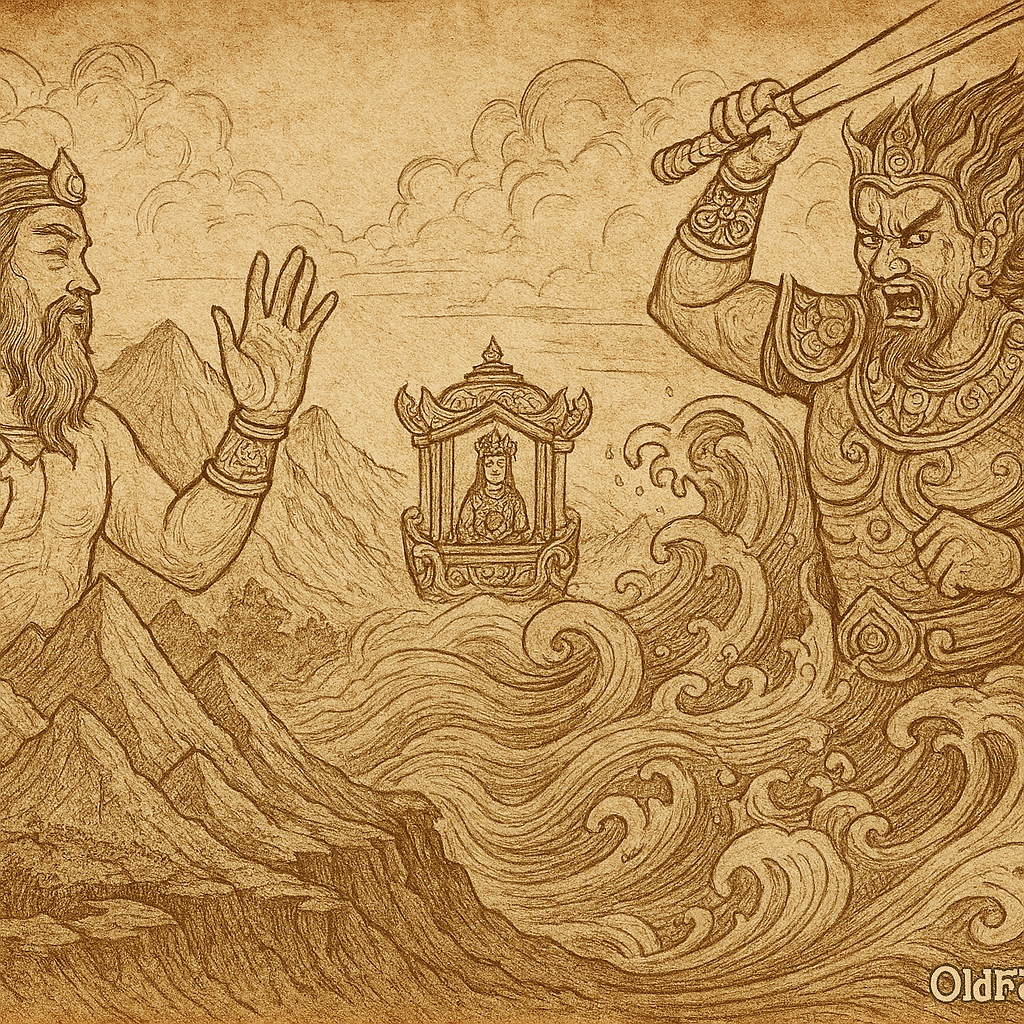
“She should have been mine!” Thủy Tinh roared, his voice echoing like crashing breakers against cliffs. He could not accept defeat. Consumed by jealousy and rage, he summoned all his power. Dark clouds gathered overhead, and rain began to fall in blinding sheets. The sea god commanded his armies of sea creatures to pursue Sơn Tinh. Waters rose rapidly, flooding fields and villages. Rivers overflowed their banks. Thunder shook the earth, and lightning split the sky.
Thủy Tinh unleashed torrential storms and sent massive waves crashing toward the mountains where Sơn Tinh had taken his bride. “Give her back to me!” he demanded over the roar of the flood. “She is mine!”
But Sơn Tinh was not intimidated. He would protect his wife and his people at any cost. Raising his arms, he commanded the mountains to grow taller, thrusting them higher into the sky, far above the rising waters. He moved hills to form barriers against the flood. With his divine power, he built massive earthen levees and dykes to hold back the deluge. Every creature of the mountains from the smallest bird to the mightiest tiger joined him in defending the land.
The battle between the two gods raged for months. Water crashed against stone. Floods rose and mountains grew. Rain poured and trees stood firm. The earth trembled with their conflict, and the people huddled in their homes, praying for the fighting to end.
Gradually, Sơn Tinh’s steady strength and the endurance of the mountains prevailed. The floodwaters could not overcome the rising land. Exhausted and defeated, Thủy Tinh was forced to withdraw his forces. The rain ceased, the waters receded, and the sun broke through the clouds once more. Princess Mỵ Nương remained safe in her mountain home with Sơn Tinh, and the people celebrated their deliverance from the flood.
But Thủy Tinh never forgot. He could not let go of his anger and jealousy. To this day, every year when the monsoon season arrives, the God of the Waters returns to challenge Sơn Tinh once more. He sends heavy rains, fierce storms, and floods sweeping across the lowlands of Vietnam, seeking to reclaim the princess he lost. And every year, Sơn Tinh responds by standing firm, his mountains unwavering, protecting his wife and the Vietnamese people from the wrath of the sea.
This is why Vietnam experiences annual flooding during the monsoon season it is the eternal battle between Thủy Tinh and Sơn Tinh, between the relentless waters and the steadfast mountains, a divine conflict that has shaped the land and the lives of the Vietnamese people for thousands of years.
Click to read all Southeast Asian Folktales — featuring legends from Thailand, Indonesia, Vietnam, and the Philippines.
The Moral Lesson
The legend of Sơn Tinh and Thủy Tinh teaches us that true strength lies not in aggression or selfish desire, but in patience, preparation, and the willingness to protect what we love. Sơn Tinh won Princess Mỵ Nương’s hand not through force or grand displays, but through diligence, arriving first and fulfilling his promises. The story also reminds us that jealousy and the refusal to accept defeat can lead to destructive consequences that harm not only ourselves but countless innocent people.
Knowledge Check
Q1: Who are Sơn Tinh and Thủy Tinh in Vietnamese mythology?
A1: Sơn Tinh is the God of the Mountains who rules over all highlands, forests, and land creatures. Thủy Tinh is the God of the Sea and Waters who controls the oceans, rain, storms, and all aquatic life. Both are powerful deities who competed for the hand of Princess Mỵ Nương in marriage.
Q2: Why did Sơn Tinh win Princess Mỵ Nương’s hand instead of Thủy Tinh?
A2: The King set a challenge that whoever arrived first at dawn with specific wedding gifts would marry the princess. Sơn Tinh arrived before Thủy Tinh, presenting all the required gifts including a nine-tusked elephant, nine-spurred rooster, nine-maned horse, glutinous rice, and bánh chưng. His preparation, diligence, and punctuality won him the bride.
Q3: What natural phenomenon does the legend of Sơn Tinh and Thủy Tinh explain?
A3: The legend explains Vietnam’s annual monsoon floods and seasonal storms. According to the myth, Thủy Tinh returns every year during monsoon season, sending heavy rains and floods in anger to attack Sơn Tinh’s mountain kingdom and reclaim the princess. This represents the yearly flooding that affects Vietnam’s river deltas and lowlands.
Q4: What do the mountains and floods symbolize in Vietnamese culture through this legend?
A4: The mountains symbolize stability, protection, and resilience qualities embodied by Sơn Tinh, who represents the Vietnamese people’s strength in facing adversity. The floods symbolize destructive natural forces and uncontrolled emotions like jealousy and rage. The eternal battle between them represents humanity’s ongoing struggle to live in harmony with powerful natural forces.
Q5: Who was Princess Mỵ Nương and why was she so important?
A5: Princess Mỵ Nương was the only daughter of the Eighteenth Hùng King of Vietnam. She was renowned throughout the land for her exceptional beauty and kindness. Her importance lies both in her royal status and in her role as the catalyst for the conflict between the two gods, which ultimately explains the origin of Vietnam’s seasonal flooding patterns.
Q6: How do Vietnamese people honor Sơn Tinh today?
A6: Sơn Tinh is considered one of the Four Immortals in Vietnamese folklore and is worshipped at temples and shrines throughout northern Vietnam, particularly in Hanoi and Vĩnh Phúc provinces. He is revered as a protector against floods and natural disasters. His legend teaches the importance of building flood defenses like dykes and levees, which Vietnamese communities have constructed for centuries to protect against seasonal flooding.
Cultural Origin: northern Vietnam