
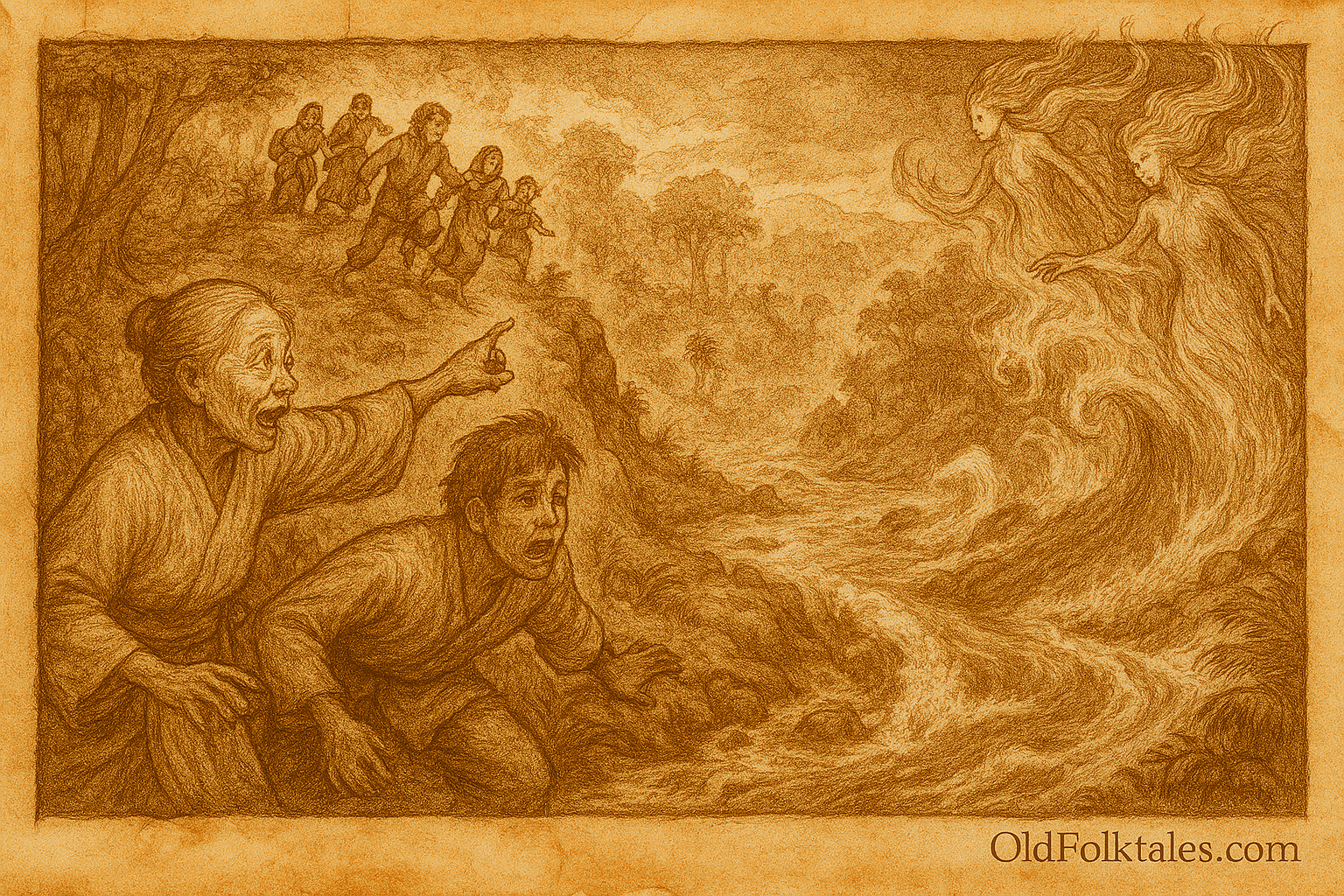
In the time before the great river flowed through what is now known as Temburong, the land was flat and covered with dense forest, and the people who lived there depended on small streams and springs for their water. Life followed the rhythm of the seasons: the monsoons brought abundance, and the dry periods required careful conservation. The villagers had learned over generations to live in harmony with these cycles, understanding that respect for nature’s patterns was essential for survival.
But there came a year when the rains did not arrive when expected. The monsoon season passed with only scattered showers, insufficient to replenish the streams and springs. As weeks turned to months, the small waterways began to shrink, then dry completely. The forest, usually lush and green, began to brown at its edges. Animals grew thin and desperate, and the villagers watched their carefully stored rice diminish with growing anxiety.
Click to read all East Asian Folktales — including beloved stories from China, Japan, Korea, and Mongolia.
The drought was unlike anything the oldest elders could remember. Even the ancient springs that had never failed in living memory began to run dry, reduced to muddy trickles that barely sustained the community. Children cried from thirst, crops withered in the fields, and a sense of desperation settled over the villages like oppressive heat.
The village leaders gathered with the bomoh, the spiritual advisor whose connection to the unseen world might offer guidance in this crisis. Nenek Rashidah was ancient beyond counting, her face a map of wrinkles that spoke of decades of wisdom accumulated. She spent three days in isolation, fasting and praying, seeking understanding of why the land had been afflicted with such severe drought.
When she emerged, her expression was grave. “The spirits of water are displeased,” she announced to the assembled villagers. “The balance has been disturbed. We must perform the proper rituals and observe strict taboos for seven complete cycles of the moon. Only through perfect observance can we hope to restore harmony and bring water back to our land.”
She laid out the requirements in detail. For the duration of the seven moon cycles, the villagers must refrain from all wasteful behavior. Not a drop of water could be spilled carelessly. No food could be thrown away, no matter how small the portion. Harsh words were forbidden, as were all forms of conflict and discord. The community must live in perfect harmony, demonstrating through their behavior that they understood the sacred nature of resources and the interconnection of all things.
Most importantly, no one was to take from the forest without proper offerings and prayers. Every hunt, every gathering of fruit or roots, every cutting of wood must be preceded by acknowledgment of the forest spirits and gratitude for what was being taken.
“These taboos are not arbitrary,” Nenek Rashidah warned. “They represent the covenant between humans and the natural world. Break them, and we risk consequences far worse than the drought we already suffer.”
The villagers, frightened and desperate, agreed readily to observe all the taboos. For the first several moon cycles, the community maintained perfect compliance. People spoke kindly to one another despite the stress of scarcity. Water was used with meticulous care, with not a drop wasted. Offerings were made faithfully before any resources were taken from the forest.
It was hard, especially as the drought continued and conditions grew more desperate. But the community held together, supporting one another through the difficulty and maintaining the strict observance that had been demanded.
Then, as the sixth moon cycle approached its end, a man named Jalil began to doubt. He was young, strong, and increasingly skeptical of what he saw as old superstitions. As he watched his children grow thin and his wife grow weary from the constant stress of scarcity, anger began to replace his initial compliance with the taboos.
“These rituals are pointless,” he muttered to a few friends who shared his growing skepticism. “We’re suffering because there’s no rain, not because spirits are displeased. What we need is action, not prayers and silly taboos.”
His friends cautioned him. “The elders say we’re nearly through the required period. Just maintain observance a little longer, and perhaps relief will come.”
But Jalil’s patience had run out. One morning, driven by hunger and frustration, he took his hunting spear and headed into the forest without performing the required rituals or making any offerings. “I’m going to feed my family,” he declared, “and I’m not going to waste time talking to invisible spirits.”
He found and killed a deer, a substantial animal that would feed his household for days. Triumphant and vindicated in his skepticism, he began to prepare the carcass right there in the forest. As he worked, he deliberately violated other taboos: he wasted parts of the animal unnecessarily, spoke crude words mocking the forest spirits, and even kicked over a small shrine that previous hunters had maintained.
“You see?” he said aloud to the silent forest. “Nothing happens. There are no spirits, no consequences, just superstitious fear keeping us from taking care of ourselves.”
But the forest was not as silent as Jalil imagined. Deep beneath the earth, ancient forces stirred. In the realm beyond human sight, water spirits who had been withholding their blessing felt the violation of the sacred taboos like a physical blow. The covenant had been broken, and broken deliberately, with mockery and contempt rather than simple forgetfulness.
The sky, which had been cloudless for months, suddenly began to darken. Not the normal darkness of rain clouds but something deeper, more ominous. The air itself seemed to thicken, becoming heavy with potential energy. Animals fled in all directions, birds rising in shrieking flocks, deer and wild pigs crashing through the undergrowth in panic.
Jalil looked up from his butchering, finally feeling the first stirrings of fear. The darkness above was unnatural, swirling with patterns that hurt the eyes to follow. Thunder began to roll, but it sounded like voices, angry and condemning, speaking in languages that predated human words.
He tried to run back to the village, abandoning his kill, but the forest seemed to shift around him, paths becoming confusing, trees appearing where none had stood moments before. Above, the swirling darkness grew more intense, and Jalil realized with horror that he had been terribly, catastrophically wrong.
The water spirits, held back for so long, were about to be released, not in gentle restoration but in violent judgment.
Back in the village, Nenek Rashidah suddenly stood from where she had been sitting, her eyes wide with horrified understanding. “He broke the taboo,” she whispered. “Someone broke the taboo, and now the spirits will respond not with blessing but with wrath. Everyone, to high ground! Now!”
The urgency in her voice sent people scrambling. Those who had learned to trust the old woman’s wisdom grabbed their children and whatever they could carry and ran for the elevated areas around the village. Others hesitated, confused and uncertain, and precious seconds were lost.
Then the deluge began.
It did not start as normal rain but as a wall of water appearing from nowhere, as if the sky itself had torn open to release oceans that had been held in reserve. The water fell with such force that it flattened small trees and sent rocks tumbling. But more terrifying was what happened to the earth itself.
The ground began to crack and shift, deep fissures opening like wounds in the landscape. From these cracks came more water, not seeping but exploding upward, as if the planet’s veins had been cut and its lifeblood was pouring out. The water spirits, denied their proper acknowledgment and offended by deliberate violation of sacred taboos, were making their displeasure manifested in the physical world.
The water did not simply fall and pool; it moved with purpose, carving through the landscape with devastating force. Trees were uprooted, hillsides collapsed, and the flat forest floor was torn into deep channels by water that seemed determined to reshape the very earth itself.
For three days and nights, the supernatural flood continued. The water carved deeper and deeper into the land, creating a massive river channel where none had existed before. The flow followed a path that seemed guided by intelligence rather than simple geography, winding through the landscape in patterns that would later prove perfect for navigation and life.
When the water finally receded to more normal levels, the transformation was complete. Where there had been flat forest floor, there was now a substantial river, flowing strong and clear, its banks carved from the earth itself, its depths sufficient to support fish and transportation, its course perfect for sustaining the villages that lined its shores.
But the cost had been terrible. Jalil was never found, presumably swept away by the initial surge. Several others who had failed to reach high ground in time were also lost. And the landscape itself bore permanent scars of the spirits’ wrath, deep channels and ravines that served as reminders of what happened when sacred covenants were violated.
Nenek Rashidah, surveying the new river from its bank, spoke to the gathered survivors. “This is Sungai Temburong, carved by the water spirits themselves. It will sustain us for generations to come, providing water, fish, and transportation. But it also serves as eternal reminder of the cost of broken taboos and the consequences of disrespecting the forces that govern our world.”
The Sultan, hearing of what had transpired, decreed that the story of Sungai Temburong’s creation should be preserved and told to every generation. “Let all know,” he proclaimed, “that the river’s abundance comes with responsibility. We must maintain the proper relationship with water spirits, observe the taboos, and remember that environmental balance depends on human behavior.”
From that day forward, the communities along Sungai Temburong maintained careful observance of water rituals. Offerings were made regularly at the river’s banks. Taboos about waste and disrespect were strictly enforced. And the story of Jalil’s fatal skepticism was told and retold, ensuring that no one would forget the lesson written into the landscape itself.
The river flows still, its waters sustaining life as the spirits intended, a blessing carved from judgment, a gift born from consequences, a reminder that the natural world operates on principles that transcend human understanding and demand respect whether we fully comprehend them or not.
Click to read all Southeast Asian Folktales — featuring legends from Thailand, Indonesia, Vietnam, and the Philippines.
The Moral Lesson
The legend of Sungai Temburong’s creation teaches us that environmental balance is directly linked to human behavior and that natural resources are not separate from spiritual realities. Taboos and rituals that seem superstitious to modern skeptics often represent accumulated wisdom about maintaining proper relationships with forces that govern the natural world. The story emphasizes that broken covenants and violated sacred rules have consequences that affect entire communities, not just individual transgressors.
Knowledge Check
Q1: What causes the severe drought in this Bruneian origin legend? A: The drought is caused by the displeasure of water spirits due to disturbed balance in the relationship between humans and the natural world. The spirits withhold their blessing until proper rituals are performed and strict taboos observed. This reflects traditional beliefs that environmental conditions are not merely physical phenomena but are influenced by spiritual forces responding to human behavior and attitudes toward nature.
Q2: What taboos must the villagers observe during the seven moon cycles? A: The villagers must refrain from all wasteful behavior including spilling water carelessly, throwing away food, speaking harsh words, engaging in conflict, and taking from the forest without proper offerings and prayers. These taboos represent the covenant between humans and the natural world, requiring demonstration through behavior that people understand the sacred nature of resources and the interconnection of all things.
Q3: Who is Jalil and what does he do to break the taboos? A: Jalil is a young skeptic who grows impatient with what he views as superstitious rituals. Near the end of the observance period, he hunts without performing required rituals or making offerings, wastes parts of his kill unnecessarily, mocks the forest spirits aloud, and kicks over a hunters’ shrine. His deliberate violation with contempt rather than simple forgetfulness triggers the catastrophic response from the offended water spirits.
Q4: How do the water spirits respond to the broken taboo? A: The water spirits, held back during the drought and now deliberately offended, unleash a supernatural flood that falls with devastating force while the earth itself cracks open with water exploding upward. The flood does not simply pool but purposefully carves through the landscape for three days and nights, creating the deep river channel of Sungai Temburong. This response demonstrates how violation of sacred rules brings consequences far more severe than the original problem.
Q5: What is the ultimate result of the supernatural flood? A: The flood creates Sungai Temburong, a substantial river that provides water, fish, and transportation for generations to come. While several people including Jalil are lost in the deluge, the resulting river transforms from judgment into blessing, sustaining the communities along its banks. This transformation demonstrates how consequences of broken taboos can ultimately become gifts if people learn lessons and change their behavior.
Q6: What does this legend teach about environmental balance in Bruneian culture? A: This Bruneian legend teaches that environmental balance is fundamentally connected to human spiritual behavior and proper observance of traditional taboos. It reflects beliefs that natural resources are governed by spiritual forces requiring respectful relationship rather than mere physical exploitation. The story emphasizes that communities bear collective responsibility for individual violations and that geographic features themselves can embody moral lessons about the inseparable connection between human conduct and environmental conditions.
Source: Adapted from Bruneian oral folklore traditions.
Cultural Origin: Brunei Darussalam, Southeast Asia.








