In the limestone karst region of northern Vietnam, where jade-green rice paddies stretch between towering stone mountains, there lies a place of ancient mystery the grottoes of Tam Coc. These three sacred caves pierce through the heart of the mountains like the fingers of a sleeping giant, carved over millennia by the patient hand of the Ngo Dong River. The waters flow through darkness and light, through chambers vast and passages narrow, and it is within these limestone halls that villagers speak in hushed tones of the Weaver.
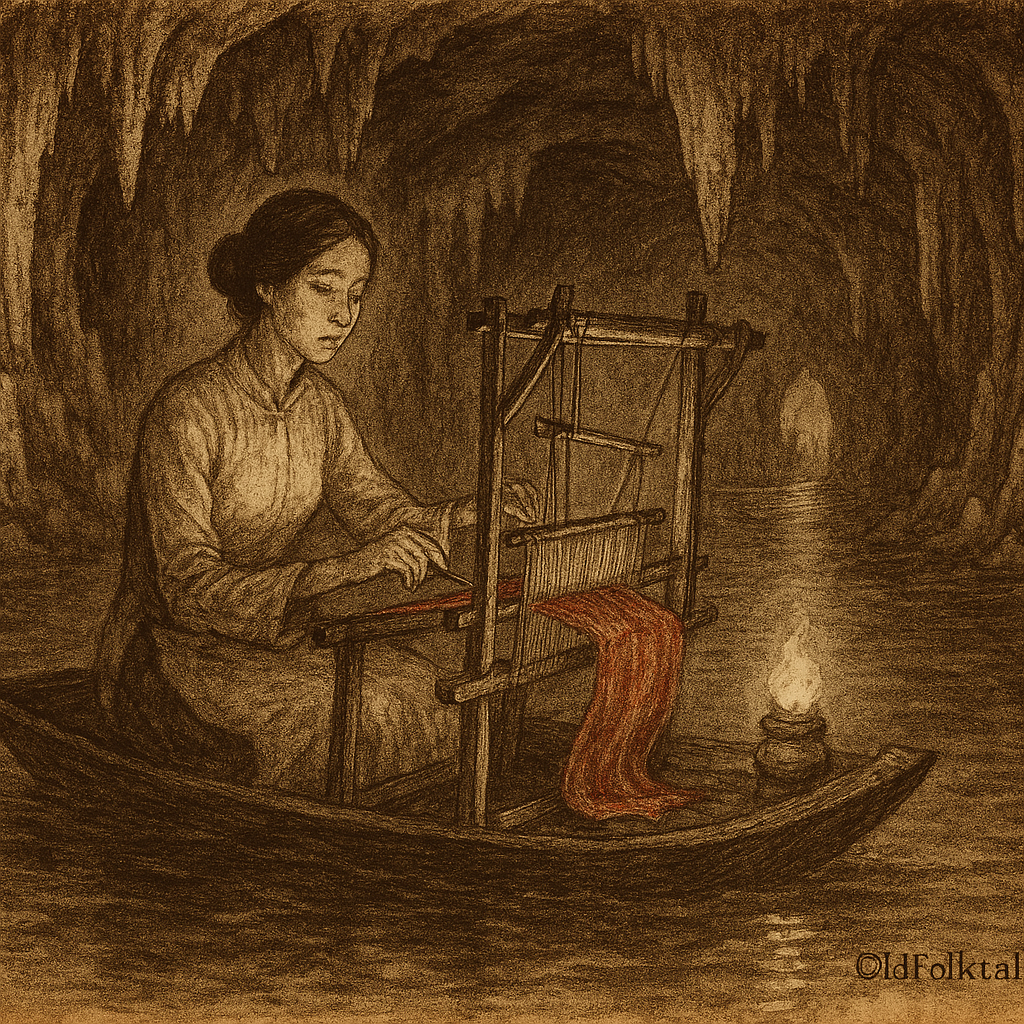
The Weaver is no ordinary spirit. She appears only during the flood season, when the river swells with monsoon rains and the waters rise to claim the lowlands. Those who have glimpsed her tell of a figure both beautiful and haunting a woman dressed in the flowing áo dài of generations past, her hair bound in the traditional style, seated upon a loom that floats impossibly upon the churning waters.
Click to read all East Asian Folktales — including beloved stories from China, Japan, Korea, and Mongolia.
The elders of the nearby villages remember their grandparents’ stories, passed down through countless rainy seasons. They say the Weaver was once a mortal woman, a master craftswoman whose skill with thread and loom was unmatched throughout the Red River Delta. Her cloth was so fine that nobles from distant provinces would send messengers to commission her work. She could weave patterns that seemed to move in the lamplight, depicting dragons that appeared to swim through clouds and phoenixes that looked ready to take flight.
But the Weaver’s story, like the river itself, took a dark turn. One terrible year, when she was still young and her hands still nimble, the monsoons came with unprecedented fury. The heavens opened as if they would never close again, and the rivers overflowed their banks. Villages throughout the valley were swept away like autumn leaves in a stream. The Weaver, working late into the night to finish a commission, did not hear the warning cries of her neighbors. By the time she realized the danger, the floodwaters had already surrounded her home.
They say she died clutching her loom, her final piece of cloth a length of brilliant red silk still stretched between the wooden frames. Her body was found days later when the waters receded, but the red cloth was never recovered. Some claimed it had been carried away by the current, destined to drift forever through the limestone caves where the river disappeared into the mountain’s heart.
Since that tragic season, the Weaver has been seen within the grottoes of Tam Coc when the rains come heavy. Fishermen who venture into the caves during floods, seeking shelter from the storm, sometimes glimpse her by the light of their lanterns. She sits upon her spectral loom, which floats upon the dark waters like a boat, and her hands move with supernatural grace, weaving cloth that glows with an inner fire always red, like the silk she died creating, like the warning of blood, like the color of danger itself.
But the Weaver does not simply haunt the caves. The villagers have learned, through observation passed down over generations, that she brings a warning. Her weaving tells a story that those who understand can read like the characters in an ancient text.
When the Weaver’s hands move with frantic speed, when the shuttle flies back and forth between the threads like a frightened bird, when the cloth seems to grow before one’s eyes this is the darkest omen. It means the disaster will be swift and severe. The floods will rise higher than expected. The storms will be more violent than predicted. Villages must prepare, families must gather their most precious possessions, and livestock must be moved to higher ground immediately. In years when the Weaver works with such desperate haste, those who heeded her warning survived, while those who dismissed it as superstition often faced tragedy.
But when the Weaver’s movements are slow and measured, when her hands pass over the loom with the peaceful rhythm of meditation, when each thread is placed with careful deliberation this brings relief to anxious hearts. A slow weaving means the season will be gentle. The rains will come and go without catastrophic flooding. The rice paddies will be nourished rather than destroyed. The villages will be safe, and the harvest will be bountiful.
Old Minh, a fisherman who has worked the waters around Tam Coc for over sixty years, claims to have seen the Weaver three times in his life. “The first time, I was young and foolish,” he tells those who will listen. “I saw her weaving quickly, her hands like lightning, but I laughed at the old stories. That year, the flood took my family’s home. The second time, I was wiser. She wove slowly, peacefully, and I knew we would be safe. The third time, her hands moved at a speed I had never imagined possible. I rushed back to the village and warned everyone I could. We moved to the high temple, and we watched as the water rose higher than anyone had ever seen. Without her warning, many would have died.”
The younger generation, educated in cities and exposed to modern science, sometimes scoff at the tales. They speak of weather patterns and meteorological predictions, of rainfall measurements and flood modeling. But the old people shake their heads and continue to watch for signs. They know that science cannot explain everything, that the limestone caves hold secrets older than any textbook, and that sometimes the warnings of spirits are more reliable than the predictions of instruments.
During the flood season, offerings are left at the entrance to the grottoes incense sticks, rice cakes, and occasionally, lengths of red cloth as a gesture of respect. The villagers pray not only for protection from the floods but also for the peace of the Weaver’s restless spirit. They thank her for her eternal vigilance, for continuing even in death to practice her craft in service of the living.
As the monsoon clouds gather each year over the karst mountains of northern Vietnam, and the Ngo Dong River begins its annual rise, the people of Tam Coc remember. They remember the Weaver who died at her loom, who loved her craft so deeply that not even death could still her hands. They watch the water levels, they observe the sky, and some those brave enough or desperate enough venture into the dark grottoes to seek a glimpse of red cloth glowing in the darkness, to observe the speed of spectral hands, to read the warning woven into the fabric of fate itself.
Click to read all Southeast Asian Folktales — featuring legends from Thailand, Indonesia, Vietnam, and the Philippines.
The Moral Lesson
The legend of the Weaver of Tam Coc teaches us the importance of heeding warnings and respecting the wisdom of those who came before us. Her story reminds us that nature’s forces are powerful and unpredictable, and that sometimes knowledge comes from sources beyond our rational understanding. The Weaver’s eternal vigil demonstrates that dedication to serving one’s community can transcend even death. Her message is clear: pay attention to signs, prepare for disasters, and never dismiss traditional knowledge as mere superstition. Those who respect the warnings of the natural and spiritual world are better equipped to survive its challenges, while arrogance and dismissal lead to tragedy.
Knowledge Check
Q1: Who was the Weaver of Tam Coc before becoming a spirit?
A: The Weaver was a master craftswoman whose weaving skill was unmatched throughout the Red River Delta. Nobles from distant provinces commissioned her fine cloth, which featured patterns so lifelike they seemed to move in lamplight.
Q2: How did the Weaver die and become a cave spirit?
A: She died during a catastrophic monsoon flood while working late at night on a commission. Surrounded by floodwaters before she could escape, she drowned clutching her loom with a piece of red silk still stretched across it.
Q3: What does the Weaver look like when she appears in Tam Coc caves?
A: She appears as a woman in a traditional áo dài with hair bound in the old style, seated on a loom that floats impossibly on the water. She weaves glowing red cloth that illuminates the darkness of the caves.
Q4: What does it mean when the Weaver works quickly on her loom?
A: When the Weaver’s hands move with frantic speed and the shuttle flies rapidly, it signals that disaster will come swiftly and severely the floods will be worse than expected and villages must prepare immediately.
Q5: What does slow weaving by the Tam Coc spirit indicate?
A: When the Weaver’s movements are slow and measured, with careful deliberation in placing each thread, it means the flood season will be gentle, the rains will nourish rather than destroy, and villages will be safe.
Q6: What cultural significance does the Weaver legend hold in Vietnamese folklore?
A: The Weaver represents the Vietnamese tradition of respecting ancestral wisdom and natural warnings. She symbolizes the connection between craft, community service, and spiritual guardianship, teaching that dedication to protecting others transcends death and that traditional knowledge complements modern science.
Source: Adapted from Nguyễn Hữu Thấu, Northern Vietnamese Grotto Legends
Cultural Origin:Tam Coc region, northern Vietnam