In the ancient days of Vietnam, when the Hùng Kings ruled the land and the kingdom was young and vulnerable, there lived a humble family in the village of Giong. The father tilled the earth, the mother tended their small home, and they lived simply as countless generations had done before them. But their hearts carried a peculiar sorrow, for they had a son who seemed unlike other children a boy who never spoke, who never walked, who lay quietly year after year as if trapped in some mysterious stillness.
The child had been born healthy and strong, his first cries loud and vigorous. But as the months passed and became years, he remained silent and immobile. While other children his age learned to toddle and chatter, forming words and running through the village paths, this boy simply lay where his mother placed him, his eyes alert and intelligent but his body and voice mysteriously still. He ate the food his parents offered, he watched the world around him with keen attention, but he gave no other sign of the normal development that marks childhood’s passage.
Click to read all East Asian Folktales — including beloved stories from China, Japan, Korea, and Mongolia.
The villagers whispered, of course. Some called it a curse, others a tragedy. But the boy’s parents loved him with unwavering devotion, caring for him with tender patience, never giving up hope that someday, somehow, their son would join the world of movement and speech. They had no way of knowing that their silent child carried within him a destiny that would shake the heavens and save an entire kingdom.
Three years passed in this way, each season flowing into the next like water in the Red River. The boy remained silent and still, growing larger but never changing in his mysterious condition. And then came the crisis that would transform everything.
From the north, an army of invaders descended upon Vietnam like a plague of locusts. These were no ordinary enemies they were demons, supernatural beings of terrible power and cruelty, led by a fierce general whose very name struck terror into hearts. They swept through the northern provinces, burning villages, destroying crops, slaughtering anyone who resisted. Their strength seemed limitless, their weapons unstoppable. The armies of the Hùng King fought bravely but were pushed back again and again, unable to withstand the demonic onslaught.
Desperate, the king sent messengers throughout the kingdom, calling for warriors, for champions, for anyone who might turn the tide of battle. The royal proclamation reached even the smallest villages, including Giong, where it was read aloud in the central square by an official whose voice trembled with barely concealed fear.
“The kingdom calls for defenders!” the messenger proclaimed. “Any man of strength and courage who can fight against the invaders will be given armor and weapons. Our land faces destruction. Our people face annihilation. Who will answer the call?”
The villagers of Giong looked at one another with helpless expressions. They were farmers, not warriors. They knew how to coax rice from the earth, not how to face demons in battle. Fear hung over the square like morning fog, thick and cold.
And then, for the first time in three years, the silent child spoke.
His voice rang out clear and strong, shattering the stillness that had imprisoned him since birth. “Mother! Father!” he called, his words echoing across the square, causing everyone to spin toward the sound in shock. “I need armor! I need weapons! I need an iron horse! I will go and fight the invaders!”
His parents stood frozen, unable to comprehend what they were hearing. Their son, their silent, immobile son, was not only speaking but was calling for implements of war. The boy sat up for the first time in his life, his movements sudden and sure, as if he had been walking and running all along and had simply chosen not to. His eyes blazed with a fierce light that seemed almost divine.
The villagers rushed to inform the king’s messenger, who hurried back to the palace with this incredible news. The Hùng King, though skeptical, was desperate enough to grasp at any hope. He ordered his smiths to forge armor and weapons, commanded his metalworkers to create an iron horse, and sent these items to the village of Giong with his blessing and his prayers.
When the armor and weapons arrived, something miraculous occurred. The moment the boy touched the metal, he began to grow. Not slowly, as children normally grow, but with supernatural speed his body stretching upward and outward, his limbs lengthening, his frame expanding with each passing moment. The villagers watched in awe and terror as the three-year-old child transformed before their eyes into a towering giant, his head reaching toward the clouds, his shoulders broad as mountains.
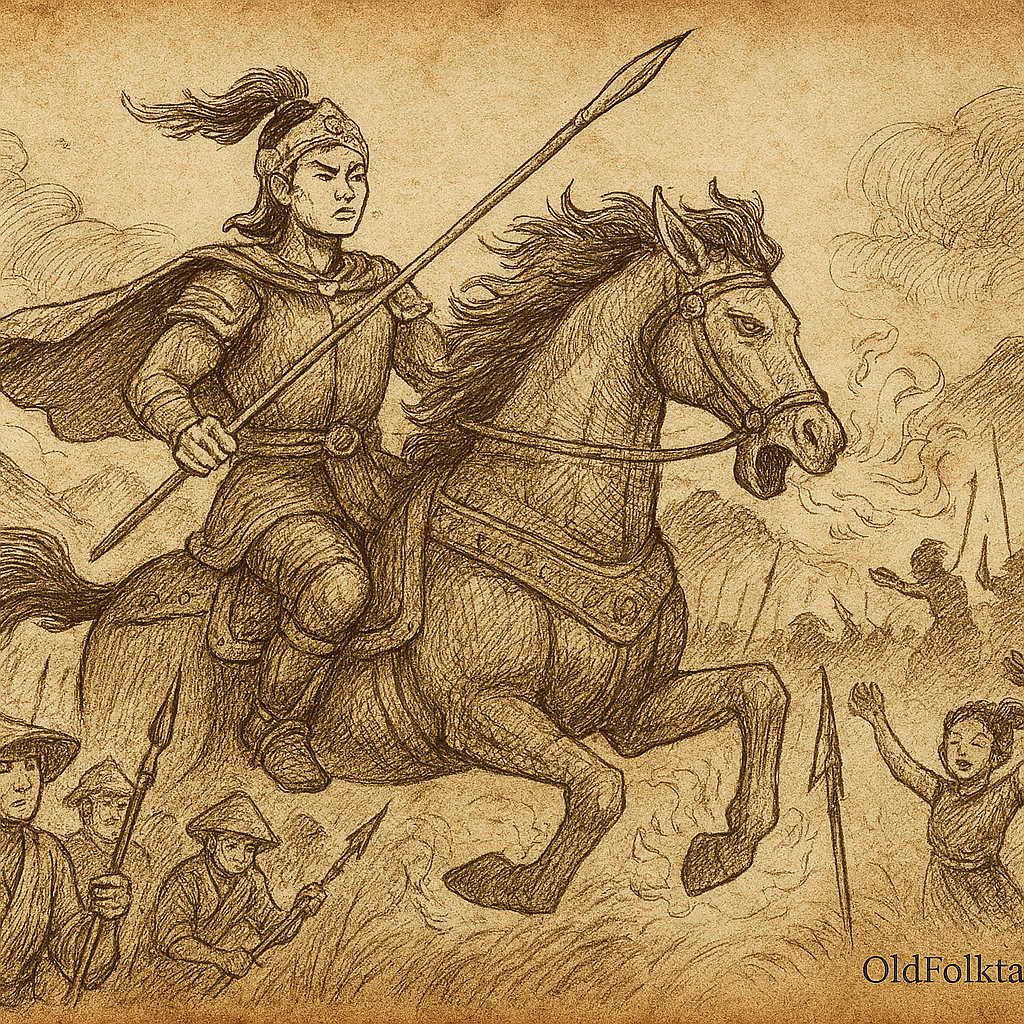
The armor that had seemed so large when it arrived now barely fit his enormous form. He strapped it on, piece by piece the breastplate that gleamed like the sun, the helmet that crowned his head like a temple dome, the gauntlets that covered hands now large enough to uproot trees. He took up the sword, which in his grip looked almost delicate, and mounted the iron horse, which came to life beneath him with a sound like thunder, breathing fire from its nostrils, its hooves striking sparks from the earth.
The giant warrior that had once been a silent child rode north toward the battle with the speed of wind and the power of a storm. The ground shook beneath the iron horse’s hooves. The sky darkened as if nature itself recognized that something momentous was occurring. Birds fled before him, animals cowered, and the very trees seemed to bow as he passed.
When he reached the battlefield, the invading demons faltered at the sight of him. They had never encountered such a being a warrior of impossible size, radiating divine power, mounted on a magical steed that breathed fire and fear. Their general, who had seemed so invincible, took one look at the approaching giant and felt doubt creep into his heart for the first time.
The battle that followed would be remembered in songs and stories for thousands of years. Gióng for that became his eternal name crashed into the enemy ranks like a landslide. His sword swept through the demonic forces like a scythe through rice stalks. When his weapon finally shattered from the fury of combat, he did not falter. Instead, he tore bamboo trees from the earth and wielded them like clubs, striking down demons by the dozens with each mighty swing. The bamboo became extensions of his righteous fury, and where he struck, invaders fell.
The iron horse trampled through the enemy lines, its hooves crushing demons, its fiery breath setting their weapons aflame. The general of the invading force, seeing his army decimated, tried to flee, but Gióng pursued him relentlessly. The chase led across rivers and mountains, through forests and plains, until finally, at the base of Sóc Mountain, the giant warrior struck down the demonic general, ending the invasion once and for all.
The surviving invaders fled in terror, scattering like leaves before a typhoon, racing back to whatever dark realm had spawned them, never to threaten Vietnam again. The kingdom was saved. The people were free.
Gióng stood on the slopes of Sóc Mountain, his enormous chest heaving from the exertion of battle, his armor dented and scorched but still gleaming in the sunlight. The iron horse stood beside him, steam rising from its flanks, fire flickering in its eyes. Around them lay the evidence of their victory broken weapons, trampled earth, bamboo stalks scattered like fallen giants.
The people of Vietnam rushed to the mountain to honor their savior, to thank him, to beg him to stay and protect them always. But Gióng looked toward the heavens, and a strange peace settled over his features. His task was complete. His purpose fulfilled. He was not meant to remain in the earthly realm.
Before the astonished eyes of thousands, the giant warrior began to rise. He did not leap or climb he simply ascended, lifting from the earth as naturally as smoke rises from a fire. The iron horse rose with him, both warrior and steed floating upward through the air, growing more radiant, more ethereal, until they seemed made of light rather than flesh and metal.
Higher and higher they rose, through the clouds, toward the sun, until they disappeared into the heavenly realm from which Gióng’s spirit had truly come. The people watched until they could no longer see anything but empty sky, and then they fell to their knees in reverence and gratitude.
Gióng’s parents stood among the crowd, tears streaming down their faces do not tear of sorrow but of awestruck understanding. Their son had never been ordinary. He had been waiting, silent and still, for the moment when his nation would need him most. He had been a vessel for divine power, a guardian spirit temporarily inhabiting human form, and now he had returned to his celestial home.
From that day forward, the people of Vietnam honored Thánh Gióng Saint Gióng as one of their greatest protectors. Temples were built in his honor. Festivals were established to commemorate his miraculous deeds. Parents told their children the story of the silent boy who became a giant warrior, who saved the kingdom with supernatural power and then ascended to heaven. The tale became a cornerstone of Vietnamese identity, a reminder that even in the darkest times, even when all seems lost, the spirit of the nation will rise to defend itself.
To this day, annual festivals celebrate Thánh Gióng, particularly in his home village, now known as Phù Đổng. Processions wind through the streets, with men dressed as the giant warrior, riding decorated horses, wielding bamboo stalks just as Gióng once did. The celebrations blend reverence and joy, honoring not just a legendary hero but the indomitable spirit he represents the spirit of Vietnam itself, which may seem quiet and peaceful but which, when threatened, can rise to impossible heights and overcome any enemy.
Click to read all Southeast Asian Folktales — featuring legends from Thailand, Indonesia, Vietnam, and the Philippines.
The Moral Lesson
The legend of Thánh Gióng teaches us that true strength often lies dormant, waiting for the moment of greatest need to manifest. The silent child who seemed weak and helpless carried within him the power to save an entire nation—reminding us never to judge by appearances or dismiss those who seem different or limited. This Vietnamese legend embodies the principle of national resilience: when faced with existential threats, ordinary people can access extraordinary courage and capability. Gióng’s transformation from a motionless child to a giant warrior symbolizes how crisis can awaken hidden potential within individuals and communities.
Knowledge Check
Q1: Who was Thánh Gióng and what made him unusual as a child?
A1: Thánh Gióng (Saint Gióng) was a legendary Vietnamese warrior who began life as a mysterious child in the village of Giong. What made him unusual was that despite being born healthy, he remained completely silent and immobile for the first three years of his life never speaking, never walking, simply lying still while other children developed normally. His parents cared for him devotedly despite not understanding his condition, unaware that he was a divine spirit waiting for the moment when Vietnam would need him most.
Q2: What threat prompted Gióng to finally speak and move?
A2: Gióng was prompted to speak and move when Vietnam faced invasion from the north by an army of supernatural demons led by a fierce general. These powerful beings were destroying villages, killing people, and pushing back the Hùng King’s armies with seemingly unstoppable force. When a royal messenger came to Gióng’s village seeking warriors to defend the kingdom, the three-year-old child suddenly spoke for the first time, demanding armor, weapons, and an iron horse so he could fight the invaders.
Q3: How did Gióng transform into a giant warrior?
A3: Gióng’s transformation occurred miraculously when the king’s armor and weapons arrived. The moment the boy touched the metal, he began growing at supernatural speed his body stretching upward and outward, transforming from a three-year-old child into a towering giant whose head reached toward the clouds and whose shoulders were broad as mountains. This divine transformation revealed his true nature as a celestial guardian spirit temporarily inhabiting human form to defend Vietnam in its hour of greatest need.
Q4: What happened when Gióng’s sword shattered during battle?
A4: When Gióng’s sword shattered from the fury of combat against the demonic invaders, he did not stop fighting. Instead, he tore bamboo trees from the earth with his enormous hands and wielded them as clubs, striking down demons by the dozens with each mighty swing. The bamboo became extensions of his righteous fury, demonstrating that his divine power transcended any particular weapon. This resourcefulness and unstoppable determination led to complete victory over the invading forces.
Q5: What happened to Gióng after he defeated the invaders?
A5: After defeating the demonic general and saving Vietnam, Gióng did not remain on earth to receive honors or rule. Instead, standing on Sóc Mountain before thousands of grateful people, he ascended to heaven. He and his iron horse rose through the air, growing more radiant and ethereal, transforming into light as they floated upward through the clouds and disappeared into the celestial realm. This ascension revealed that he had been a divine guardian temporarily taking human form, returning to the heavenly realm once his earthly mission was complete.
Q6: How is Thánh Gióng honored in Vietnamese culture today?
A6: Thánh Gióng is honored as one of Vietnam’s greatest protectors through temples built in his name and annual festivals, particularly in his home village of Phù Đổng (formerly Giong). These celebrations feature processions with men dressed as the giant warrior riding decorated horses and wielding bamboo stalks, reenacting his legendary battle. The festivals blend reverence and joy, commemorating not just a mythical hero but the indomitable spirit of Vietnamese national resilience. Gióng symbolizes the belief that the Vietnamese people, though peaceful, possess inner strength that rises to defend the nation when threatened.
Source: Adapted from Vietnamese oral traditions and national folklore
Cultural Origin: Vietnam