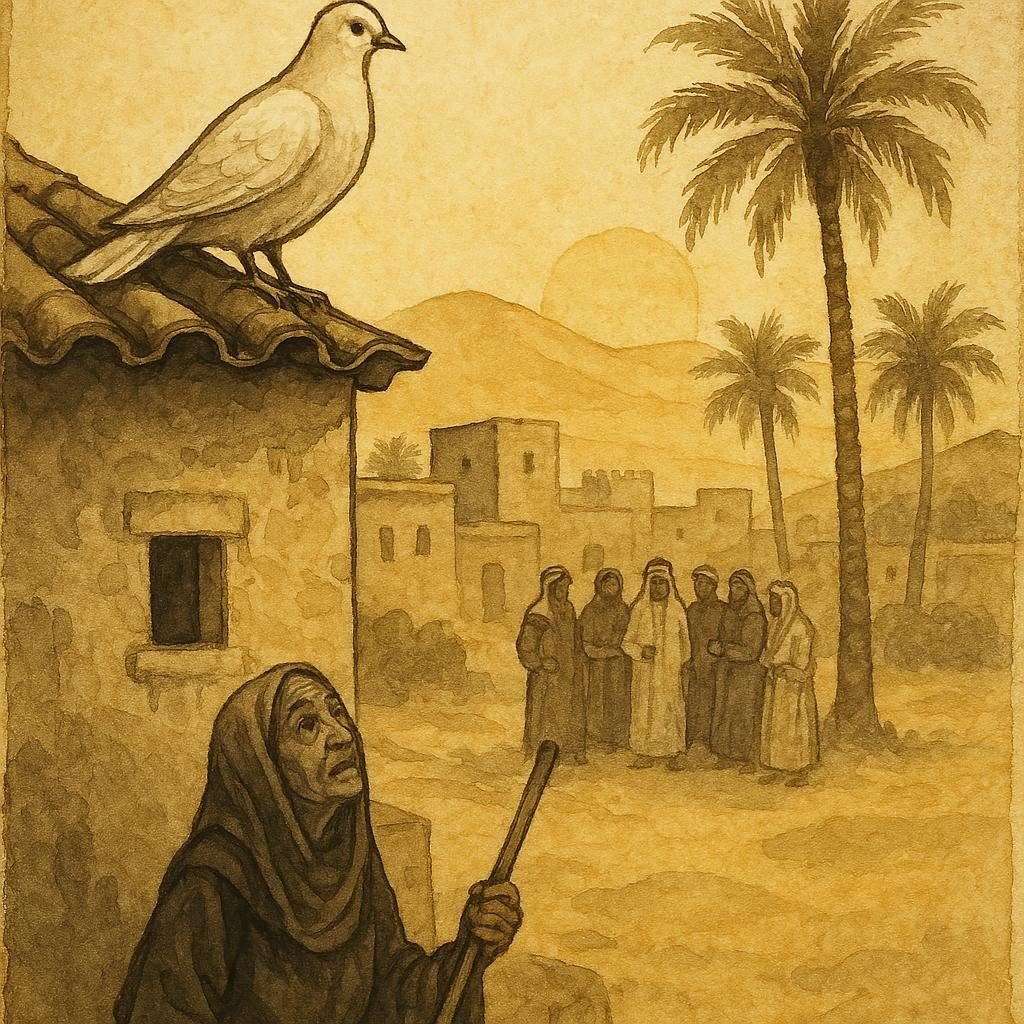
In the heart of a quiet Saudi village, surrounded by sunlit dunes and the rustle of palm leaves, there lived a dove whose ceaseless cooing tested everyone’s patience. Each morning, before dawn stretched its golden fingers across the sky, the dove perched upon the roof of a humble household and began her endless song. “Coo… coo… coo…” soft at first, then louder, until it echoed through the village streets.
At first, the people paid her little attention. The merchant, the baker, and the old shepherd simply waved their hands and muttered, “Just a bird greeting the morning.” But as the days went by, the dove’s cries grew louder, more persistent, and far more difficult to ignore.
In one home lived an elderly woman known for her quick temper. She sold bread at the market and prized her early morning rest. “This annoying dove will drive me mad!” she declared one morning, throwing a slipper at the window. The slipper missed, of course, the dove had already taken flight, circling above the courtyard with graceful defiance.
The neighbours laughed at her frustration. “It is only a dove,” said a young boy, smiling. “Perhaps she brings a message from the heavens.” But the old woman would hear none of it. The next day she tried to chase the bird away with a broom; the day after, she scattered seeds far down the street, hoping the bird would settle elsewhere. Yet every dawn, the dove returned, her silvery feathers gleaming in the light, her song echoing louder than before.
Before long, even the villagers who once laughed began to grow weary. The blacksmith found his hammering out of rhythm; the children complained they could not nap in the afternoon; even the imam paused during prayer to frown at the incessant cooing above.
At last, the villagers gathered to find a solution. “We must catch the dove,” said one. “Or frighten it away forever,” said another. But an elderly imam raised his hand for silence. “Perhaps,” he said gently, “this dove has come for a reason. Sometimes what annoys us most holds a lesson we are slow to see.”
They were doubtful but agreed to wait. The next morning, as the dove began her cry again, the old imam went outside and spread a handful of dates upon the ground. The dove fluttered down carefully, tilting her head as if to thank him. Then, something curious happened: the dove began picking at the dates and dropped a few seeds near the mosque’s courtyard. Over the next weeks, the seeds sprouted into small green shoots, a rare sight in that arid land.
When the villagers saw this, their annoyance turned to wonder. The dove had not been a nuisance at all but an unwitting bringer of life. The sprouts grew into palms, whose shade cooled the square and whose fruits fed the poor. The same woman who once threw her slipper now smiled each morning at the bird perched upon her roof.
“It seems,” she said with a laugh, “that patience has sweeter fruit than anger.”
From that day, no one called the dove annoying. She remained part of the village’s mornings, a living reminder that irritation often hides an unseen blessing, that wisdom comes, sometimes, on fluttering wings.
Moral Lesson
The story of The Annoying Dove teaches that impatience and irritation can blind us to hidden blessings. What seems troublesome may, in truth, bring renewal, growth, and harmony if met with calm and understanding.
Knowledge Check
1. Who is the main character in “The Annoying Dove”?
The main character is a dove whose constant cooing irritates the villagers but eventually reveals a lesson in patience.
2. What emotion does the story teach readers to control?
The folktale highlights the importance of patience over anger or irritation.
3. How does the dove contribute to the village’s wellbeing?
By dropping seeds that grow into fruitful palm trees, the dove unknowingly blesses the community.
4. What is the symbolic meaning of the dove in Saudi folklore?
The dove represents persistence, divine guidance, and the unexpected rewards of tolerance.
5. What cultural value is reflected in this Saudi Arabian folktale?
It reflects the value of sabr patience and faith in the wisdom of fate.
6. What lesson can children learn from this story?
Children learn that kindness and calm observation often lead to understanding, while anger brings regret.
Source
Adapted from “The Annoying Dove” in Folktales from the Arabian Peninsula (Saudi Arabia: Magical Stories), collected by Nadia Jameel Taibah.
Cultural Origin: Saudi Arabia (Arabian folklore)