
In the lush rainforests of Brunei, where dipterocarp trees tower toward the sky and the morning mist hangs between vine-draped branches like gossamer curtains, there lived in ancient times a bird known throughout the forest for its extraordinary gifts. This was Burung Tiong, the gracula bird, also called the hill myna, a creature blessed with glossy black feathers that shimmered with purple and green iridescence in the sunlight, bright yellow wattles that adorned its head like a crown, and most remarkable of all, a voice so melodious and versatile that it could mimic any sound in the forest with perfect accuracy.
Burung Tiong was, without question, one of the most beautiful birds in the forest. When it perched on a high branch in the morning light, its feathers gleaming like polished obsidian, other birds would stop their own songs to admire its splendor. When it sang, the forest fell silent to listen, for its voice could reproduce the haunting call of the gibbon, the melodic whistle of the white-rumped shama, the complex trills of the bulbul, and even the gentle babbling of forest streams.
Click to read all East Asian Folktales — including beloved stories from China, Japan, Korea, and Mongolia.
Such beauty and talent should have been received with gratitude and humility. The gifts were, after all, bestowed by nature and not earned through any particular effort or virtue on the bird’s part. But Burung Tiong, instead of being grateful for its blessings, became arrogant and vain. It spent hours each day preening its magnificent feathers and admiring its reflection in pools of water. It flew from tree to tree showing off its plumage, demanding admiration from every creature it encountered.
Worst of all, Burung Tiong began to mock the other birds of the forest. When the simple jungle fowl scratched in the undergrowth searching for insects, Burung Tiong would perch above and call out in a voice dripping with contempt, “Look at you, scratching in the dirt like common chickens! Have you no dignity? Have you no grace? You should be ashamed to be seen in such an undignified posture!”
When the hornbill flew past with its heavy, labored wing beats, Burung Tiong would laugh cruelly. “What an ungainly creature you are! Your beak is ridiculously large, your flight is clumsy, and your call sounds like a barking dog! How embarrassing it must be to be you!”
The small brown sunbirds, who worked diligently pollinating flowers and feeding on nectar, were subjected to Burung Tiong’s scorn as well. “You plain little things,” the vain bird would say, mimicking their high-pitched chirps in an exaggerated, mocking manner. “You have no beauty, no talent, no voice worth hearing. Why do you even bother singing when everyone knows my voice is superior in every way?”
Day after day, Burung Tiong’s mockery continued. No bird was safe from its cruel tongue. The peaceful doves were too fat and slow. The swift swallows were too small and insignificant. The colorful kingfishers were gaudy and tasteless in their bright plumage. Burung Tiong always found something to criticize, some reason to place itself above all others, some justification for its sense of superiority.
The other birds of the forest grew weary of Burung Tiong’s arrogance. They tried to avoid it, changing their feeding patterns and nesting sites to stay away from areas where the vain bird frequented. But Burung Tiong only interpreted their absence as further proof of its superiority. “They cannot bear to be near me,” it said proudly to itself. “My beauty and talent make them feel inferior, so they hide in shame. How pathetic they are!”
The forest itself seemed to grow tired of Burung Tiong’s behavior. The trees whispered among themselves about the arrogant bird. The wind carried stories of its cruelty from one end of the forest to the other. Even the spirits that dwelled in the ancient trees and sacred groves became aware of the problem.
In the very heart of the forest stood the oldest tree, a massive dipterocarp that had witnessed countless seasons and sheltered countless generations of forest creatures. This tree was home to a powerful forest spirit, an ancient being who maintained harmony among all living things and ensured that the natural order was preserved. The spirit had been patient, hoping that Burung Tiong would recognize its own foolishness and reform its behavior. But as the bird’s arrogance only grew worse with each passing day, the spirit knew that intervention was necessary.
One morning, Burung Tiong woke feeling particularly pleased with itself. It had spent the previous day flying throughout the forest showing off its plumage and tormenting smaller, plainer birds with its sharp mockery. As it stretched its wings and prepared to begin another day of self-admiration, it suddenly felt a strange sensation, as if invisible hands were touching its feathers.
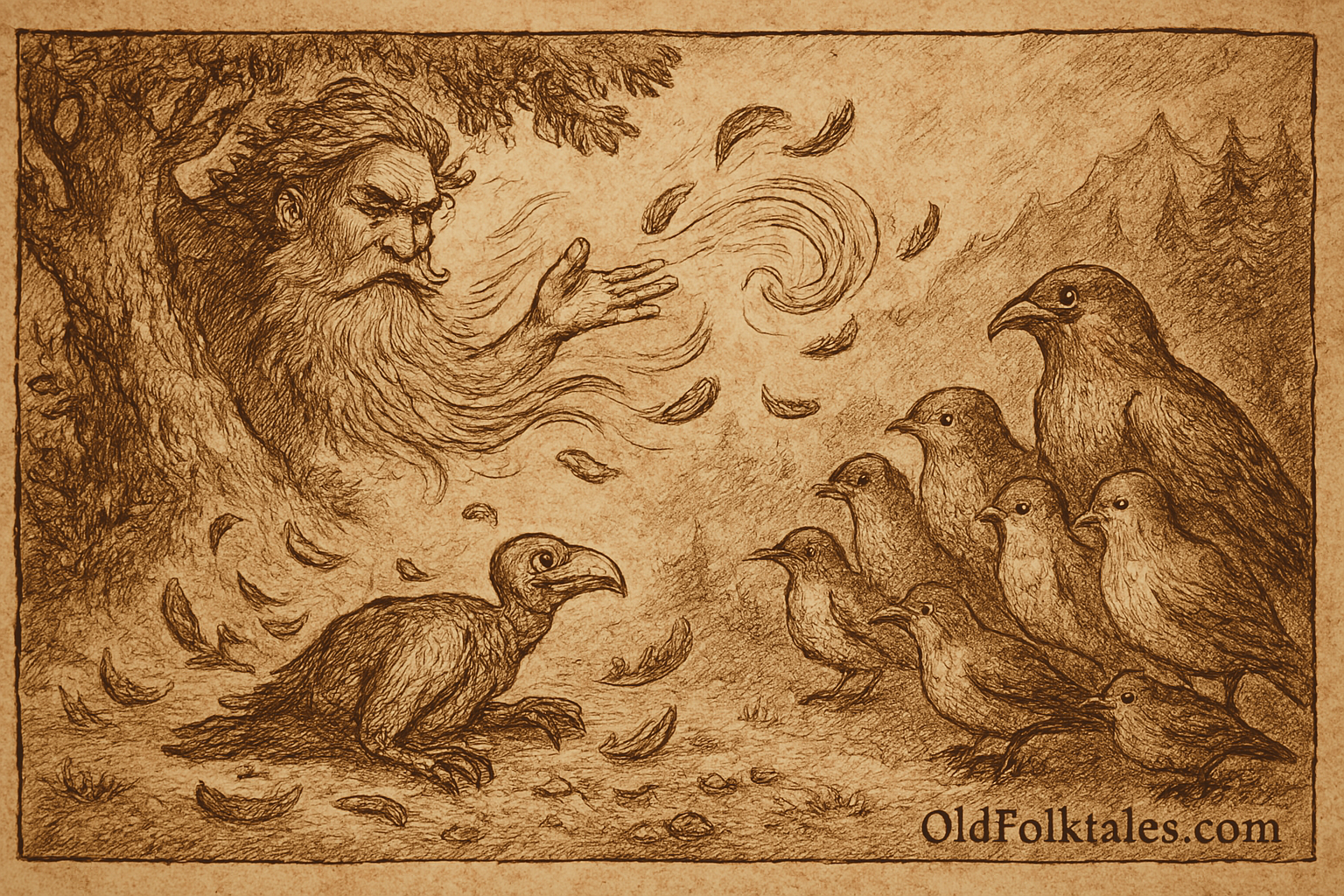
Before Burung Tiong could react, a supernatural wind swept through the tree where it roosted. This was no ordinary breeze but the breath of the forest spirit itself, carrying with it the collective disapproval of every creature that had suffered from the arrogant bird’s cruelty. The wind grew stronger, and as it did, something terrible began to happen.
Burung Tiong’s beautiful feathers, which it had spent so much time preening and admiring, began to fall. Not naturally, as feathers might during molting, but forcefully, torn away by the spirit wind as punishment for the bird’s vanity and cruelty. The glossy black feathers that had shimmered so magnificently scattered into the air like dark snow. The iridescent plumage that had caught the light so beautifully was stripped away, leaving patches of bare, vulnerable skin exposed.
Burung Tiong cried out in horror and dismay, trying desperately to hold onto its remaining feathers, but the wind was relentless. Within moments, the once magnificent bird was left looking bedraggled and pathetic, with only sporadic tufts of feathers remaining, its bare skin visible in multiple patches, giving it the appearance of having been roughly and incompletely plucked or shaved.
When the wind finally ceased and the forest fell silent, Burung Tiong looked at itself in the pool where it had so often admired its reflection and felt overwhelming shame. The beautiful, majestic bird was gone. In its place was a pitiful creature, awkward and ugly, with patches of bare skin and scraggly remnants of what had once been glorious plumage.
The other birds, seeing what had happened, gathered in the trees around the humiliated Burung Tiong. The arrogant bird expected them to mock it just as cruelly as it had mocked them, to laugh at its misfortune and celebrate its downfall. But the birds of the forest were not cruel like Burung Tiong had been. Instead, they felt pity.
The simple jungle fowl, which Burung Tiong had scorned for scratching in the dirt, spoke first. “Now you know what it feels like to be judged for your appearance rather than your character. Perhaps this experience will teach you empathy.”
The hornbill, whose flight and call Burung Tiong had ridiculed, added, “We all have our own beauty and purpose. You forgot that your gifts were blessings to be shared with gratitude, not weapons to be used against others.”
The small brown sunbirds, who had endured so much of Burung Tiong’s scorn, surprised everyone by offering help. “We can show you where the best insects are found, and which fruits are ripest. Your loss of feathers will make it harder to stay warm and protected. Let us help you survive while your feathers grow back.”
Burung Tiong, overwhelmed by the kindness of the birds it had treated so poorly, felt true remorse for the first time. Tears fell from its eyes as it croaked out an apology, its once melodious voice now rough with shame. “I have been a terrible creature. I used my gifts not to bring joy but to cause pain. I mocked you for things that were not flaws but simply differences. I am so deeply sorry.”
The forest spirit, observing from the ancient tree, was satisfied. The punishment had served its purpose. But the spirit also understood that transformation requires more than punishment alone. As Burung Tiong began the slow process of growing new feathers, the bird was changed in more than just appearance.
Its feathers did eventually grow back, but they never quite regained their former perfection. Some grew in at odd angles, others were shorter than they should have been, and the pattern of regrowth left permanent reminders of what had been lost, like scars on the bird’s appearance. To this day, the gracula bird has an unusual, somewhat disheveled appearance compared to other birds, particularly around its head and neck where feathers seem perpetually ruffled or incomplete, as if the bird had indeed been shaved or roughly plucked.
But more importantly, Burung Tiong’s character had changed. The bird that had once been so arrogant became humble. The voice that had been used for mockery was now used to warn other birds of danger, to help young birds learn their songs, and to add beauty to the forest soundscape without demanding constant admiration. Burung Tiong learned to appreciate the gifts of others instead of comparing them unfavorably to its own, and it discovered that true respect comes not from possessing beauty or talent but from how one treats others.
The story of Burung Tiong Bercukur spread throughout the forests and villages of Brunei, passed from generation to generation as both explanation and warning. When people see the gracula bird with its somewhat disheveled appearance, particularly the patches that look almost shaved or scraped, they remember the tale. Parents tell it to children who show signs of vanity or cruelty, reminding them that pride always comes before a fall and that mocking others ultimately reflects more poorly on the mocker than the mocked.
In village communities throughout Brunei, where harmony and mutual respect are essential for survival and prosperity, the tale of Burung Tiong Bercukur serves as a powerful reminder. Beauty and talent are gifts to be grateful for, not weapons to wield against others. True worth is measured not by one’s advantages but by one’s character and treatment of others. And perhaps most importantly, those who have been humbled often become the wisest and most compassionate, for they have learned through painful experience what pride had prevented them from understanding.
Click to read all Southeast Asian Folktales — featuring legends from Thailand, Indonesia, Vietnam, and the Philippines.
The Moral Lesson
This fable teaches that pride and arrogance lead inevitably to downfall and shame. Burung Tiong’s punishment for using its gifts to mock others rather than bring joy demonstrates that talents are blessings meant to be shared humbly, not weapons of cruelty. The story emphasizes that true beauty lies in character and kindness, not physical appearance or abilities, and that harmony in communities requires mutual respect and humility. The gracula bird’s permanent reminder of its shame serves as a warning against vanity and the cruel treatment of others.
Knowledge Check
Q1: What made Burung Tiong special before its punishment? A: Burung Tiong was blessed with glossy black feathers that shimmered with purple and green iridescence, bright yellow wattles like a crown, and most remarkably, a melodious voice that could perfectly mimic any sound in the forest. It was considered one of the most beautiful and talented birds, able to reproduce the calls of other animals and even natural sounds like babbling streams.
Q2: How did Burung Tiong abuse its gifts and what birds did it mock? A: Burung Tiong became arrogant and vain, spending hours preening and demanding admiration. It cruelly mocked the jungle fowl for scratching in dirt, the hornbill for its large beak and clumsy flight, the brown sunbirds for being plain, the doves for being fat and slow, the swallows for being small, and the kingfishers for being too colorful. No bird was safe from its scorn.
Q3: Who punished Burung Tiong and how was the punishment delivered? A: A powerful forest spirit living in the oldest dipterocarp tree in the forest’s heart delivered the punishment. The spirit sent a supernatural wind carrying the collective disapproval of all creatures that had suffered from Burung Tiong’s cruelty. This spirit wind forcefully tore away the bird’s beautiful feathers, leaving it bedraggled with bare patches of skin, looking as if it had been roughly plucked or shaved.
Q4: How did the other birds respond to Burung Tiong’s humiliation? A: Unlike Burung Tiong’s cruel mockery, the other birds showed compassion and pity rather than celebrating its downfall. The jungle fowl taught about empathy, the hornbill reminded it about shared purpose, and the sunbirds offered practical help with finding food and surviving while feathers grew back. Their kindness made Burung Tiong feel genuine remorse for its past cruelty.
Q5: What permanent changes resulted from Burung Tiong’s punishment? A: While the bird’s feathers eventually grew back, they never regained their former perfection. Some grew at odd angles, others were shorter, and the regrowth pattern left permanent reminders like scars, particularly around the head and neck where feathers appear perpetually ruffled or incomplete. More importantly, its character transformed from arrogant to humble, using its voice to help others rather than mock them.
Q6: What cultural values does this Bruneian fable teach about village community life? A: The story emphasizes values essential to harmonious village communities: humility over pride, kindness over cruelty, mutual respect over competition, and the understanding that talents are gifts to share rather than tools for establishing superiority. It teaches that character and treatment of others matter more than beauty or abilities, and that community harmony requires everyone to value each other’s contributions.
Source: Adapted from traditional Bruneian oral folklore
Cultural Origin: Brunei Darussalam








