In the deep forests of Malaya, where the jungle canopy stretched so thick that sunlight reached the ground only in scattered coins of gold, there lived a hunter whose skill was legendary throughout the region. His name was Haikal, and there was no animal he could not track, no prey he could not bring down. Tigers fled at his approach. Wild boar fell to his spear. Deer became offerings at his feet. His reputation spread from village to village until his name was spoken with a mixture of admiration and something approaching fear.
But with Haikal’s skill came a pride that grew like a poisonous vine, wrapping itself around his heart until humility could find no purchase there. He began to believe that he was not merely a skilled hunter but a master of the forest itself, superior to both beast and nature. He would boast in the village square, his voice carrying across the evening gatherings, “There is no creature in this forest that I cannot defeat. I am the true king of these lands.”
Click to read all East Asian Folktales — including beloved stories from China, Japan, Korea, and Mongolia.
The village elders would shake their heads at such talk. They knew what Haikal had forgotten: that the forest was not merely a collection of trees and animals but a living entity with its own guardians and spirits. They spoke of the old ways, of the respect that must be shown to certain creatures who served as protectors of the wild places.
“There are some animals you must never hunt,” the eldest woman, Nenek Salmah, warned him one evening. Her voice was soft but carried the weight of generations. “The great bear of the northern hills is one such creature. It is not merely an animal but a guardian spirit, a protector of the forest’s balance. To kill it, especially with disrespect in your heart, would be to invite terrible consequences.”
Haikal laughed, the sound harsh and dismissive. “A bear is a bear, old mother. It has claws and teeth like any other beast, and I have defeated all who came before. Your spirits and guardians are nothing but stories to frighten children.”
The next morning, despite the warnings of the elders and the pleading of his wife, Haikal took his finest spear, sharpened his longest knife, and set out into the northern hills. He was determined to prove that no creature, guardian or not, was beyond his ability to conquer. In his mind, killing the sacred bear would cement his reputation as the greatest hunter who had ever lived.
The journey took him deep into territory he rarely visited. The trees here grew more ancient, their trunks wider than three men could embrace, their roots like the fingers of giants clutching the earth. The air felt different, charged with something Haikal could not name. Animals watched him pass with unusual stillness, as if they knew something he did not.
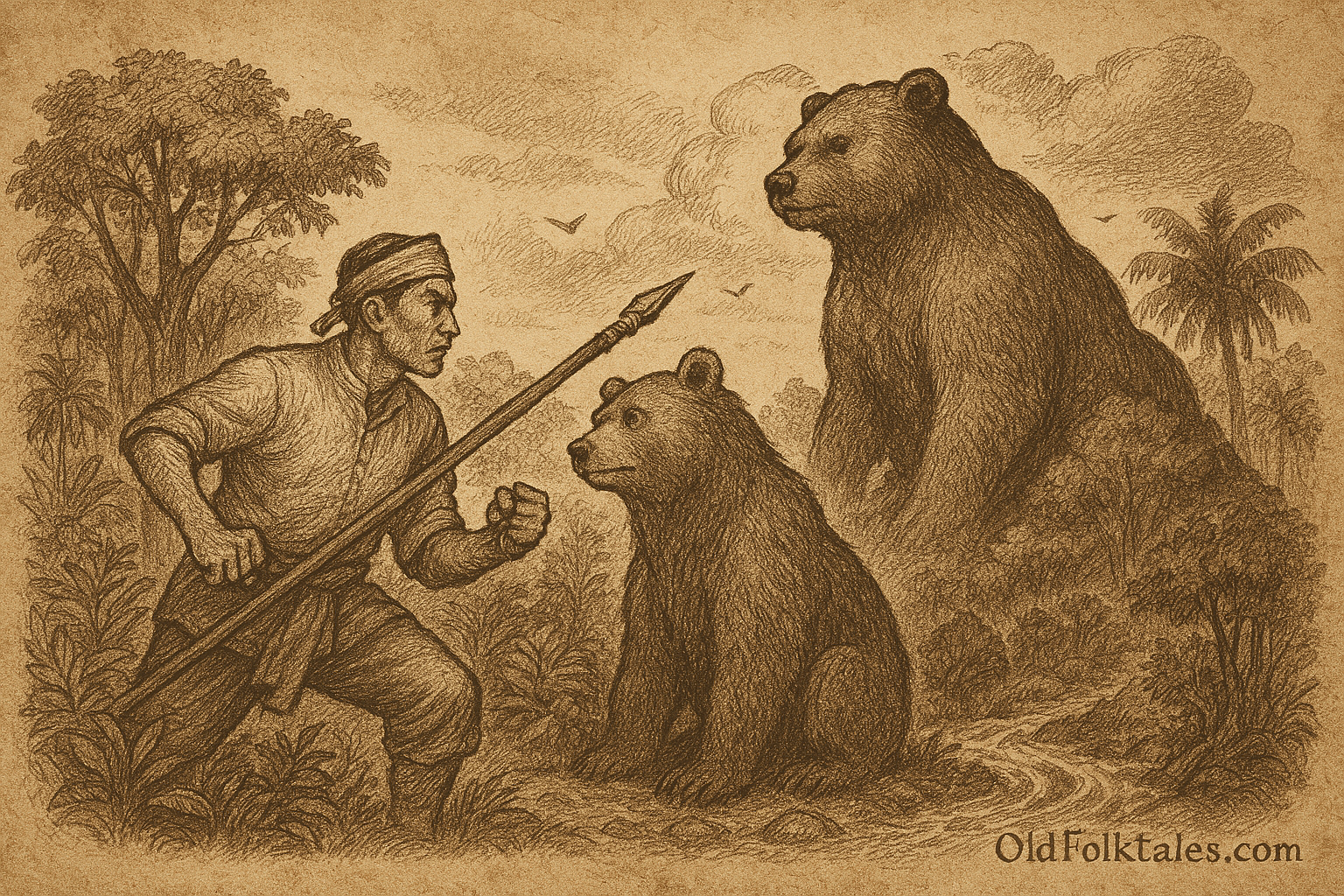
On the third day, he found what he sought. In a clearing where a stream cascaded over moss covered rocks, a massive bear stood drinking. It was larger than any bear Haikal had ever seen, its fur the color of aged honey touched with silver, its presence radiating a power that was more than physical. When it raised its head and looked directly at him, Haikal felt something he had not experienced in years: a flutter of uncertainty, a whisper of fear.
But pride is a powerful master, and it drowned out that small voice of caution. Haikal raised his spear, his muscles tensing for the throw. The bear did not run. It simply stood, its dark eyes holding his gaze with an intelligence that seemed almost human. In that moment, the creature seemed to be giving him a choice, offering him one final chance to turn away and acknowledge what he was about to do.
Haikal’s response was to laugh, cold and mocking. “So the great guardian stands before me. Let us see if spirits can die like ordinary flesh.”
With those words of supreme disrespect, he hurled his spear with all his considerable strength. The weapon flew true, striking the bear’s chest. The creature let out a roar that shook the very leaves from the trees, a sound that was pain and fury and something else, something that spoke of ancient powers awakened and ancient laws broken.
The bear fell, its great body crashing to the earth. But as its blood soaked into the ground, something extraordinary and terrible began to happen. The earth beneath Haikal’s feet started to tremble. What began as a gentle shaking quickly intensified into a violent quaking that threw him to his knees. The sky darkened as if the sun itself had turned away in horror.
Haikal tried to run, but his legs would not move. He looked down in terror to see that his feet had sunk into the soil, which now held him fast like a living hand. The transformation began at his feet and moved upward, his flesh hardening, turning gray and cold as stone. He opened his mouth to scream, but no sound emerged, only the rough texture of rock forming over his tongue.
His last conscious thought was of his wife’s face, of the elders’ warnings, of the bear’s knowing eyes. Then even thought ceased as the stone claimed his mind, preserving forever his final expression of terror and regret.
The earth continued to shake and rise. Where Haikal had stood, the ground swelled upward, forming a hill that grew until it dominated the landscape. The shape it took was unmistakable: the silhouette of a great bear, crouching as if in eternal watchfulness. Some said they could see the outline of a man within the hill, forever trapped within the stone, forever paying the price for his arrogance.
When the trembling finally ceased and villagers came to investigate, they found the new hill and understood immediately what had occurred. They named it Bukit Beruang, Bear Hill, and it became a sacred place, a reminder carved into the very landscape of what happens when humans forget their place in the natural order.
Birds nested in the trees that grew on Bukit Beruang’s slopes, but they sang with a melancholy note. Animals would approach the hill but never stay long, as if they sensed the tragedy embedded in its stone. On certain nights, when the moon was full and the wind moved through the jungle in just the right way, villagers claimed they could hear sounds coming from the hill: the echo of a bear’s final roar, the whisper of regret, the eternal warning against pride that places itself above the sacred.
Haikal’s wife lived out her days in quiet sorrow, and when asked about her husband, she would only say, “He forgot that being skilled does not make one supreme, and that the forest’s guardians demand respect, not challenge.”
To this day, Bukit Beruang stands as both geographical feature and moral monument. Parents bring their children to see it, pointing out the bear like shape of its profile against the sky. “See,” they tell them, “this is what becomes of those who let pride blind them to the sacred. This is the price of arrogance toward the protectors of our world. The hill remembers, and so must we.”
Click to read all Southeast Asian Folktales — featuring legends from Thailand, Indonesia, Vietnam, and the Philippines.
The Moral Lesson
This Malaysian folktale delivers a powerful warning against arrogance and the failure to respect nature’s sacred protectors. It teaches that skill and strength do not grant humans supremacy over the natural world or permission to disrespect its guardians. The story emphasizes traditional Southeast Asian beliefs in the spiritual dimension of nature, where certain animals serve as more than mere beasts but as protectors maintaining cosmic balance. Haikal’s transformation into stone represents the permanent consequences of hubris and disrespect toward sacred things. generations.
Knowledge Check
Q1: Who is Haikal and what makes him both respected and dangerous in his community?
A: Haikal is a legendarily skilled hunter whose abilities are unmatched throughout the region. However, his exceptional skill has bred dangerous pride and arrogance, making him believe he is superior to nature itself. He dismisses spiritual beliefs, mocks elder wisdom, and sees himself as the true king of the forest rather than recognizing his place within nature’s balance.
Q2: What warning do the village elders give Haikal about the great bear?
A: Nenek Salmah and other elders warn Haikal that the great bear of the northern hills is not merely an animal but a guardian spirit and protector of the forest’s balance. They explain that certain creatures must never be hunted, and killing the bear, especially with disrespect, would invite terrible consequences. They emphasize this is sacred knowledge, not mere superstition.
Q3: What signs indicate the bear is more than an ordinary animal?
A: The bear is extraordinarily large with honey colored fur touched with silver. Its presence radiates power beyond the physical. When it looks at Haikal, its dark eyes hold human like intelligence, and it seems to offer him a final choice rather than fleeing. The forest itself feels different in the bear’s territory, and other animals watch with unusual stillness.
Q4: How does Haikal show ultimate disrespect before killing the bear?
A: Rather than showing any reverence or acknowledging the bear’s sacred nature, Haikal laughs coldly and mockingly at the creature. He calls it “the great guardian” with sarcasm and says “let us see if spirits can die like ordinary flesh,” demonstrating supreme contempt for both the bear and the spiritual beliefs surrounding it before hurling his spear.
Q5: What supernatural events occur after Haikal kills the sacred bear?
A: After the bear falls, the earth begins to tremble violently and the sky darkens. Haikal’s feet sink into the soil and his body transforms from flesh to stone, starting at his feet and moving upward until he is completely petrified. The earth continues to shake and rise, forming a hill in the shape of a crouching bear with the hunter trapped forever within.
Q6: What does Bukit Beruang teach about Malaysian cultural beliefs regarding nature?
A: The story reflects Malaysian and broader Southeast Asian beliefs that nature possesses spiritual dimensions and sacred guardians who maintain cosmic balance. It teaches that humans must approach the natural world with humility and respect, that certain creatures and places are sacred and protected, that elder wisdom about spiritual matters should be heeded, and that supernatural justice will punish those who violate sacred laws. The permanent geological reminder serves as intergenerational moral instruction.
Cultural Origin: Malay tradition, Malaysia (Southeast Asia)