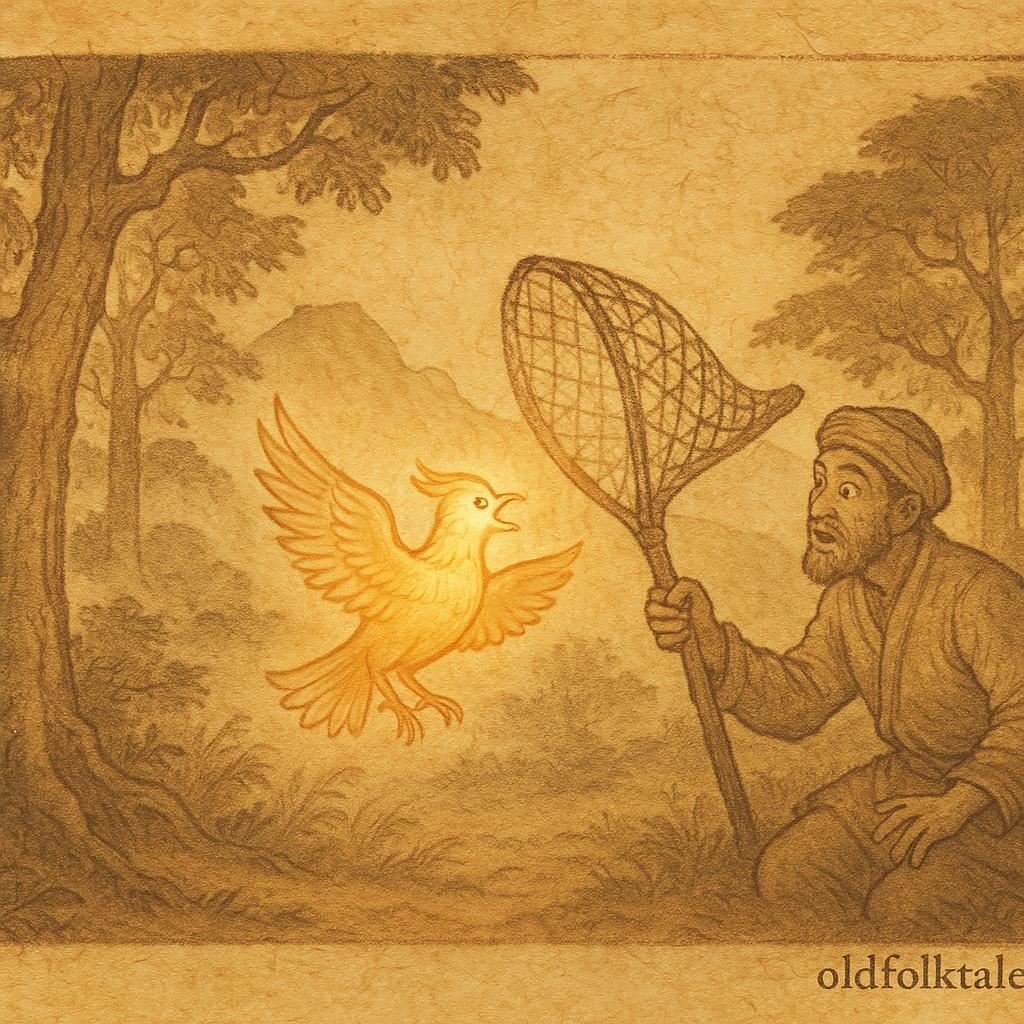
A long time ago, in the sunlit valleys of Tajikistan, where mountains kissed the sky and rivers whispered through emerald meadows, there lived a skilled hunter. His arrows never missed, and his traps were the envy of every man in the village. Yet, for all his success, the hunter’s heart was restless. He always wanted more, more game, more gold, more glory.
One morning, as dawn’s light painted the peaks with gold, the hunter ventured deep into the forest. The air was cool and filled with the songs of unseen birds. He moved quietly, hoping to catch a rare animal that would bring him great fortune. Suddenly, a flash of bright color caught his eye, a bird of such beauty he had never seen before. Its feathers shimmered with hues of sapphire and gold, and its song was sweeter than any he had heard.
Explore timeless legends from China, Japan, and Korea in our East Asian Folktales collection.
With practiced precision, the hunter raised his net and caught the bird. It fluttered helplessly, yet its eyes, full of calm wisdom, met his. To his surprise, the bird spoke in a clear, gentle voice.
“Good hunter,” it said, “I am no ordinary creature. I possess the power to grant wishes. Free me, and I shall reward you with whatever your heart desires.”
The hunter stared in astonishment. “You can grant wishes?” he asked, tightening his grip on the net.
“Yes,” replied the bird. “But listen carefully, greed brings ruin. Ask wisely, and you will live in peace and happiness. But if your heart grows hungry for more, all that you gain will turn to dust.”
The hunter thought for a long moment. He had always dreamed of wealth beyond measure. “Very well,” he said finally. “If what you say is true, grant me a chest of gold coins. That is all I desire.”
The bird nodded its jeweled head. “As you wish.”
The hunter blinked, and before him, a chest filled with shining gold appeared. The bird smiled softly. “Now, release me, as you promised.”
The hunter hesitated. “What if you can give me even more? Why should I let you go when you could make me the richest man alive?”
The bird’s eyes dimmed with sadness. “Beware, hunter. The more you take, the less joy you will find. True wealth lies not in gold, but in gratitude.”
But greed had already taken root in the hunter’s heart. “I will not release you,” he said. “You shall grant me endless treasure.”
The bird sighed. “You have broken your word.” It flapped its wings once, and in an instant, the golden chest vanished. The hunter’s hands were empty, and the forest fell silent.
“Why?” cried the hunter. “Where is my gold?”
“You wished without wisdom,” said the bird. “A greedy heart can never be filled. Learn from this, and perhaps you may yet find peace.”
With that, the bird slipped through the hunter’s loosened grasp and soared into the sky, its feathers glinting like sunlight on water. The hunter reached after it, but the air was empty. He stood alone, surrounded by the hush of trees.
Days passed, and the hunter wandered the forest in regret. No matter how many traps he set, his luck was gone. The animals avoided him, and the once-kind whispers of the forest seemed to mock his folly. The gold he had imagined gleamed only in his dreams, a cruel reminder of his loss.
One evening, he sat beside a stream, watching its ripples glint like coins in the fading light. He remembered the bird’s words: “True wealth lies not in gold, but in gratitude.” At last, he understood. His greed had blinded him to the simple blessings he already possessed, the beauty of the forest, the peace of his home, and the freedom of honest work.
The hunter returned to his village a changed man. He no longer sought riches but lived quietly, sharing his food with others and respecting every creature of the wild. And though he never saw the magical bird again, sometimes, when the wind rustled through the trees, he thought he heard its song, a reminder of the day he had learned that wisdom is richer than gold.
Moral Lesson
This Tajik folktale teaches that greed leads only to loss, while gratitude and wisdom bring peace. Desire must be tempered by understanding, for true wealth is found not in possession, but in contentment.
Knowledge Check
1. Who were the main characters in “The Bird and the Hunter”?
The story features a greedy hunter and a wise magical bird that can grant wishes.
2. What promise did the hunter make to the bird?
He promised to release the bird in exchange for a single wish.
3. What was the hunter’s first wish?
He wished for a chest full of gold coins.
4. What lesson did the bird try to teach the hunter?
That greed brings ruin and that true wealth lies in gratitude and wisdom.
5. What happened when the hunter broke his promise?
The golden chest disappeared, and the bird escaped, leaving the hunter with nothing.
6. What moral does this Tajik folktale convey?
It warns against greed and teaches that wisdom and contentment are the truest forms of wealth.
Source: Tajik folktale, Tajikistan.
Adapted from the Silkroad Foundation collection of Tajik Folk Tales (1998 Edition).