
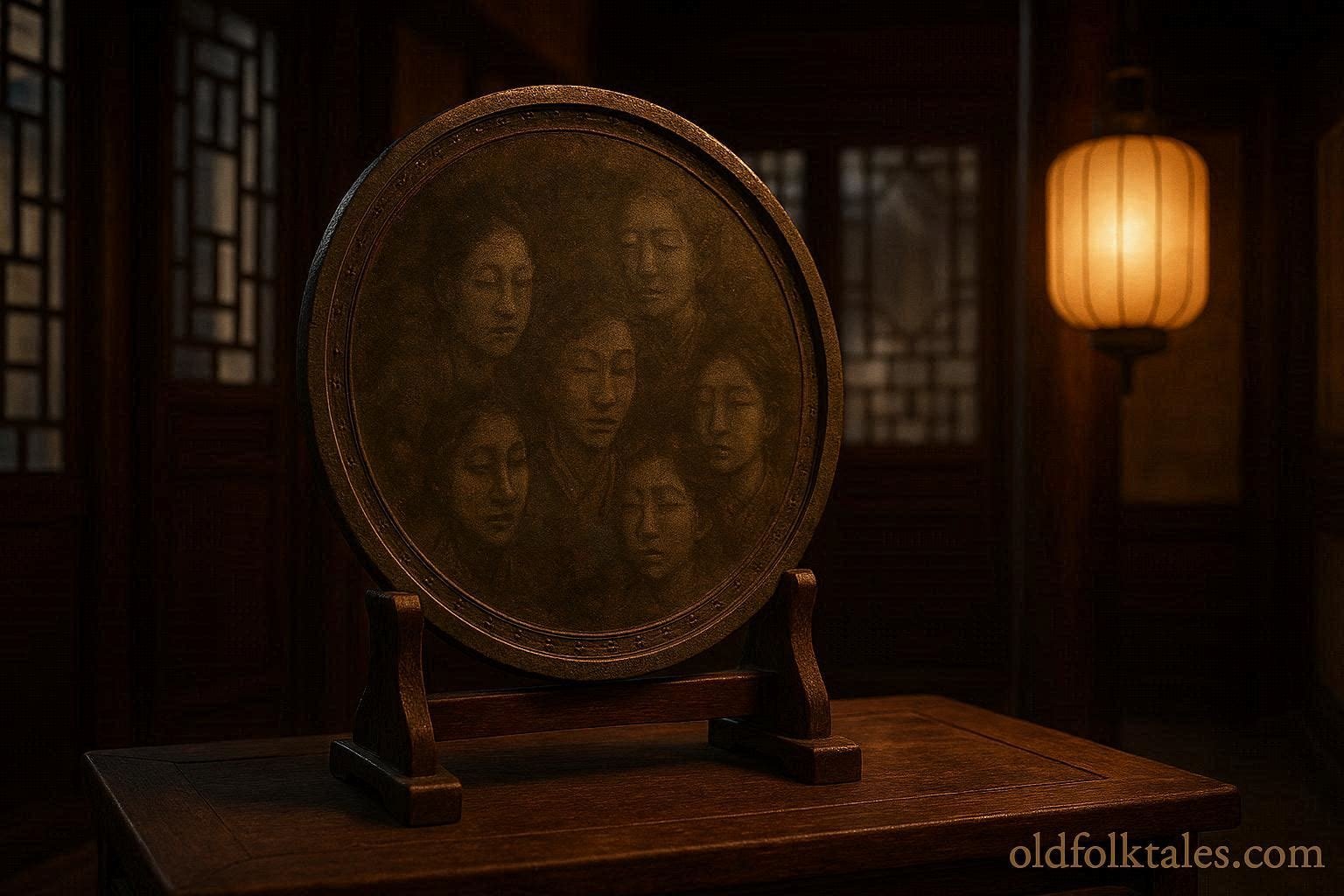
Mist often settled gently over the waterways of Jiangnan, softening the tiled roofs and stone bridges that lined the canals. In one such town lived a family of metal artisans whose ancestors had crafted ritual vessels and household tools for generations. Among their possessions was an ancient bronze mirror, circular and heavy, etched with fading cloud patterns along its rim. It was said to be older than the town itself, passed down from an era when artisans believed objects could absorb the spirit of human intention.
The mirror usually rested wrapped in silk inside a wooden chest. It was not admired for beauty alone, but for its unsettling reputation. Elders whispered that the mirror did not merely show a person’s face. It showed the truth carried behind the eyes. For this reason, it was brought out only on rare occasions, often when disputes threatened to tear families apart or when hidden crimes disturbed the peace of the town.
The mirror’s power became known again during the tenure of Magistrate Shen, a man celebrated publicly for fairness but quietly feared for his ambition. He had risen quickly in office, and his residence gleamed with new stone walls and carved doors. Merchants praised him in public, yet many villagers felt an unease they could not name. Whispers of bribery drifted through tea houses, but no proof could be found.
Journey through enchanted forests and islands in our Southeast Asian Folktales collection.
One summer, a violent dispute erupted between two merchant families over ownership of a riverside warehouse. Each accused the other of forgery and deceit. Documents were presented, witnesses argued, and tempers flared. Unable to reach a verdict, Magistrate Shen ordered the bronze mirror brought from the artisan family, claiming it would restore harmony and truth.
The mirror was carried to the court hall and placed upon a lacquered stand. Its surface was polished until it shone like still water. One by one, those involved in the dispute were ordered to gaze into it. The first merchant leaned forward confidently. As his reflection appeared, the mirror’s surface darkened slightly. Lines deepened on his reflected face, and his eyes seemed to avert themselves. Gasps filled the hall. The merchant staggered back, overcome with shame, and confessed to altering dates on old records.
The second merchant stepped forward trembling. When he looked into the mirror, his reflection remained clear, though tears filled his eyes. The mirror showed no distortion, and a sense of calm spread through the hall. The truth of the matter became evident, and the rightful ownership was restored. The townspeople rejoiced, praising the mirror as a guardian of justice.
Encouraged by its power, Magistrate Shen began using the mirror more frequently. Thieves were exposed. False witnesses faltered. Corrupt clerks were dismissed. The town prospered under what appeared to be renewed moral order. Yet the artisan family noticed something troubling. Each time the mirror revealed truth, its surface seemed to dull slightly, as if burdened by what it had absorbed.
Eventually, rumors spread that the magistrate himself had never faced the mirror. Some villagers began to question why a tool of truth was never turned upon the one who wielded it. Whispers grew louder, and unease returned.
One evening, during the Ghost Festival when lanterns floated along the canals, an elderly woman approached the magistrate’s residence. She claimed her son had been imprisoned unjustly after refusing to pay a bribe. The magistrate dismissed her words and ordered her removed. As she was dragged away, she cried out that truth could not be hidden forever. Her voice lingered in the courtyard like smoke.
That night, Magistrate Shen dreamed of faces pressing against bronze, their mouths opening without sound. He awoke shaken and ordered the mirror brought to his private chamber. He told himself that a righteous man had nothing to fear.
When the mirror was placed before him, the room felt suddenly cold. Shen stared into the bronze surface. At first, his reflection appeared composed and dignified. Then the mirror clouded. His reflected eyes grew sharp and calculating. Scenes flickered within the bronze surface. Coins exchanged beneath tables. Documents burned at night. Innocent men led away in chains. The reflection smiled, though Shen did not.
Terrified, he tried to turn away, but the mirror seemed to hold his gaze. His reflection aged rapidly, lines carving deeply into his face. His hands shook as guilt pressed upon him with unbearable weight. When servants finally forced the door open, they found the magistrate collapsed before the mirror, alive but broken in spirit.
The following days brought confessions. Shen admitted to years of corruption, manipulation, and cruelty. He was removed from office and exiled. The town, shaken yet relieved, gathered once more around the mirror.
The elders decided that such power could not remain in daily use. The mirror had served its purpose, but its burden was heavy. A final ceremony was held. Incense filled the air as prayers were spoken, thanking the mirror for its service. The artisans sealed it once more in silk and wood, placing it in a temple storeroom where it would rest undisturbed.
Over time, the story of the bronze mirror spread beyond Jiangnan. Scholars wrote of it as a moral parable. Parents told it to children as a warning against hidden wrongdoing. The mirror itself faded into legend, but its lesson endured. Truth, once revealed, cannot be forgotten, and those who seek to judge others must first be willing to face themselves.
Even now, when disputes arise in the waterways of Jiangnan, elders say that the mirror still remembers faces. Not because it reflects them, but because the truth they carried was finally seen.
Moral Lesson
The story teaches that truth is unavoidable and moral accountability applies to all, regardless of power or status. Objects of justice reveal not only the faults of others but also demand self reflection. When integrity is neglected, consequences follow, but when truth is embraced, harmony can be restored.
Knowledge Check
- What special ability did the bronze mirror possess?
It revealed the true intentions and hidden morality of anyone who gazed into it. - Why was the mirror brought to the court hall?
It was used to resolve a dispute between two merchant families by revealing the truth. - What change occurred in the mirror over time?
Its surface dulled as it absorbed the moral weight of revealed truths. - Why did villagers begin to distrust Magistrate Shen?
He used the mirror on others but never allowed it to be used on himself. - What happened when Magistrate Shen finally looked into the mirror?
His corruption was revealed, leading to confession, removal from office, and exile. - Why was the mirror sealed away at the end of the story?
Its power was considered too heavy for constant use, and it had fulfilled its role as a moral revealer.
Source
Adapted from Shanghai Museum Folk Artifact Narrative Records, 2015.
Cultural Origin
Jiangnan material culture folklore.








