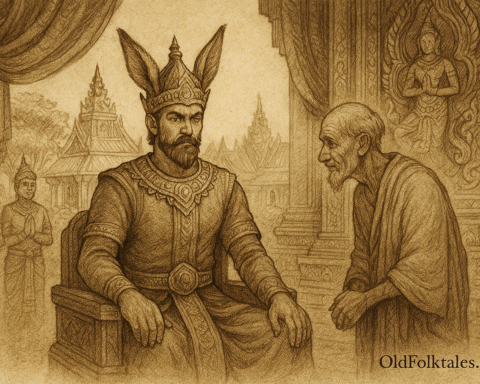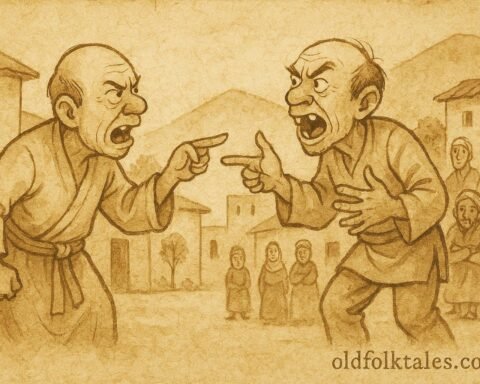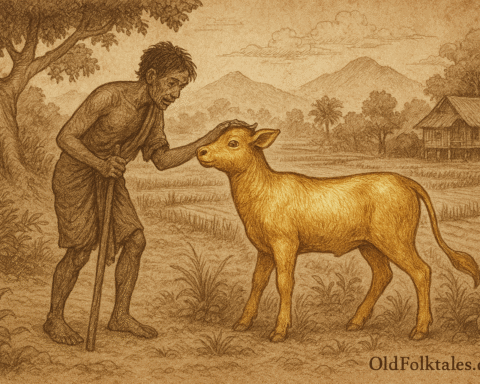
In a humble village of Bangladesh, there lived a simple-minded Brahman priest whose greatest failing was not his poverty but his laziness. He and his wife barely scraped by on the occasional gifts from wealthy patrons during marriages and funeral ceremonies. When word spread that a neighboring king was celebrating his mother’s elaborate funeral rites, an occasion that would draw generous offerings to Brahmans the wife urged her husband to make the journey. After much nagging, he reluctantly agreed.
The good wife burned a plantain tree to ashes, using them to scrub her husband’s clothes until they gleamed white, befitting a priest approaching a royal palace. But the half-witted Brahman never bothered asking directions. He simply wandered wherever his eyes led him, straying far from any proper road until he found himself in a desolate region where no human footsteps had trodden for miles.
As he walked, extraordinary sights appeared before him. First came hillocks of cowrie shells, the very currency of the land glittering by the roadside. Then came mounds of copper coins, then silver four-anna pieces, eight-anna pieces, and finally hillocks of gleaming rupees. His astonishment reached its peak when he beheld a massive hill of burnished gold mohurs, fresh as if newly minted, blazing in the sunlight like a mountain of captured fire.
Beside this golden treasury stood a magnificent palace, and at its door waited a woman of breathtaking beauty. “Come, my beloved husband!” she called. “You married me in your youth and never returned. Blessed is this day that brings you back to me!” The Brahman, bewildered, had no memory of such a marriage, but as a Kulin Brahman, he supposed his father might have arranged it when he was too young to remember. The woman’s beauty and obvious wealth convinced him to accept her claim.
What the simple Brahman didn’t know was that this “woman” was a Rakshasi, a monstrous raw-eating demon who had devoured the entire kingdom: the king, queen, royal family, and every last subject. The region lay empty of human life because she had consumed them all.
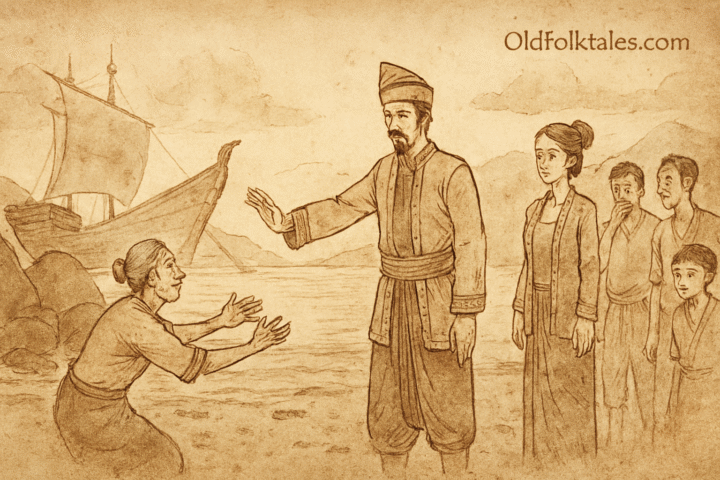
For a week, the Brahman lived in luxury with the Rakshasi, who then suggested he fetch his other wife to live with them. Furnished with fine silks and jewels, he returned to his village. His wife, who had given him up for dead, was shocked to see him return bearing treasures fit for royalty. When he spoke of his “first wife” and mountains of gold, she suspected madness, until she saw the magnificent gifts. Then her blood ran cold. This could only be the work of a Rakshasi.
Despite her fears, she accompanied her husband back to the palace. The Rakshasi greeted her with feigned affection, weeping tears of joy and calling her “beloved sister.” For fifteen years, they lived together in deceptive peace, and both wives bore the Brahman sons. The Rakshasi’s child, beautiful as a god, was named Sahasra Dal (Thousand-Branched). The human wife’s son, born a year later, was called Champa Dal (Champaka Branch). The boys grew inseparable, riding to school daily on swift ponies.
But the Rakshasi’s true nature, like murder itself, would eventually surface. When the Brahman took up hunting, his demonic wife could no longer resist her appetite for raw flesh. The human wife watched in horror as the Rakshasi devoured entire antelopes, her monstrous jaws seeming to stretch from earth to heaven as she swallowed legs and limbs whole.
When confronted, the Rakshasi’s fury erupted. The human wife knew doom had arrived. Before sending her son Champa Dal to school, she gave him a golden vessel containing drops of her breast milk. “Watch its color constantly,” she warned. “When it turns slightly red, your father is dead. When it becomes completely red, I too am gone. Then ride for your life.”
That morning, the Rakshasi lured the unsuspecting Brahman to the river, transformed to her gigantic true form, and tore him limb from limb. She then rushed home and devoured his wife whole, clothes, hair, and all.
At school, young Champa Dal watched in horror as the milk reddened, first partially, then completely. Crying out in anguish, he leaped onto his pony. His half-brother Sahasra Dal demanded to know what was wrong. “Your mother has devoured mine!” Champa wailed. “Don’t come near me!”
“I won’t devour you, I’ll save you!” Sahasra Dal galloped after him. When his mother appeared in her terrible demon form demanding Champa Dal, Sahasra rode to meet her and, with his princely sword supple as a palm leaf, severed her head.
The two boys rode for days on their extraordinary horses, pakshirajes, literally kings of birds, covering hundreds of miles. As sunset approached, they reached a village where they found a respectable family in deep mourning. Through questioning, Sahasra Dal learned of a terrible Rakshasi who had depopulated the entire region. To spare the population, the king had made a desperate bargain: each night, one family must send a member to a temple to be devoured.
“Tonight is our family’s turn,” the head of household explained with resignation. “We’re deciding who must go.”
The two friends exchanged glances. “We shall go in your place,” Sahasra Dal declared, ignoring the family’s protests that guests were sacred and must be protected, not sacrificed.
That night in the temple, Sahasra kept watch while Champa slept. At midnight, a sound like a rushing tempest announced the Rakshasi’s arrival. She thundered at the door:
“How, mow, khow! A human being I smell; Who watches inside?”
Sahasra Dal answered: “Sahasra Dal watcheth, Champa Dal watcheth, Two winged horses watch.”
The Rakshasi groaned and retreated, recognizing Rakshasa blood in Sahasra’s veins. Three more times before dawn she returned, receiving the same answer. But at four o’clock, exhausted Sahasra woke Champa to keep watch, warning him to mention Sahasra’s name first in reply.
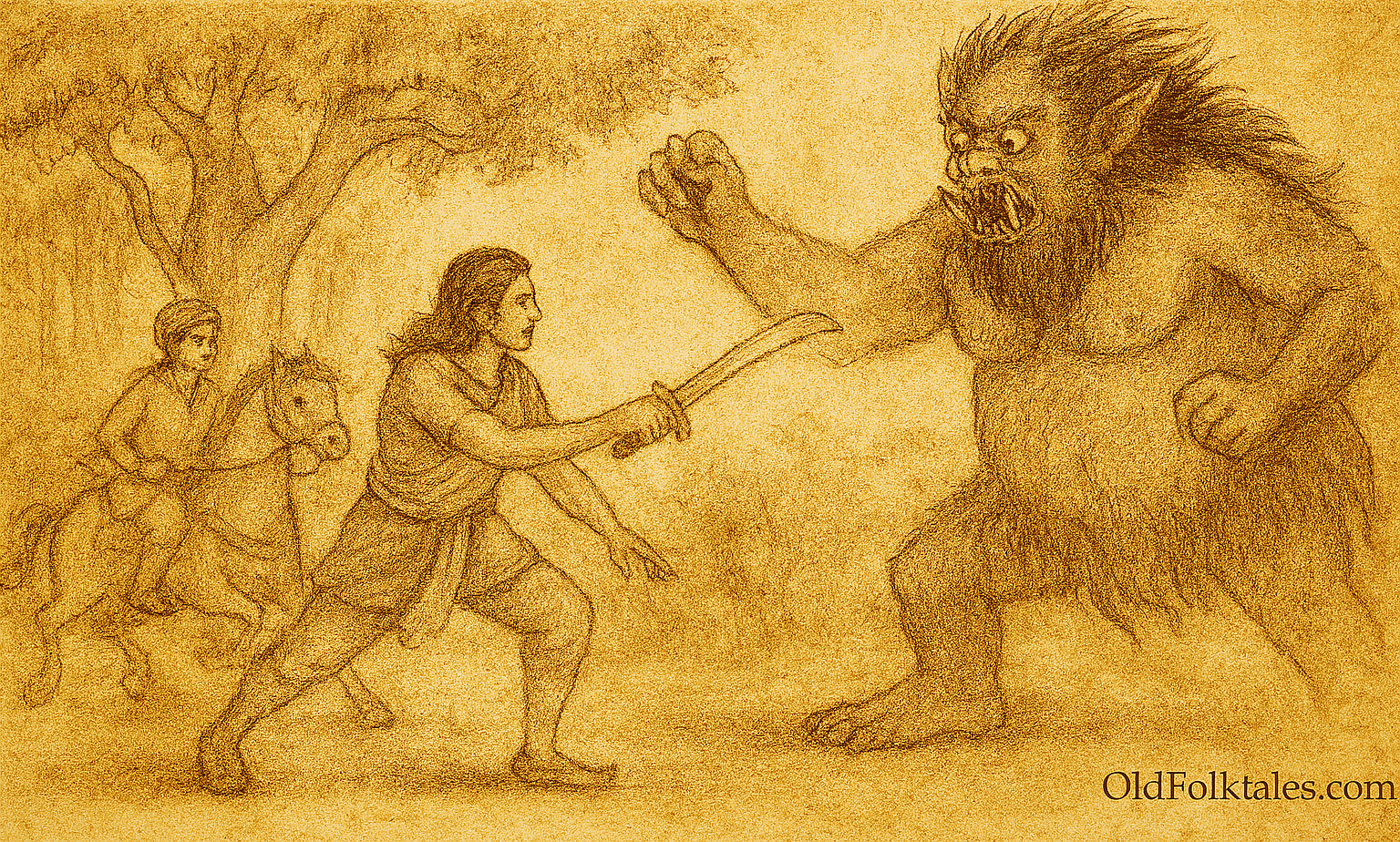
When the Rakshasi called again, terrified Champa forgot the instruction and named himself first. With a triumphant shriek, the demon smashed through the door, but Sahasra sprang awake and with his supple sword beheaded the monster. Her mountain-sized corpse fell, covering acres of ground.
Come morning, wood-cutters found the body. Each tried claiming the reward, the king’s daughter and half his kingdom but the truth emerged. Sahasra Dal married the princess and gained sovereignty, while Champa Dal remained with him in prosperity and friendship.
But happiness proved fleeting. A scheming maid-servant in the palace, secretly another Rakshasi, falsely accused Champa Dal of impropriety to eliminate him, as he’d witnessed her nocturnal hunting. The queen-mother, dependent on this servant, forced Sahasra Dal to banish his friend.
Heartbroken, Champa rode his fleet horse across thousands of miles until he reached a magnificent but empty palace. In a side chamber, he found a sleeping princess of heavenly beauty named Keshavati. Near her head lay two sticks, one silver, one gold. When he touched her with the gold stick, she awakened and revealed her tragedy: seven hundred Rakshasas had devoured her entire kingdom. Only an old Rakshasi’s strange affection saved her, using the silver stick to kill her each morning and the gold stick to revive her each evening.
Through Keshavati’s clever questioning, Champa learned the secret of Rakshasa life: in a crystal pillar beneath a tank’s waters lived two bees. If destroyed without a drop of blood touching the ground, all Rakshasas would perish.
The next morning, Champa dove deep, retrieved the bees in one breath, and sliced them over ashes. The Rakshasas’ death screams echoed across the land as seven hundred monsters died instantly, their massive bodies falling where they stood.
Champa and Keshavati married by exchanging flower garlands. But when Keshavati bathed in the river, one of her seven-cubit-long hairs came loose. She tied it to a floating shell, which drifted downstream to where Sahasra Dal bathed. Finding the extraordinary hair, he became obsessed with meeting its owner.
The evil maid-servant, commanded to fetch the hair’s owner, sailed upriver in a magical boat of Hajol wood with Mon Paban oars. Disguised as Keshavati’s aunt, she lured the princess aboard with beautiful wicker baskets and poisoned sweetmeats. The boat flew back downstream, delivering Keshavati to Sahasra Dal’s palace.
For six months, Keshavati claimed a vow prevented her from seeing strange men. Meanwhile, Champa Dal wandered like a madman searching for her. When he finally reached Sahasra Dal’s capital, he spotted her at a window. They devised a plan: Champa would pose as a Brahman reciter for the vow’s completion ceremony.
Before the assembled court, Champa recited their entire story from the beginning, the half-witted Brahman, the Rakshasas, their brotherhood, separation, and reunion. Throughout, he asked Keshavati behind a screen, “Is this correct?” She replied, “Quite correct; go on, Brahman.”
When the tale ended, Sahasra Dal leaped up, embracing the reciter. “You can be none other than my brother Champa Dal!” The evil maid-servant was buried alive in a pit filled with prickly thorns. The two couples lived together happily ever after, their brotherhood restored and their love triumphant.
Journey through enchanted forests and islands in our Southeast Asian Folktales collection.
The Moral Lesson
This epic folktale teaches that true brotherhood and loyalty transcend even blood ties and supernatural evil. Sahasra Dal’s willingness to kill his own demonic mother to save Champa Dal, and their eventual reunion despite betrayal and separation, demonstrates that genuine friendship withstands all trials. The story also warns against false servants and deceptive appearances, showing that evil often wears beautiful masks. Most importantly, it reveals that courage, cleverness, and unwavering loyalty can overcome even the most monstrous of adversaries.
Knowledge Check
Q1: What are Rakshasas in Bangladeshi folklore and Hindu mythology?
A: Rakshasas (male) and Rakshasis (female) are enormous demon giants in Hindu mythology, known as “raw-eaters” because they devour living creatures whole. They likely represent mythologized versions of aboriginal chiefs whom Aryan settlers encountered. In this folktale, they possess supernatural strength, can change forms, and terrorize entire kingdoms by consuming all living beings.
Q2: Why did Sahasra Dal kill his own mother despite having Rakshasa blood himself?
A: Sahasra Dal’s act of killing his Rakshasi mother demonstrates that moral character transcends biological nature. Despite being half-Rakshasa, he chose loyalty to his innocent friend Champa Dal over his demonic heritage. This pivotal moment establishes the story’s central theme: true friendship and righteousness matter more than bloodline or supernatural power.
Q3: What is the significance of the two magical sticks silver and gold in the story?
A: The silver stick represents death while the gold stick symbolizes life and resurrection. The old Rakshasi used these to control Keshavati, killing her each morning to prevent other Rakshasas from devouring her and reviving her each evening. When Champa Dal discovered these sticks, they gave him power over life and death, allowing him to communicate secretly with Keshavati and ultimately save her.
Q4: What does the crystal pillar with two bees symbolize in Rakshasa mythology?
A: The crystal pillar (Sphatikasthambha) submerged in water represents the hidden source of Rakshasa immortality. The two bees atop it contain the collective life force of all seven hundred demons. This symbolizes how evil’s power often depends on a single vulnerable secret and that discovering and destroying that secret requires both courage (diving deep) and wisdom (preventing blood from touching ground).
Q5: How does Champa Dal’s recitation technique serve as a storytelling device?
A: Champa Dal’s public recitation of their entire story serves multiple purposes: it reveals truth before witnesses, unmasks the evil maid-servant, reunites the separated friends, and allows Keshavati to confirm events while maintaining her vow. This meta-narrative technique, a story within a story, is common in South Asian folklore, emphasizing how truth-telling itself becomes a form of justice and redemption.
Q6: What role does hospitality play in Bangladeshi cultural values within this tale?
A: The story emphasizes the sacred duty of hospitality when the family protests against letting guests sacrifice themselves, declaring “guests are like gods.” This reflects the deep-rooted South Asian principle of atithi devo bhava (the guest is god). The host’s obligation to endure any privation for guests’ comfort is so strong that the two brothers must insist forcefully to take the family’s place in the temple sacrifice.
Source: Bangladeshi folktale, Bangladesh