In the rolling countryside of Srei Ambel, where rice paddies stretched like mirrors reflecting the endless sky and sugar palm trees swayed in the warm breeze, there lived a boy so poor he had no name beyond what the villagers called him”the buffalo boy.” His parents had died when he was still small, leaving him nothing but a tattered sampot and the responsibility of tending the village’s water buffaloes. He slept in the animal shelter, ate whatever rice the charitable villagers would spare, and spent his days leading the great beasts to graze in the fields and bathe in the muddy rivers.
The other children mocked him for his poverty and his smell of animals. They threw stones and called him names, laughing as he walked barefoot through the village with his charges. But the buffalo boy bore their cruelty with quiet dignity, finding his only companionship in the creatures he tended. While other boys learned to read sutras at the temple or helped their fathers in the markets, he learned the language of animals the twitch of an ear that meant contentment, the stamp of a hoof that signaled unease, the low rumble in a throat that spoke of trust.
Click to read all East Asian Folktales — including beloved stories from China, Japan, Korea, and Mongolia.
Among all the buffaloes, two were special to him. The first was an old bull named Preah, whose horns curved like the crescent moon and whose hide was the color of storm clouds. Preah had belonged to the boy’s father and remembered him with an animal’s deep loyalty. The second was a younger cow named Neary, whose eyes held an unusual intelligence and whose strength belied her graceful frame. These two the boy treated not as mere beasts of burden, but as family the only family he had left in this world.
Each day, the buffalo boy would speak to Preah and Neary as he led them to the fields. He told them of his loneliness, his dreams, and his fears. He sang them the songs his mother had once sung to him, lullabies in the old Khmer tongue that spoke of ancient kings and magical creatures. And slowly, miraculously, something extraordinary happened. The buffaloes began to understand.
At first, it was simple things. When the boy asked Preah to move left or right, the great bull would obey without needing to be prodded with a stick. When he told Neary to wait while he gathered firewood, she would stand still as a statue until he returned. The villagers noticed and whispered among themselves perhaps the buffalo boy wasn’t entirely useless after all. Perhaps there was something special about him, something the ancestors had blessed him with in compensation for his poverty.
The boy taught his buffaloes more than commands. He taught them to recognize danger, to distinguish between friend and stranger. He taught them the meaning of protection and loyalty. In the evenings, he would sit between them in the shelter, his small body dwarfed by their massive forms, and tell them stories of brave warriors and noble deeds. “If ever our village is threatened,” he would whisper, stroking their rough hides, “you must help me protect our people. They may not love us, but this is our home.”
The buffaloes would rumble deep in their chests, a sound the boy had come to understand as agreement.
Years passed in this humble way, seasons turning from rain to sun and back again. The buffalo boy grew taller, though he remained thin as a sugar palm. His skill with the animals became so renowned that even wealthy merchants from Kampot would travel to see the buffaloes that understood human speech. But still, the boy remained poor, still he slept in the shelter, and still he asked for nothing but enough rice to fill his belly.
Then came the day the village would never forget.
It was during the harvest season, when the rice stood golden and ready for cutting, when the granaries were full and prosperity seemed certain. A band of bandits, hardened men who had been soldiers in forgotten wars, descended upon Srei Ambel like a plague of locusts. They came at dawn, when the mist still clung to the ground, their faces hidden behind black cloths, their hands gripping rusted swords and sharpened bamboo spears.
The villagers, caught unaware, fled in panic. Old men stumbled, mothers clutched screaming children, and the young men who tried to resist were quickly beaten down. The bandits moved through the village like a destructive wind, seizing rice, chickens, valuables, and anything else their greedy hands could grasp.
The buffalo boy, waking to the sounds of terror, understood immediately what was happening. His heart pounded with fear, but his voice remained steady as he approached Preah and Neary. The two buffaloes were already agitated, snorting and stamping, sensing the violence in the air.
“My friends,” the boy said, placing a hand on each of their broad heads. “Our village needs us. Will you fight with me?”
Preah lowered his great horned head, and Neary pawed the ground with her powerful hooves. The boy understood their answer.
Together, they charged into the village center where the bandits had gathered their plunder. The buffalo boy rode upon Preah’s back, while Neary ran beside them like thunder given form. The bandits, used to fighting frightened farmers, were utterly unprepared for what descended upon them.
Preah fought with the fury of the storm gods, his horns goring and tossing bandits like rag dolls. Neary moved with devastating precision, her hooves crushing weapons and breaking bones. The buffalo boy, clinging to Preah’s neck, shouted directions and warnings, coordinating their attack with a skill that seemed almost supernatural. The buffaloes understood every word, responding to his commands with perfect unity.
The battle was fierce but brief. The bandits, realizing they faced not merely animals but something far more formidable, broke and ran. Those who could still walk fled into the forest, abandoning their weapons and their plunder, wanting nothing more than to escape this cursed village and its demon buffaloes.
When the dust settled and silence returned to Srei Ambel, the villagers emerged from their hiding places to find the buffalo boy standing amid the scattered weapons and abandoned loot, with Preah and Neary flanking him like guardian statues. Blood stained the earth, but not one villager had been seriously harmed.
The people rushed forward with gratitude and wonder, reaching out to thank their unlikely savior. The village elder, tears streaming down his weathered face, declared that the buffalo boy would never want for anything again. He would have a proper house, proper clothes, and a place of honor in the village.
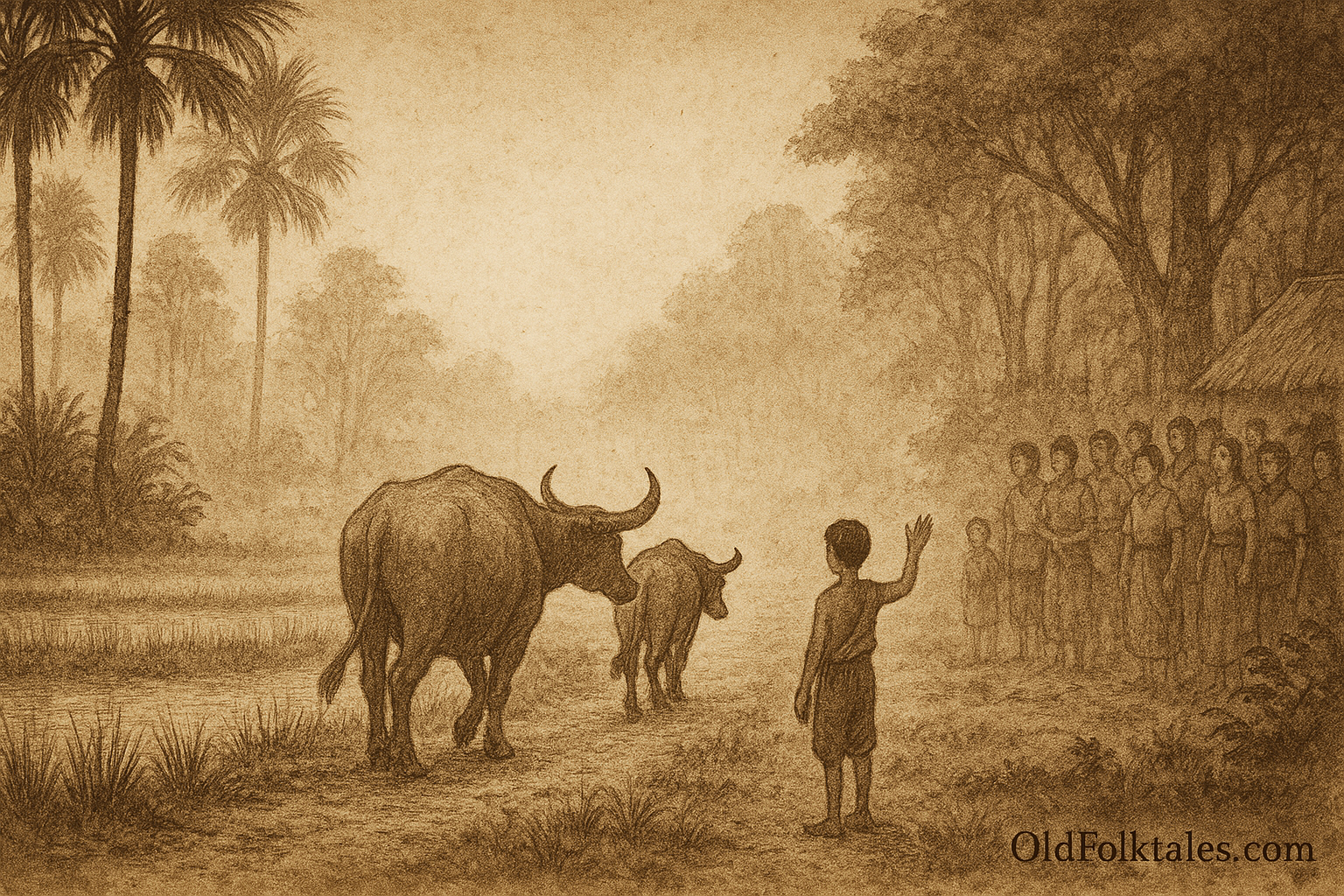
But when they turned to embrace the boy, something strange occurred. Preah and Neary began backing away, moving toward the forest at the village’s edge. The buffalo boy looked at them with understanding in his eyes.
“You must go,” he said softly, though his voice carried to everyone present. “Your work here is done.”
The villagers watched in awe as the two buffaloes who had saved them all, who had fought like warriors from the ancient legends turned and walked into the shadowy forest. The boy made no move to stop them. He stood perfectly still, one hand raised in farewell, as his only true friends disappeared between the trees.
Some said the buffaloes were not ordinary animals at all, but apsaras who had taken animal form to teach the village about judging by appearance rather than character. Others claimed they were the spirits of the boy’s ancestors, watching over him in his poverty and revealing themselves only when needed most. The boy himself never said, keeping whatever knowledge he possessed locked away in his heart.
True to the elder’s word, the village provided for the buffalo boy. He grew into a man of wisdom and compassion, known throughout the district for his kindness and his understanding of both animals and people. He became a respected elder himself, sought out for advice and mediation. And at every harvest gathering, when the rice was safely stored and the village celebrated another year of prosperity, he would tell the story of Preah and Neary, of two buffaloes who understood human speech and who taught a poor boy that true nobility comes not from wealth or status, but from loyalty, courage, and love.
Children would listen wide-eyed, and adults would nod with remembered wonder. And sometimes, on quiet evenings when the mist rose from the paddies, villagers swore they could hear the low rumble of buffalo voices in the distant forest, still watching, still protecting, still remembered.
Click to read all Southeast Asian Folktales — featuring legends from Thailand, Indonesia, Vietnam, and the Philippines.
The Moral Lesson
The legend of the Buffalo Boy of Srei Ambel teaches us that greatness can emerge from the humblest circumstances, and that true worth is measured not by wealth or status but by character and compassion. The story illustrates the power of treating all beings with kindness and respect the boy’s gentle care for his buffaloes created a bond strong enough to save an entire village. It reminds us not to judge others by their appearance or social position, for those we dismiss as worthless may prove to be our greatest protectors.
Knowledge Check
Q1: Who was the buffalo boy of Srei Ambel and why was he poor?
A: The buffalo boy was an orphan whose parents died when he was young, leaving him with nothing. He survived by tending the village’s water buffaloes, sleeping in the animal shelter and eating whatever charitable villagers would spare him.
Q2: What were the names of the two special buffaloes and what made them unique?
A: The two buffaloes were named Preah (an old bull with crescent-shaped horns who had belonged to the boy’s father) and Neary (a younger, intelligent cow of great strength). They were unique because they learned to understand human speech and commands.
Q3: How did the buffalo boy teach the animals to understand human language?
A: The boy spoke to them daily as companions rather than beasts, singing them songs in the old Khmer tongue, telling them stories, and treating them with kindness and respect. Over time, this deep bond allowed them to understand his words and intentions.
Q4: What happened when bandits attacked the village of Srei Ambel?
A: The buffalo boy and his two buffaloes charged into battle against the raiders. Preah and Neary fought with extraordinary skill goring, trampling, and crushing the bandits’ weapons while the boy directed their coordinated attack, ultimately driving the bandits away without serious harm to villagers.
Q5: Why did the buffaloes disappear into the forest after the battle?
A: After saving the village, Preah and Neary walked into the forest and vanished, their purpose fulfilled. Some believed they were divine spirits (apsaras) or ancestral guardians who revealed themselves only when needed most, returning to the spirit realm once their mission was complete.
Q6: What cultural values does this Cambodian legend represent?
A: The legend embodies Cambodian values of compassion toward all beings, the importance of loyalty and gratitude, respect for those who serve humbly, the Buddhist principle that wisdom can come from any source, and the belief in protective spirits. It also emphasizes community responsibility and honoring those who sacrifice for others.
Source: Adapted from Cambodian Royal Chronicles Oral Supplement, Folktales of Srei Ambel District
Cultural Origin: Cambodian folklore tradition, Srei Ambel District, Cambodia