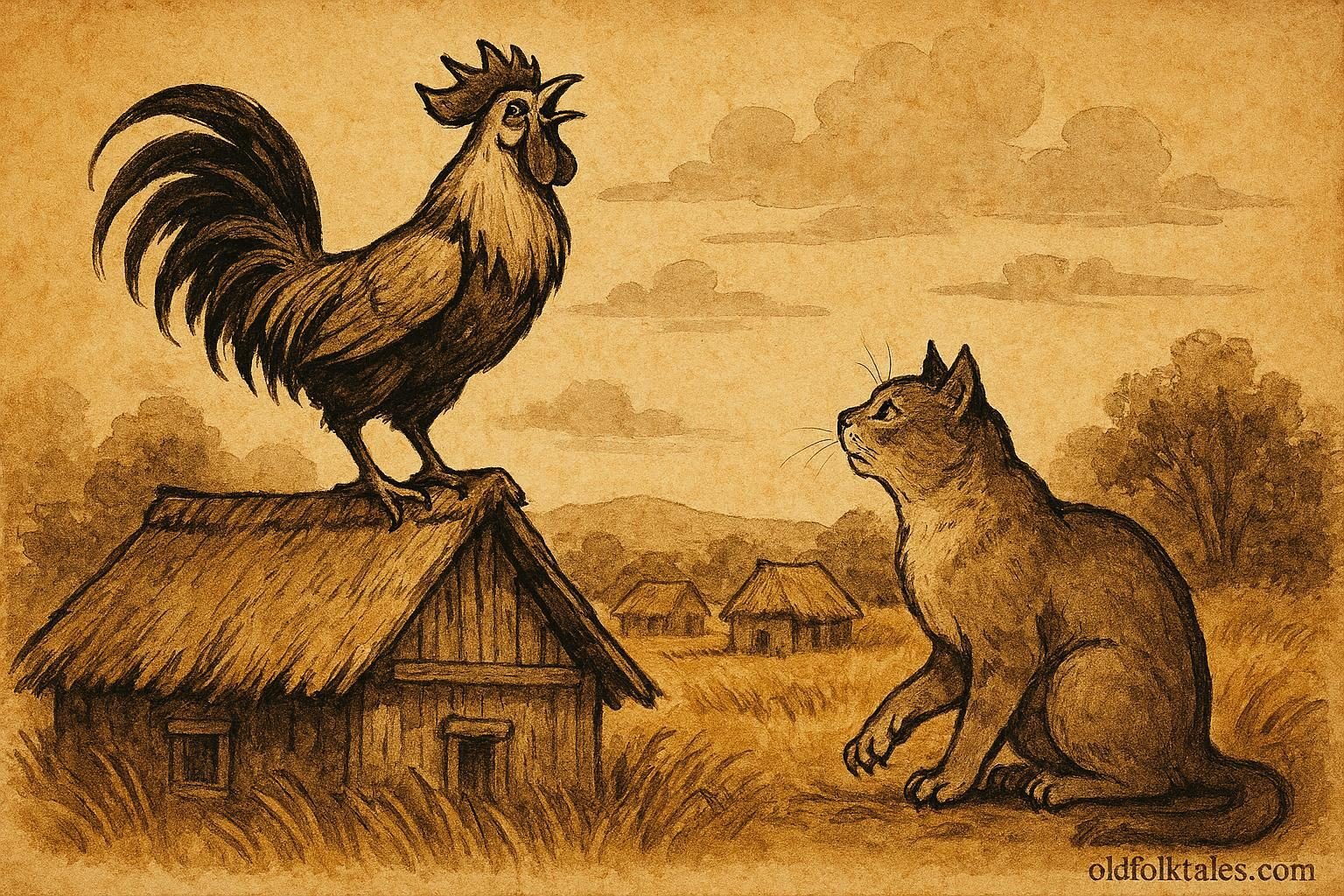
In a small village in Sri Lanka, where the sun rose over golden fields and the village huts were dotted with clay rooftops, there lived a Cat and a Cock under the same roof. Though they shared a home, they did not share peace. The Cat often prowled the floor, sharp-eyed and hungry, while the Cock strutted proudly, alert to every sound and shadow.
One morning, as sunlight streamed through the bamboo slats of the window, the Cat crouched and whispered, “Friend, I am going to eat you.”
The Cock, unruffled, fluffed his feathers and replied, “Wait, friend. Do not eat me. I can show you a good reason why I should live.”
Curious, the Cat paused. “What is this good reason?” he demanded.
The Cock spoke calmly, his chest puffed with dignity. “Every morning, I crow to awaken the men of the village. When they rise, they set food before you. If you eat me, who will crow? If the men do not wake, there will be no food for you. Therefore, spare me.”
The Cat considered this and nodded. “It is good,” he said, and allowed the Cock to live.
Days passed, but the Cock’s cleverness did not end. One night, while darkness cloaked the village, the Cock crowed sharply from the rooftop. The Cat, annoyed, hissed, “Friend, you crowed at night! Now I will eat you.”
“Do not eat me,” said the Cock. “I crowed at night so that thieves who prowl might believe it is morning. They flee in fear, and the village is safe. If I perish, the thieves might steal food, and there will be less for you. Spare me, friend.”
The Cat, seeing the logic, relaxed his claws. “It is good,” he said again.
Soon the Cock began crowing in the evening, just as the sun dipped low behind the hills. The Cat sharpened his teeth and threatened, “Friend, you crowed in the evening! Now I will eat you.”
The Cock, calm and wise, explained, “I crowed in the evening so that the men would know it is time to collect the food they left out to dry in the sun. If I am eaten, they might fail to gather their provisions, and there will be little for you to eat. Therefore, do not harm me.”
The Cat, impressed by the Cock’s foresight, nodded. “It is good,” and refrained from attacking.
Another time, the Cock crowed in the afternoon. The Cat, growing impatient, hissed once more, “Friend, you crowed in the afternoon! I shall eat you now.”
The Cock fluffed his feathers and spoke with reason. “I crow in the afternoon to remind the men to feed their children when they return from school. If I am gone, they might forget, and food will be scarce. Spare me, friend.”
Again, the Cat considered carefully and said, “It is good,” letting the Cock live.
Finally, one clear morning, the Cock crowed as usual, welcoming the sunrise with a bright, confident voice. The Cat, looking at him with calm acceptance, said, “Friend, you crowed at the proper time. That is right.” From that day onward, the Cat and the Cock lived in harmony, respecting each other’s place in the household and recognizing that cooperation could be more valuable than hunger or dominance.
The village around them went on with its rhythm of labor, children’s laughter, and the crowing of the Cock. And in the quiet of the house, the Cat and the Cock shared a unique understanding born not from friendship alone, but from wisdom, respect, and mutual benefit.
Moral Lesson
This Sri Lankan folktale teaches that wisdom, reasoning, and foresight can prevent conflict. By understanding the needs of others and demonstrating their usefulness, one can foster respect and cooperation, even between natural rivals. Clever thinking and dialogue can achieve what force alone cannot.
Knowledge Check
1. Who are the main characters in “The Cat and the Cock” folktale?
The Cat and the Cock, two animals living in the same house, are the central figures.
2. What strategy does the Cock use to avoid being eaten?
The Cock uses reasoning and persuasion, explaining how his crowing benefits the Cat and the village.
3. How does the Cock’s crowing help the village at night?
By crowing at night, the Cock scares away thieves who might steal food.
4. What lesson does the afternoon crowing convey?
It teaches that timely action and awareness help maintain routine and meet responsibilities, benefiting all.
5. What is the overall moral of the story?
Respect, foresight, and cooperation can resolve conflicts, even between natural enemies.
6. What cultural origin does this tale belong to?
This folktale is part of Sinhala folklore from Sri Lanka, collected by Henry Parker.
Source: Adapted from the Sinhalese folktale “The Cat and the Cock” in Village Folk-Tales of Ceylon, Vol. I, collected by H. Parker (1910), London: Luzac & Co.
Cultural Origin: Sri Lanka (Sinhalese folklore)