In a village nestled between the volcanic mountains and emerald rice terraces of Java, there lived a prosperous farmer who had worked the land all his life. His fields were the most fertile in the region, his harvest the most abundant, and his wealth the envy of many. He had two children: an elder son named Bagus and a younger daughter named Wulan. Both had grown strong and capable under their father’s guidance, learning to tend the crops and manage the family’s holdings.
The old farmer loved his children equally, though their characters were as different as sun and shadow. Bagus was ambitious and calculating, always seeking ways to expand the family fortune. He spoke often of building more terraces, acquiring neighboring lands, and increasing their wealth. Wulan, though equally hardworking, possessed a gentler spirit. She found joy in the simple rhythms of planting and harvest, in the songs the women sang as they worked, and in caring for the village elders who could no longer tend their own fields.
Click to read all East Asian Folktales — including beloved stories from China, Japan, Korea, and Mongolia.
As the farmer aged, his bones growing brittle and his steps uncertain, he knew the time had come to divide his inheritance. He called his children to him one evening as the sun painted the sky in shades of crimson and gold. The air was heavy with the scent of jasmine and the distant sound of gamelan music from a neighboring celebration.
“My children,” he said, his voice weathered but firm, “I have worked this land for fifty years, and soon I must join the ancestors. I wish to divide my property between you while I still draw breath, so there will be no confusion when I am gone.”
He explained his decision carefully. The inheritance would be split equally: half the rice fields, half the water buffalo, half the fruit orchards. Each child would receive the same value, measured not just in land but in potential and prosperity. It was fair, balanced, and given with a father’s love.
But Bagus’s face darkened like storm clouds gathering over the mountains. He had long assumed, as the eldest son, that the lion’s share would be his. In his mind, he had already planned how to use the additional wealth, what expansions to make, what status to achieve. The thought of sharing equally with his sister felt like a theft of his birthright.
“Father,” he said, his voice tight with barely contained anger, “this is not just. I am the elder. I am the son who will carry our family name. The bulk of the inheritance should be mine by tradition and right.”
The old farmer shook his head sadly. “I have given you both equal gifts of life and equal opportunities to learn. You shall receive equal shares of what I have built.”
That night, after their father had returned to his sleeping mat, Bagus approached Wulan with eyes burning with resentment. “You should refuse your half,” he demanded. “You will marry and join another family. You have no right to claim what should be mine.”
Wulan stood her ground, though her heart trembled. “Father has spoken his wish. I will not dishonor him by refusing what he has chosen to give me. This is not about greed, brother. This is about respecting our father’s decision.”
Their argument grew heated, voices rising into the night air like angry spirits. Bagus accused Wulan of manipulation, of poisoning their father’s mind against him. Wulan defended herself, but also grew angry at her brother’s selfishness, his inability to see beyond his own desires. They hurled words like stones at each other, each accusation harder and sharper than the last.
“You are no brother of mine!” Bagus shouted, his face twisted with rage.
“And you are no son our father can be proud of!” Wulan cried back, tears streaming down her face.
As their quarrel reached its terrible peak, something extraordinary and terrible occurred. The earth beneath their feet began to tremble. The air grew thick and oppressive, as if the land itself was holding its breath. The ancestors, it was said, watched over the living and would not tolerate such of family bonds and such naked greed.
The ground opened slightly between them, and before either could step back, their feet began to sink into the soil. They tried to run, but their legs had turned heavy as stone. They reached for each other in sudden terror, their anger forgotten in the face of this supernatural judgment, but it was too late.
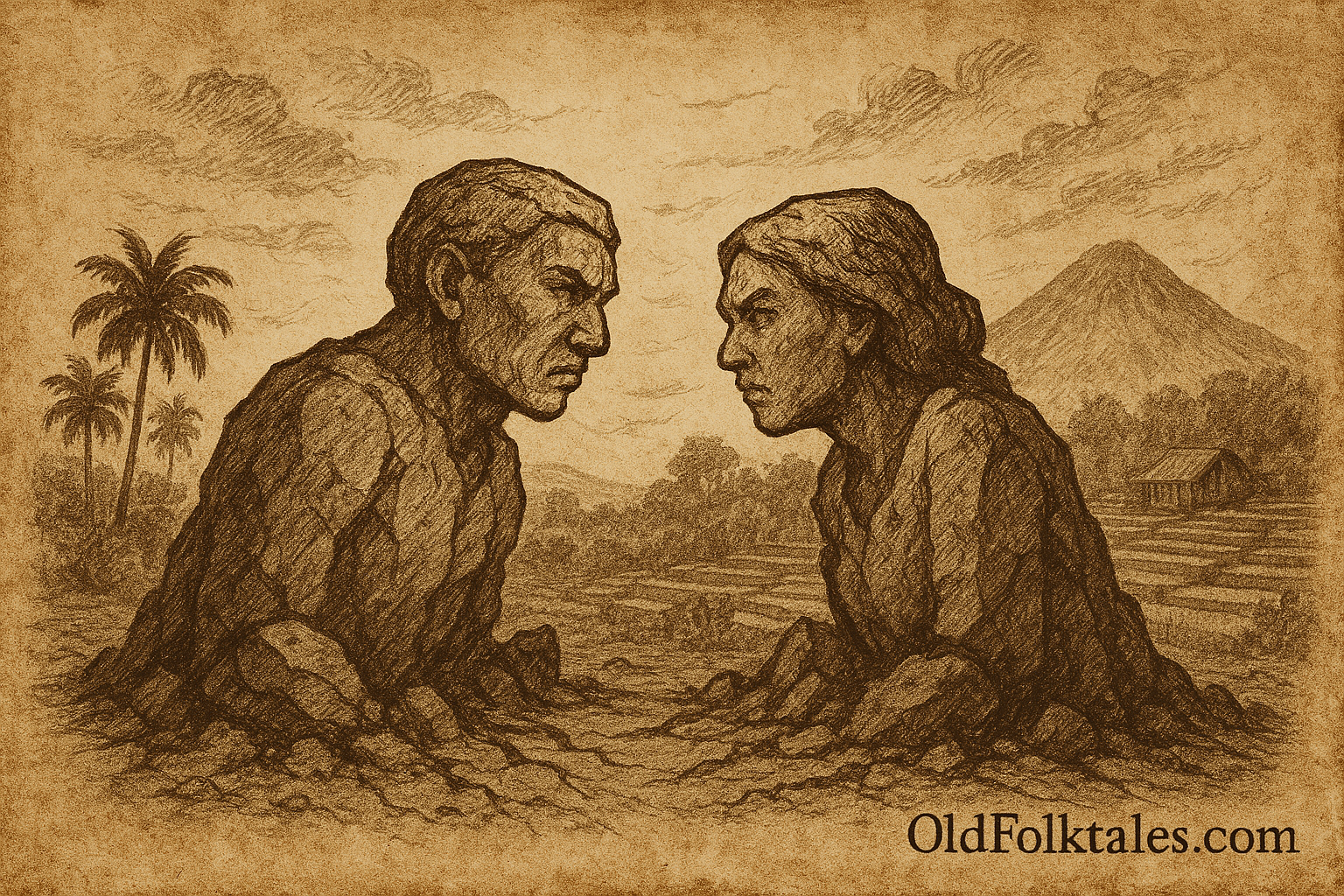
Their bodies hardened, transforming from flesh to rock. Within moments, where two siblings had stood in bitter argument, there now rose two massive stones, facing each other as if frozen in eternal dispute. The rocks were unlike any other formation in the region: rough, angular, and positioned so close together that they seemed to be in perpetual confrontation.
The old farmer discovered them at dawn. His grief was so profound that he died within the week, his heart broken by the loss of both his children and the destruction of his family’s harmony.
But the story does not end there. Villagers who passed the stones reported strange phenomena. During certain times of year, particularly when families gathered for harvest festivals or inheritance ceremonies, the stones would appear to move. They seemed to shift closer together, then apart, as if the siblings were still locked in their quarrel. Some claimed to hear sounds emanating from the rocks at night: angry whispers, bitter accusations, and occasionally, the sound of weeping.
The formation became known as Batu Bertangkup, the Clashing Stones. Parents would bring their children to see them, using the story as a powerful lesson. “See what becomes of those who let greed poison family love,” they would say. “See how the land itself punishes those who cannot honor their parents’ wishes and who turn sibling against sibling for material gain.”
To this day, the stones stand as silent witnesses to the terrible cost of greed and family discord. They remind all who see them that wealth means nothing if it destroys the bonds of kinship, and that the earth itself will react to injustice, preserving it as a warning for generations to come.
Click to read all Southeast Asian Folktales — featuring legends from Thailand, Indonesia, Vietnam, and the Philippines.
The Moral Lesson
This folktale serves as a powerful warning against allowing greed and materialism to destroy family bonds. It teaches that inheritance and wealth are far less important than maintaining harmony and respect within the family. The story emphasizes the Indonesian cultural values of honoring parental decisions, treating siblings with fairness, and recognizing that the land and ancestors watch over human behavior. When family members prioritize material gain over relationships, they risk not only their own destruction but also bring shame upon their family name.
Knowledge Check
Q1: Who are Bagus and Wulan in this Indonesian folktale?
A: Bagus and Wulan are siblings, the children of a prosperous farmer in Java. Bagus is the ambitious elder son who believes he deserves the majority of the inheritance, while Wulan is the younger daughter with a gentler spirit who accepts her father’s decision to divide the property equally.
Q2: What causes the conflict between the two siblings?
A: The conflict arises when their aging father decides to divide his inheritance equally between both children. Bagus, as the eldest son, expects to receive the larger portion by tradition and becomes enraged when his father chooses equal distribution. His greed and sense of entitlement lead him to quarrel bitterly with his sister.
Q3: What supernatural event occurs during their quarrel?
A: As their argument reaches its peak, the earth begins to tremble and both siblings’ bodies turn to stone. They are transformed into two massive rocks that stand facing each other in eternal confrontation, frozen at the moment of their dispute. This represents the land’s reaction to their injustice and broken family bonds.
Q4: What is Batu Bertangkup and what makes it unusual?
A: Batu Bertangkup, meaning “Clashing Stones,” is the name given to the rock formation created when the siblings turned to stone. The formation is unusual because the stones appear to move closer together and apart at certain times, particularly during family gatherings, and some villagers claim to hear angry whispers and weeping coming from the rocks.
Q5: What happens to the father after his children are turned to stone?
A: The old farmer discovers the stones at dawn and is so profoundly grief stricken by losing both his children and witnessing the destruction of his family’s harmony that he dies within a week, his heart broken by the tragedy that his inheritance decision inadvertently caused.
Q6: What cultural values does this folktale teach about family and inheritance in Indonesian society?
A: The tale emphasizes core Indonesian values including respecting parental decisions and wisdom, maintaining family harmony over material gain, treating siblings fairly regardless of birth order or gender, and recognizing that greed destroys relationships. It reflects the animistic belief that the land and ancestors actively watch over human behavior and will punish moral transgressions, especially those violating sacred family obligations.
Source: Adapted from Indonesian Legends and Folk Tales by Adèle de Leeuw.
Cultural Origin: Javanese tradition, Indonesia (Southeast Asia)