
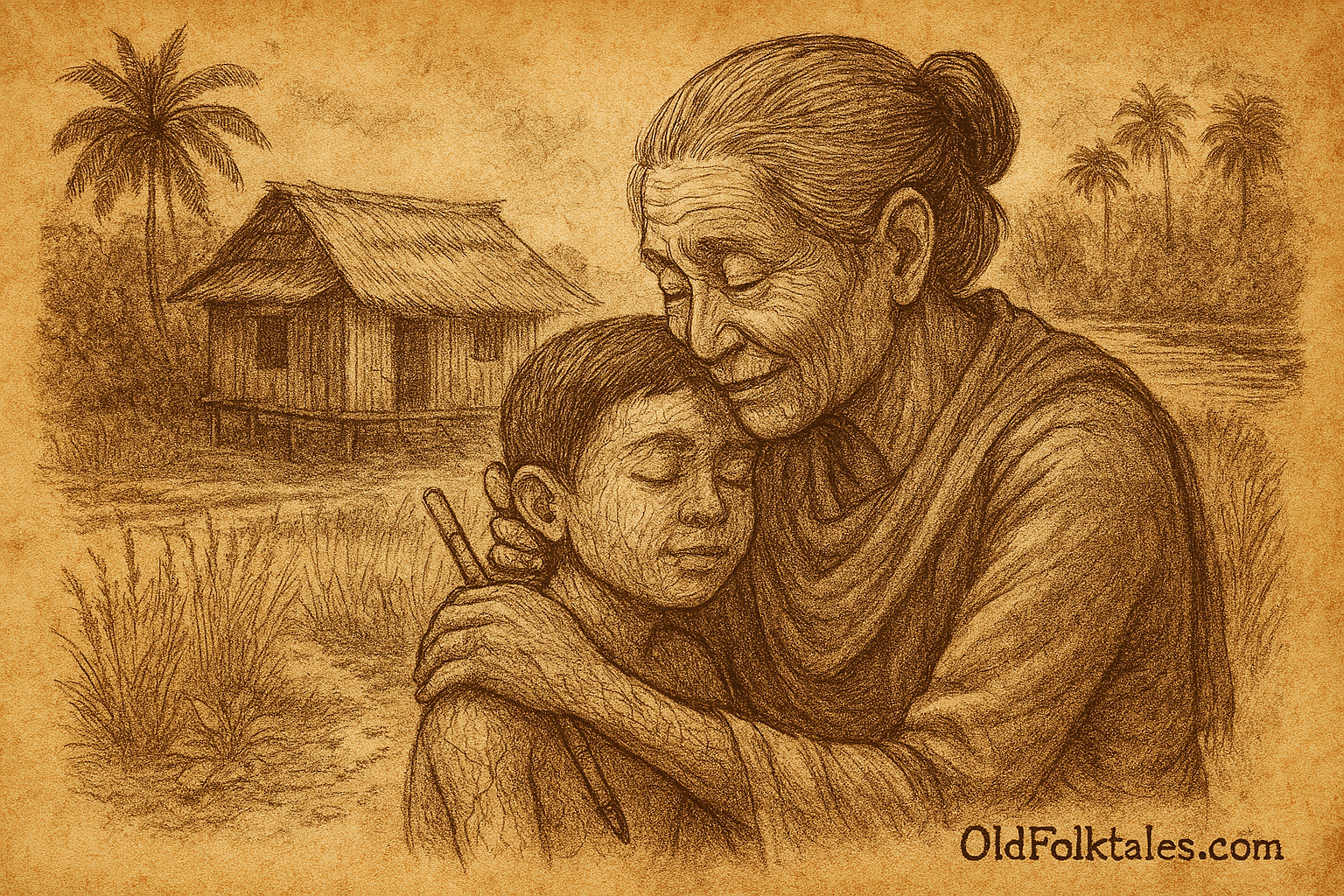
In the fertile province of Kampong Thom, where rice paddies stretched like emerald carpets beneath the Cambodian sun, there lived a widow whose heart carried the weight of profound loneliness. Her husband had departed this world years before, leaving her with empty rooms and silent evenings. The laughter of children playing in neighboring compounds only deepened the ache in her chest. She had no son to help tend the fields, no daughter to share her daily tasks, no young voice to fill the hollow spaces of her wooden home.
Each morning, the widow walked to the riverbank to gather clay for her pottery. Her hands weathered and wise, shaped bowls and jars that she would sell at the market. But one particular evening, as the golden light of sunset painted the sky in shades of orange and pink, something stirred within her heart. Instead of forming a practical vessel, her fingers began to mold the clay into the shape of a small boy.
Click to read all East Asian Folktales — including beloved stories from China, Japan, Korea, and Mongolia.
She worked with tender care, sculpting eyes that seemed ready to see, a mouth that looked poised to speak, and small hands that appeared capable of embracing. Every curve and contour received her attention, as if love itself could breathe life into the earth. When she finished, she placed the clay figure on a woven mat in the corner of her home, and before sleeping, she whispered a prayer to the spirits of her ancestors.
“If only you could be real,” she murmured, touching the clay boy’s smooth cheek. “If only I could hear you call me mother.”
That night, while the widow slept beneath her mosquito net and the moon climbed high above the palm trees, something miraculous occurred. A wandering spirit, touched by the widow’s loneliness and the purity of her love, drifted through the darkness and entered the clay form. The figure’s chest began to rise and fall with breath. Color bloomed across the earthen skin. And when the first rooster announced the dawn, the clay boy opened his eyes.
The widow awoke to the sound of movement in her home. Her heart seized with fear until she saw him, the clay boy, standing and stretching as though he had always been alive. Joy flooded through her like monsoon rains filling a dry riverbed. She rushed to embrace him, tears streaming down her weathered face.
“Mother,” the clay boy said, and the word was sweeter than any melody she had ever heard.
From that day forward, the widow’s life transformed completely. The clay boy proved to be a tireless worker, strong beyond what his small frame suggested. He labored in the rice fields from sunrise to sunset, his clay hands never tiring as he planted seedlings and pulled weeds. He carried water from the well, repaired the roof of their home, and brought his mother fish from the river. The widow’s fields flourished as they never had before, yielding grain so abundant that her neighbors whispered in amazement.
But not all hearts rejoiced at the widow’s good fortune. A wealthy farmer who owned vast stretches of land nearby grew bitter with jealousy. He watched the clay boy work with inhuman endurance and resented how the widow’s modest plot now rivaled his own harvests. His envy festered like an infected wound until he could bear it no longer.
One scorching afternoon, the jealous farmer confronted the clay boy in the field. His face was twisted with rage, his fists clenched tight.
“You’re nothing but clay and tricks!” he shouted, and before anyone could intervene, he struck the boy hard across the back.
A terrible crack echoed across the field. The widow, working nearby, screamed and ran toward her son. A fissure appeared in the clay boy’s body, spreading like lightning across his form. But instead of crumbling to lifeless earth, something wondrous happened.
Light poured from the crack, brilliant and pure as the sun itself. The clay shell fell away, and from within emerged a magnificent bird with feathers that shimmered gold and silver. Its wings spread wide, casting rainbow reflections across the rice paddies. The bird circled above the widow three times, its song filling the air with notes of such beauty that all who heard it wept.
Then the bird flew higher and higher, until it disappeared into the heavens. But where its shadow had passed over the widow’s fields, the rice grew taller and stronger. From that harvest onward, her land produced more abundantly than any in the province. The widow never wanted for anything again, and though she mourned the loss of her clay son, she understood that the spirit had blessed her with far more than she had ever dreamed possible.
The jealous farmer, witnessing the miracle, fell to his knees in shame. His own fields withered that season, teaching him the bitter price of envy.
Click to read all Southeast Asian Folktales — featuring legends from Thailand, Indonesia, Vietnam, and the Philippines.
The Moral Lesson
This Cambodian tale teaches us that pure love and kindness can work miracles, while jealousy and spite bring only ruin. The widow’s genuine devotion to her clay son, formed not from greed but from loneliness and maternal love, attracted divine blessing. When we act from authentic compassion rather than selfish desire, the universe responds with abundance. Meanwhile, those who strike out at others’ happiness from envy ultimately harm only themselves.
Knowledge Check
Q1: Who created the clay boy in this Cambodian folktale?
A: A lonely widow from Kampong Thom created the clay boy by molding him from river clay, shaping him with love and longing for a child to end her solitude.
Q2: How did the clay figure come to life?
A: A wandering spirit, moved by the widow’s loneliness and pure-hearted love, entered the clay form during the night, bringing it to life by morning.
Q3: What qualities did the clay boy possess?
A: The clay boy was an extraordinarily tireless and strong worker who helped his mother in the rice fields and brought prosperity to their household through his dedicated labor.
Q4: Why did the jealous farmer strike the clay boy?
A: The wealthy farmer grew envious seeing the widow’s modest fields flourish and rival his own vast holdings, and his jealousy drove him to attack the clay boy in rage.
Q5: What happened when the clay boy was struck?
A: The clay shell cracked open and released a magnificent shining bird with golden and silver feathers, which blessed the widow’s fields with eternal abundance before flying to the heavens.
Q6: What is the cultural significance of this Cambodian folktale?
A: This story from Kampong Thom reflects Cambodian values of maternal love, spiritual intervention, agricultural blessing, and the karmic consequences of jealousy versus compassion in rural Khmer culture.
Source: Adapted from Récits Populaires Khmers by François Bizot
Cultural Origin: Cambodia








