In the sun-baked deserts of Qatar, where golden dunes roll endlessly beneath the sky and the wind whispers across empty plains, the elders often told a tale to entertain children around the evening fire. It was the Story of the Gazelle, a Bedouin fable cherished across the Arabian Peninsula. The tale was simple yet profound: strength alone cannot guarantee survival; true power lies in intelligence, patience, and clear thinking.
Among the creatures of the desert, none were as admired as the gazelle. With slender legs, bright alert eyes, and swift movements, the gazelle was known not only for beauty but for cleverness. The Bedouin storytellers described it as an animal guided by ʿaql, sound reason and clear wit. But roaming those same sands was a very different kind of creature: the hyena or sometimes the wolf, depending on the version. This predator was large, powerful, and always hungry, yet hopelessly foolish.
Though their encounters varied from story to story, the lesson remained the same: the gazelle survived not by strength, but by intelligence.
The First Encounter: The Tug-of-War Trick
One day, a greedy hyena spotted the gazelle drinking at a small desert pool fed by underground springs. Its mouth watered as it imagined an effortless meal.
“Gazelle,” the hyena called out, puffing its chest, “today, I finally catch you. No more running!”
The gazelle lifted her head calmly. Her dark eyes sparkled, not with fear, but with a quiet understanding of the hyena’s nature.
“Oh mighty hyena,” she said, “perhaps you will catch me. But would it not be better to prove your strength first? Surely a hunter as powerful as you can win a simple tug-of-war.”
The hyena’s pride swelled. “Tug-of-war? Easy! I will drag you across the sand like a dry palm leaf.”
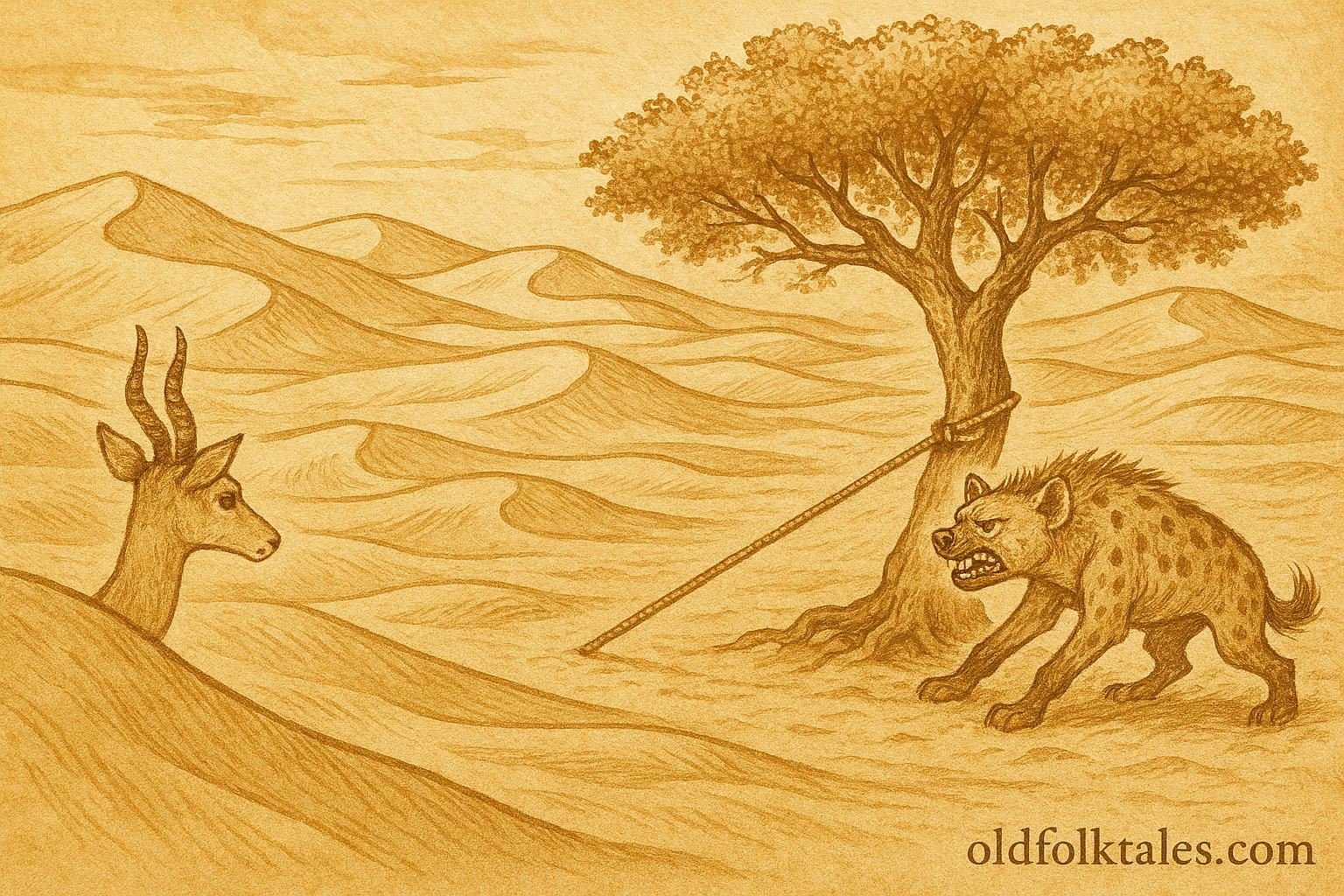
The gazelle nodded gracefully and led the hyena to a strong desert tree with deep roots gripping the ground. She handed the hyena one end of a thick rope and tied the other end around the trunk.
“I’ll pull from the other side,” she said. “When I shout, begin.”
The hyena clamped the rope in his jaws, muscles bulging. He waited impatiently for the signal.
“Pull!” the gazelle shouted from a distance.
The hyena threw all his weight backward. He pulled and pulled, claws digging furiously into the sand. But the tree did not budge. Its roots held firm, and the hyena believed the mighty resistance came from the gazelle herself.
“Ah! She is stronger than she looks!” he huffed, panting and sweating.
The gazelle watched from behind a dune, amused.
The hyena tugged until his mouth hurt, until his legs shook, until he collapsed in exhaustion.
By the time he realized the trick, the gazelle was already far away, leaving only hoofprints behind.
The Second Encounter: Fishing with the Tail
Days later, the hyena, more humiliated than ever, swore he would not fall for another trick. But hunger can cloud even the little judgment he possessed.
He found the gazelle resting beside a shallow wadi where cool water collected after a rare rainfall.
“This time,” he growled, “no games. I will catch you now.”
The gazelle appeared thoughtful, glancing into the clear water.
“Of course,” she said gently, “but wouldn’t you like an easy meal first? Look at all the fish below the surface. You could eat them now and save your energy.”
The hyena blinked. “Fish? How do I catch them?”
“My dear friend,” the gazelle replied, “you have the perfect tool, your tail! Sit by the water, dip your tail in, and be absolutely still. When the fish bite, pull them out!”
The idea seemed brilliant to the hyena.
He sat at the edge of the wadi and lowered his tail into the cold water. The gazelle encouraged him, saying, “Patience is key. Do not move at all.”
Hours passed. The desert night grew colder. The water chilled the hyena’s tail until it felt heavy and numb.
Still, he waited.
Still, the gazelle watched.
Finally, the hyena grew impatient. “I must have caught dozens!” he shouted proudly. He yanked his tail upward, but it remained submerged, frozen stiff in the cold water and held fast by the mud. The hyena howled as he pulled harder, only hurting himself.
The gazelle, already at a safe distance, called out gently, “Perhaps next time you will think before believing everything you hear.”
Wisdom in the Desert
In each retelling of the story, children laughed at the hyena’s foolishness and clapped when the gazelle escaped. But the elders always ended with a knowing smile. The desert, they said, is unforgiving. The clever survive; the reckless do not. Through these entertaining episodes, they instilled the value of ʿaql, clear thinking, cleverness, and the ability to outwit challenges, even when facing greater force.
The gazelle became a symbol of resilience, quick thinking, and the belief that wisdom can overcome brute strength. The hyena stood as a reminder that pride and greed blind the mind.
Moral of the Story
True strength lies not in muscle but in intelligence. In the vast deserts of Qatar, where danger hides in many forms, wise thinking ensures survival more than physical power ever could.
Knowledge Check
1. What is the central theme of the Gazelle story?
Intelligence and wit are more powerful than physical strength.
2. Which desert animal serves as the clever protagonist?
The gazelle, a symbol of quick thinking and graceful survival.
3. What trick did the gazelle play involving a tree?
She convinced the hyena to play tug-of-war with a tree, exhausting him.
4. Why did the hyena put his tail in the water?
The gazelle tricked him into “fishing” by dipping his tail into cold water.
5. What cultural lesson does the story emphasize in Bedouin tradition?
The importance of ʿaql—clear reasoning, over brute force.
6. From which region does this folktale originate?
The Arabian Peninsula, especially Qatari Bedouin storytelling traditions.
Source
Adapted from the Qatari animal fable “The Story of the Gazelle,” referenced in Qatar Tales: Folktales from the Arab Gulf by Emily Kipling and Qatar National Library archives.