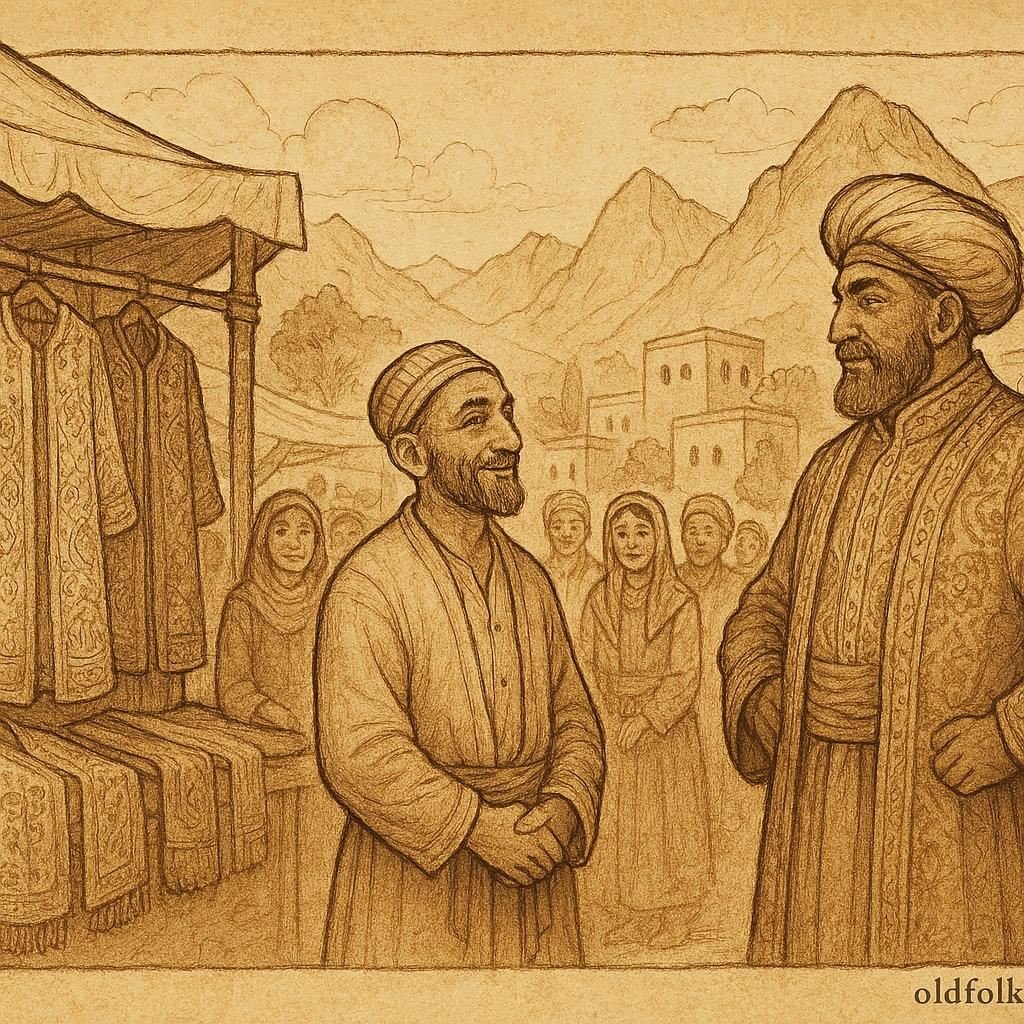
In a bustling mountain village of Tajikistan, where the call of merchants echoed through cobbled lanes and the scent of dye and spices filled the air, there lived a poor but skillful tailor. His shop was small, tucked between the stalls of a weaver and a pot seller, yet it was always bright with laughter. Though his clothes were modest, his hands were deft, and his heart honest.
One morning, a wealthy merchant entered the shop, draped in silks and gold rings that caught the morning sun. “Tailor,” he said grandly, “I need new robes, ten of them, made from the finest cloth. Make them swiftly, and I shall reward you well.”
Explore desert legends and palace tales in our Western Asian Folktales archive.
The tailor, though poor, took pride in his craft. “It shall be done,” he replied humbly, bowing his head. For weeks he worked from dawn until dusk, his needle dancing like a silver fish through the fabric. His wife brought him tea as the oil lamp flickered late into the night. At last, the robes were finished, rich garments fit for a king.
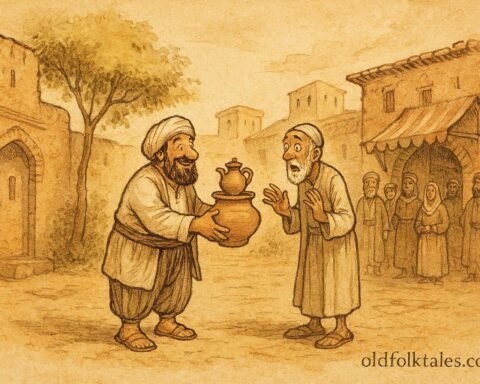
When the merchant returned, his eyes gleamed at the sight of them. “Excellent work,” he said smoothly. “You have done well.” But when the tailor asked for his payment, the merchant’s smile turned sly. “I will pay you later,” he said, pretending to search his purse. “Bring the robes to my house tomorrow, and I shall reward you properly.”
The tailor hesitated but agreed, trusting the man’s promise. The next day, he wrapped the robes carefully in clean cloth and carried them to the merchant’s grand house. The merchant took the bundle eagerly, then laughed. “Payment?” he said mockingly. “I owe you nothing. Be gone, fool, before I have you thrown out.”
The tailor’s face burned with anger and shame. Yet he did not shout or plead. He bowed quietly and walked away. But in his heart, a plan began to take shape, a plan as sharp as his needle.
The next week, the tailor appeared at the merchant’s shop with a bright smile. “Good sir,” he said cheerfully, “I am truly grateful for your business. The robes looked splendid on you. Because of your fine reputation, others wish for garments as grand. I now have a special order for the governor himself!”
The merchant’s greed flickered in his eyes. “Indeed?” he said. “The governor, you say?”
“Yes,” said the tailor smoothly. “He seeks a merchant who can provide gold-trimmed cloth and fine thread for his garments. I told him only one man in our town was worthy, you.”
Flattered, the merchant puffed his chest. “Then bring him to me! I will supply him with whatever he desires.”
That evening, the tailor went to the governor’s palace. Bowing deeply, he said, “My lord, the finest merchant in the region wishes to offer you exquisite fabrics for your new robes, at no charge until the work is complete.”
The governor smiled, impressed by such generosity. “Tell him to deliver the materials at once,” he said.
The next morning, the merchant loaded his servants with bolts of silk and gold thread and marched proudly to the palace. When he arrived, the governor’s attendants greeted him warmly. “Ah, the generous merchant!” they said. “You have come to provide the fabrics for His Excellency’s new robes?”
The merchant’s face paled. But before he could speak, the governor appeared. “You honor me,” he said. “Your tailor has praised your noble spirit.”
The merchant dared not protest. To do so would make him appear dishonest before the governor. He bowed low and handed over the costly materials, forcing a strained smile.
Days later, the tailor finished the governor’s robes, and they were magnificent. When he brought them to the palace, the governor paid him handsomely. The tailor accepted the payment, then bowed deeply. “My lord,” he said respectfully, “there is one matter more, the merchant who so generously offered these fine materials has not yet been paid for them.”
The governor nodded. “Indeed. Pay him double what he gave, for his kindness deserves reward.”
The tailor smiled quietly as the stunned merchant accepted the payment he had never intended to earn. The merchant could say nothing. His own deceit had been turned against him, and the tailor had gained both his rightful due and newfound respect from all in the town.
From that day forward, the merchant learned to keep his word, and the tailor’s little shop never lacked for work again.
Moral Lesson
This Tajik folktale teaches lessons on justice, wit, and the triumph of integrity over greed. The clever tailor shows that wisdom and calm thinking are stronger than deceit, proving that honesty and intelligence can restore balance when the powerful try to take advantage of the humble.
Knowledge Check
1. What is the main conflict in “The Clever Tailor”?
The story centers on the tailor’s struggle against a greedy merchant who tries to cheat him of payment.
2. How does the tailor outsmart the merchant?
He cleverly involves the governor, turning the merchant’s own greed into a trap that forces him to act honestly.
3. What qualities make the tailor admirable?
His intelligence, patience, and moral integrity make him a symbol of justice and self-respect.
4. What does the merchant represent in the story?
The merchant symbolizes greed, arrogance, and the belief that wealth can control others.
5. What is the core message of this Tajik folktale?
That cleverness and fairness can overcome deceit, and that honesty is a lasting strength.
6. What cultural values are reflected in the tale?
The story reflects Tajik values of humility, honor, fairness, and the respect earned through wisdom and honest work.
Source: Adapted from a traditional Tajik folktale, Silkroad Foundation’s Collection of Tajik Folk Tales.
Cultural Origin: Tajikistan