In the rolling hills and stone-lined paths of old Mount Lebanon, there lived a poor cobbler whose life was marked by long days, worn shoes, and the steady rhythm of a hammer against leather. Though his hands were rough and his clothes patched many times over, he harbored a gentle spirit, a patient heart, and an unwavering belief that honest work, no matter how humble, had its own quiet dignity.
Every coin he earned was spent with care. After many days of saving, he finally gathered enough coins to buy a fish from the market, hoping to enjoy a rare, hearty meal. He carried the fish home, grateful for even this small blessing.
As he cleaned it, his knife struck something hard inside the belly of the fish. At first, he thought it was a stone, but when he held it up to the window, the object glowed with a brilliant inner fire. It was a gem, large, dazzling, and clearly worth more than anything he had ever possessed.
The cobbler knew he should not hide such a find. With simple honesty, he wrapped the gem in cloth and went to the king’s jeweler, thinking the man would know how to value it. Perhaps he would even tell him how such a treasure came to be inside a fish.
The jeweler, however, was a man of greed. The moment he saw the gem, his eyes darkened with desire. He asked sharply, “Where did you get this?”
The cobbler answered truthfully, “I found it inside a fish I bought.”
But the jeweler refused to believe him. Instead, he hurried to the palace, presenting the gem to the king and claiming that the cobbler had stolen it. The king, trusting his jeweler, ordered the cobbler to be thrown into prison.
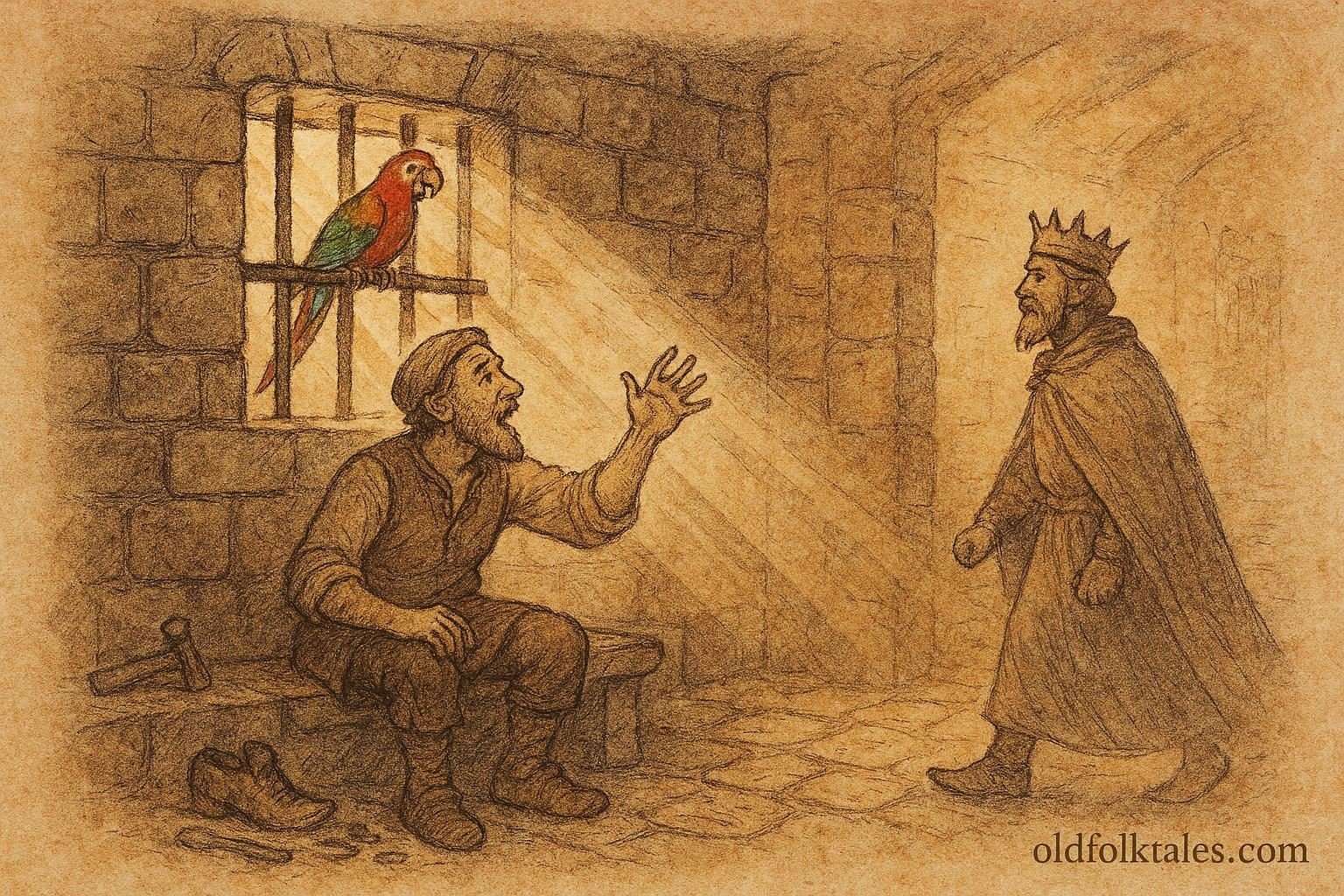
The cobbler obeyed without protest. Though frightened, he clung to his faith that truth would someday be revealed. In the dim, echoing chamber of the prison, his only companion was his loyal parrot, a bright, clever bird who had lived with him for years. The parrot accompanied him even there, perching on the narrow window ledge, listening to everything that happened within those cold stone walls.
Days passed, and the parrot observed the cobbler’s innocence and sorrow. With sharp eyes and a sharper mind, it pieced together what must have happened: the jeweler had lied. The bird knew the cobbler did not possess the cunning to steal such a gem. The truth, simple as it was, had been twisted by greed.
When news spread that the king would visit the prison to inspect conditions, the parrot prepared itself. As the king walked by the cells, the parrot fluttered toward him and cried out, “O King! O King! The jeweler lied! The gem was found in a fish! My master is innocent!”
The king stopped. Shocked, he turned to the guards. Everyone knew the cobbler’s parrot was unusually intelligent, but to hear it reveal such a secret was astonishing. The king demanded an investigation on the spot.
The jeweler was summoned, and under the weight of the king’s stern gaze, his deception began to unravel. Pressed with questions, he stuttered, contradicted himself, and finally broke down, confessing that he had falsely accused the cobbler in order to keep the gem for himself.
Enraged by this betrayal, the king ordered the jeweler’s execution, an act meant to purge corruption from his court. As for the cobbler, the king freed him immediately and invited him to the palace.
Moved by the cobbler’s honesty and impressed by his calm endurance even in suffering, the king rewarded him generously. He bestowed upon him fine clothes, land, and gold, things the cobbler had never imagined possessing. But most remarkable of all, the king appointed him as one of his personal advisors, believing that a man who valued truth above wealth was worthy of guiding others.
And so the humble cobbler, once wrongfully imprisoned, rose through righteousness to a place of honor, watched over proudly by the clever parrot who had spoken on his behalf.
Moral Lesson
Honesty, even when powerless, holds greater strength than all the schemes of the corrupt. Truth may be delayed, but it is never destroyed, and often, it is revealed through unexpected allies.
Knowledge Check
1. Who is the main character in “The Cobbler Who Became King’s Advisor”?
The main character is a humble Lebanese cobbler whose honesty guides the story’s events.
2. What symbolizes unexpected fortune in this Lebanese folktale?
The gem found inside the fish symbolizes unexpected blessings that come to the honest.
3. How does the cobbler prove his innocence in the story?
His loyal parrot reveals the truth to the king, exposing the jeweler’s lies.
4. What cultural value does the Lebanese folktale highlight?
The tale emphasizes honesty, humility, and trust in divine justice.
5. Why is the jeweler punished in the story?
He is executed because he falsely accused the cobbler to steal the gem.
6. What is the central moral of this Lebanese folktale?
Truth and integrity ultimately triumph over greed and falsehood.
Source
Adapted from the Lebanese folktale “The Cobbler Who Became King” in Folktales of Lebanon, collected by Anis Frayha (1953), American University of Beirut. Origin: Baabda, Mount Lebanon Governorate.