In the countryside of Cambodia, where rice paddies stretched like green mirrors toward distant purple mountains and small villages clustered along winding dirt roads, there lived a poor cowherd named Ratana. He owned nothing but the worn sampot tied around his waist, a bamboo staff weathered smooth by years of use, and a humble lean-to shelter at the edge of a wealthy landowner’s pasture. His life consisted of tending cattle that belonged to others, guiding them to graze in the morning and returning them safely each evening for a handful of rice and a few coins that barely sustained him.
Despite his poverty, Ratana possessed a gentle spirit and a generous heart. He spoke softly to the animals in his care, knowing each cow by name and temperament. He would share portions of his meager meals with stray dogs and wounded birds. The village children loved him because he never shooed them away when they wanted to watch the cattle, and he would tell them stories of celestial beings and ancient heroes while the afternoon sun painted long shadows across the fields.
Click to read all East Asian Folktales — including beloved stories from China, Japan, Korea, and Mongolia.
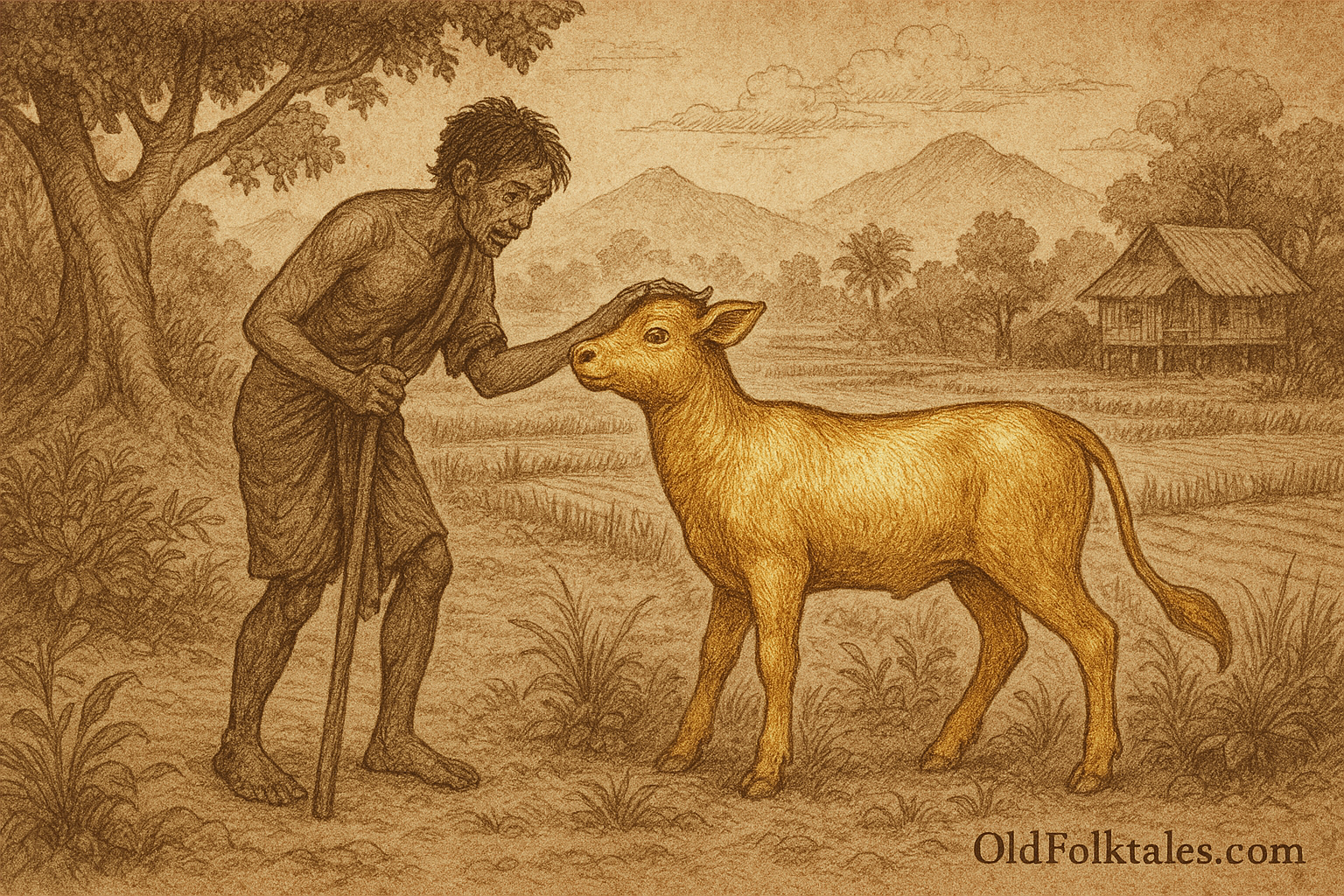
One morning, as monsoon clouds gathered on the horizon and the air hung heavy with the promise of rain, Ratana discovered something extraordinary in the pasture. Nestled in the tall grass near a sacred banyan tree stood a calf unlike any he had ever seen. Its hide gleamed with a lustrous golden color that seemed to capture and hold the morning light. Its eyes were deep and knowing, holding an intelligence that transcended ordinary animal awareness.
Ratana approached slowly, speaking in his usual gentle tones. “Little one, where did you come from? Are you lost?” The calf regarded him calmly, showing no fear, and when Ratana reached out to touch its shimmering coat, he felt warmth flow through his fingers like gentle sunlight.
No one in the village claimed ownership of the golden calf. The landowner insisted it must belong to Ratana, perhaps sent by his ancestors or the spirits as a reward for his kindness. “Care for it as you care for my herd,” the landowner said, his eyes gleaming with curiosity at the creature’s unusual appearance.
From the moment the golden calf entered Ratana’s life, his circumstances began to transform in subtle but remarkable ways. The cattle he tended grew healthier and fatter, producing more milk than they ever had before. The fields where he grazed them seemed to yield more nutritious grass. Even the weather appeared to cooperate, with rains coming at just the right times and the sun shining when sunshine was needed.
The landowner, pleased with the improved condition of his herd, began paying Ratana more generously. Neighbors started seeking Ratana’s advice about their own livestock, and they would press gifts of food and cloth into his hands in gratitude for his help. For the first time in his life, Ratana had enough to eat each day, with surplus to save and share with others less fortunate.
The golden calf grew alongside this prosperity, always staying close to Ratana, following him through the fields like a devoted companion. In the evenings, it would rest near his shelter, its golden hide glowing softly in the twilight like a small sun refusing to set completely. Ratana cared for the mysterious creature with the same tenderness he showed all living things, never questioning the source of his changed fortune but accepting it with humble gratitude.
Years passed peacefully in this manner. Ratana’s reputation as a skilled cowherd spread throughout the region. He was able to build a proper house to replace his lean-to, and he married a kind woman from a neighboring village. They had children who grew up playing beside the golden calf, treating it as part of their family. Ratana never forgot his years of poverty, and he remained generous to those who suffered the hardships he once knew.
But prosperity, like water flowing through cupped hands, can sometimes change the shape of a person’s character. As Ratana accumulated more wealth and comfort, a new thought began to take root in his mind like a weed in a well-tended garden.
One day, a traveling merchant passed through the village, his cart laden with expensive silks and precious ornaments from distant lands. The merchant saw the golden calf grazing near Ratana’s house and stopped abruptly, his eyes widening with avarice.
“That is a remarkable animal,” the merchant said, his voice smooth as oil. “I have traveled to many kingdoms and seen many wonders, but never a calf with such a coat. Surely it is worth a fortune. Have you considered selling it? I could make you a wealthy man, wealthier than any cowherd has a right to dream of being.”
The merchant’s words planted a poisonous seed in Ratana’s thoughts. That night, lying awake while his wife and children slept peacefully, he began to calculate. The golden calf had already brought him prosperity, true, but imagine what he could do with the vast sum the merchant had hinted at. He could buy land of his own, hire servants, perhaps even move to the capital city and live like a nobleman. His children could receive the finest education. His wife could wear silk every day.
The more he thought about it, the more reasonable it seemed. After all, he told himself, the calf was just an animal, however unusual. It had served its purpose in lifting him from poverty. Now it could serve one final purpose by making him truly rich. Surely that was the sensible thing to do.
Over the following days, Ratana’s treatment of the golden calf began to change in subtle ways. He stopped speaking to it with the same affection. He saw it now not as a companion but as a valuable commodity. He began to calculate its worth rather than appreciate its presence. When he looked at it, he no longer saw a mysterious blessing but a means to an end.
The golden calf seemed to sense this transformation. Its eyes, once trusting and warm, became sad and distant. It began to move more slowly, as if a light within it was dimming.
Finally, Ratana made his decision. He sent word to the merchant, agreeing to sell the golden calf for the enormous sum that had been offered. The merchant would arrive in three days to complete the transaction. Ratana said nothing to his wife or children, planning to surprise them with his newfound wealth.
But that very night, as Ratana drifted into sleep with visions of gold coins dancing in his mind, the golden calf stirred from its resting place near the house. It stood in the moonlight, its coat shimmering one last time with full brilliance, and then it simply walked away into the darkness, moving toward the sacred banyan tree where Ratana had first discovered it years before.
By the time it reached the ancient tree, the golden calf had become translucent, like morning mist touched by dawn light. It paused for a moment, looking back toward the sleeping village, and then it faded completely, dissolving into the air as if it had never existed at all.
When Ratana awoke the next morning and discovered the golden calf missing, panic seized his heart. He searched everywhere, calling desperately, enlisting his neighbors in a frantic hunt that lasted for days. But the miraculous creature had vanished without a trace, leaving not even hoofprints in the soft earth.
The merchant came as promised, but finding no golden calf to purchase, he departed with harsh words about wasted journeys and broken promises. And then, as if the calf had taken all good fortune with it when it departed, Ratana’s prosperity began to unravel.
His cattle sickened and produced less milk. The fields yielded ordinary grass. The weather turned unpredictable and difficult. His advice no longer seemed to help neighbors with their livestock, and the gifts they had given stopped coming. Within a year, Ratana found himself nearly as poor as he had been before the golden calf appeared, though now he had a family to support and memories of better times to haunt him.
He understood too late what he had lost. The golden calf had not been merely an animal or even just a magical benefactor. It had been a test and a blessing combined, one that required him to maintain the same pure heart that had attracted it in the first place. His greed had broken an invisible bond, and once broken, it could not be restored.
Ratana lived the rest of his days with this knowledge heavy in his heart. He returned to honest work as a cowherd, treating the ordinary cattle with the same gentleness he had once shown the golden calf. He told his children the story of what he had lost and why, hoping they would learn from his mistake what he had learned too late.
And sometimes, in the early morning mist, he would walk to the sacred banyan tree and stand there quietly, hoping for a glimpse of golden light among the shadows. But the miraculous calf never returned, for blessings given to the pure of heart cannot be recalled once greed has entered and claimed that space.
Click to read all Southeast Asian Folktales — featuring legends from Thailand, Indonesia, Vietnam, and the Philippines.
The Moral Lesson
This tale teaches that blessings and good fortune are tied not just to actions but to the moral character and intentions behind them. When we receive gifts through our virtue, maintaining that virtue is essential to keeping what we have been given. Greed transforms blessings into commodities and sacred relationships into transactions, destroying the very foundation upon which prosperity was built. The story warns that attempting to exploit or profit excessively from gifts given freely will cause those gifts to vanish, for true abundance flows only to those who value spiritual wealth above material gain.
Knowledge Check
Q1: Who was Ratana and what was his life like before finding the golden calf?
A1: Ratana was a poor cowherd in rural Cambodia who owned almost nothing, living in a humble lean-to shelter and tending cattle for a wealthy landowner in exchange for minimal payment. Despite his poverty, he possessed a gentle spirit, treated animals with kindness, was generous with what little he had, and was beloved by village children for his storytelling.
Q2: How did the golden calf change Ratana’s circumstances?
A2: The golden calf brought prosperity in natural ways: the cattle Ratana tended became healthier and more productive, fields yielded better grass, weather cooperated perfectly, and the landowner paid him more generously. Neighbors sought his advice and gave him gifts, allowing him to build a proper house, marry, start a family, and escape poverty while maintaining his generous character.
Q3: What temptation did the traveling merchant present to Ratana?
A3: The merchant recognized the golden calf’s extraordinary value and offered Ratana an enormous sum of money to purchase it, far more than any cowherd could normally earn. This temptation planted thoughts of greater wealth in Ratana’s mind, making him see the calf not as a blessing or companion but as a valuable commodity he could sell to become truly wealthy.
Q4: How did Ratana’s attitude toward the golden calf change after meeting the merchant?
A4: Ratana’s relationship with the golden calf transformed from affectionate companionship to calculating ownership. He stopped speaking to it with the same kindness, began viewing it as a means to wealth rather than a blessing, and saw it as a commodity to be sold rather than a mysterious gift to be treasured. His heart changed from gratitude to greed.
Q5: What happened when Ratana decided to sell the golden calf?
A5: The night after Ratana agreed to sell the calf, the creature sensed the betrayal and walked away to the sacred banyan tree where Ratana had first found it. There, it became translucent and dissolved into the air, vanishing completely. When Ratana discovered it missing, all his prosperity began to unravel, and he returned nearly to his original state of poverty.
Q6: What does the golden calf symbolize in Cambodian folklore?
A6: The golden calf symbolizes blessings that are given to those with pure hearts and moral virtue. It represents the principle that spiritual gifts require continued worthiness to maintain, and that prosperity rooted in goodness will vanish when greed replaces gratitude. The creature embodies the Buddhist and Hindu concept that material blessings are tied to moral behavior and right intentions.
Source: Adapted from traditional Cambodian folklore and Southeast Asian moral tales documented in “Cambodian Folk Stories” by Muriel Paskin Carrison and “Buddhist Moral Tales from Southeast Asia” compiled in “Jataka Tales and Cambodian Folklore” by the Buddhist Institute of Phnom Penh.
Cultural Origin: Khmer Folk Tradition, Rural Cambodia