In a small village surrounded by snow-covered mountains, there once lived a humble man named Yohei. He was kind and hardworking but very poor. Each day, he gathered firewood in the forest and sold it at the market to buy food. Though his house was small and lonely, his heart was gentle and full of compassion for all living creatures.
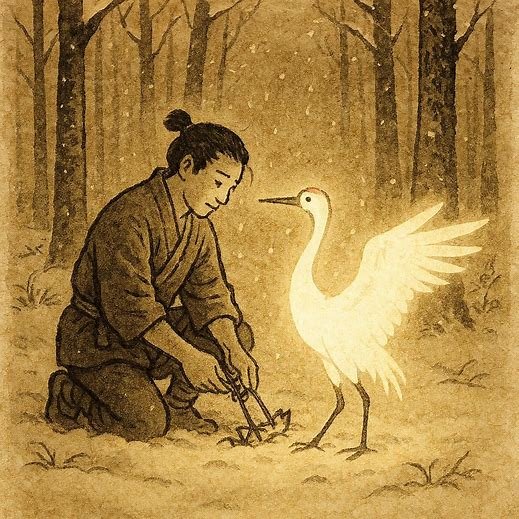
One cold winter evening, as Yohei was returning home through the quiet fields, he heard a faint cry in the wind. He stopped and listened carefully. The sound came again a weak, trembling cry, like a child in distress. Following the sound, he soon discovered a beautiful white crane caught in a hunter’s trap. Its wings fluttered helplessly, and its feathers were stained with snow and pain.
“Oh, poor creature,” Yohei said softly, kneeling beside it. “You do not belong in such suffering.” He gently opened the trap and freed the bird. The crane looked at him with shining eyes, as if to thank him. Then it spread its great wings and flew into the sky, disappearing beyond the clouds.
Yohei watched until the bird vanished completely. “Be safe, little one,” he whispered. Though his fingers were frozen, his heart felt warm.
That night, as the snow fell thicker and the wind howled through the mountains, Yohei sat alone by his small fire. Suddenly, he heard a knock on his door. Surprised, he opened it to find a young woman, beautiful and graceful, standing in the snow. She was dressed in simple white robes, her hair glistening like frost.
“Forgive me,” she said softly. “I have lost my way in the storm. May I rest in your home tonight?”
Yohei nodded at once. “Please come in, kind lady. You must be freezing.” He gave her the warmest seat by the fire and shared what little food he had. The young woman smiled gratefully.
From that night onward, she stayed with him, helping with chores and weaving cloth to sell at the market. Slowly, Yohei’s life changed. His home felt alive again, filled with warmth and laughter. The two grew close, and in time, the woman became his wife.
One day, she said gently, “Dear husband, I wish to weave a special cloth, one unlike any seen before. But I must ask one thing. While I weave, promise that you will not look inside the room. No matter what you hear or how long it takes, you must not look.”
Yohei was puzzled but agreed. “I will not look. You have my word.”
The woman smiled softly and went into the weaving room. For three days and nights, the sound of the loom filled the house. The rhythm was steady, yet at times weak, as though she were struggling. Yohei waited patiently, but his heart grew uneasy.
At last, unable to resist, he quietly slid open the door and peeked inside. What he saw made him gasp. There was no woman at the loom , only the white crane he had once rescued. The bird plucked its own feathers one by one and wove them into shimmering cloth. Its wings drooped in pain, but it continued weaving with pure devotion.
Yohei cried out in shock. “My beloved, what are you doing?”
The crane turned her head slowly. Her eyes were sad but full of love. “You broke your promise,” she said gently. “I am the crane you saved from the trap. I came to repay your kindness. But now that you know my true form, I can no longer stay in this world.”
She folded the finished cloth carefully and placed it in his hands. “This is my gift to you. It will bring you wealth and comfort. But remember me with kindness, not sorrow.”
Before Yohei could speak, the crane spread her white wings. Light surrounded her, and she rose into the sky, her figure fading into the falling snow.
Yohei wept as he watched her vanish beyond the clouds. He kept the beautiful cloth, selling it for a great fortune, but his heart remained heavy. Though his house became rich, it never felt warm again. Every time he heard the cry of cranes in the distance, he looked to the sky and whispered her name, remembering the love and gratitude that once filled his home.
Explore timeless legends from China, Japan, and Korea in our East Asian Folktales collection.
Moral Lesson
The Grateful Crane teaches that kindness returns to those who give it freely, but curiosity and broken trust can lead to loss. True love and gratitude live in acts of selflessness.
Knowledge Check
1. What kind act did Yohei perform at the beginning of the story?
He rescued a white crane that had been trapped by a hunter.
2. Who appeared at Yohei’s door after the rescue?
A beautiful young woman who sought shelter from the snowstorm.
3. What did the woman ask Yohei before she began weaving?
She asked him not to look into the room while she was weaving.
4. What did Yohei see when he broke his promise?
He saw the white crane weaving cloth using her own feathers.
5. Why did the woman have to leave?
Because Yohei broke his promise, revealing her true identity as a crane.
6. What is the main moral of the story?
Kindness brings blessings, but broken trust can destroy what love builds.
Source:
Adapted from “Tsuru no Ongaeshi” (The Grateful Crane), a traditional Japanese folktale preserved through oral storytelling and Edo-period collections such as Nihon Mukashibanashi.
Cultural Origin: Japan (Edo-era folklore)