In the northern reaches of Thailand, where the Nan River winds through verdant valleys and ancient forests, there once stood a modest temple called Wat Khao Noi. The temple sat on a gentle hill overlooking a particularly wide bend in the river, where the waters ran deep and dark, their currents slow and mysterious. It was here, in this peaceful sanctuary surrounded by the sounds of flowing water and rustling bamboo, that a monk named Phra Somchai devoted his life to meditation, prayer, and the teachings of the Buddha.
Phra Somchai was known throughout Nan Province for his gentle spirit and profound compassion. His face, weathered by years of sun and contemplation, always bore a serene smile. The villagers spoke of how he would sit for hours beneath the sala by the riverbank, his saffron robes bright against the green landscape, watching the water flow past as he chanted his sutras. But what made Phra Somchai truly remarkable was not his devotion alone it was his unlikely friendship with a creature most people feared.
Click to read all East Asian Folktales — including beloved stories from China, Japan, Korea, and Mongolia.
Deep in the river bend below the temple lived an ancient crocodile. The creature was enormous, its scales dark as river mud and scarred from decades of survival. Local fishermen had known of this crocodile for generations, calling it “Grandfather Crocodile” or simply “the Old One.” Most people gave the creature a wide berth, warning their children to stay away from that particular stretch of the river. The crocodile had lived there longer than anyone could remember, a silent guardian of the deep waters.
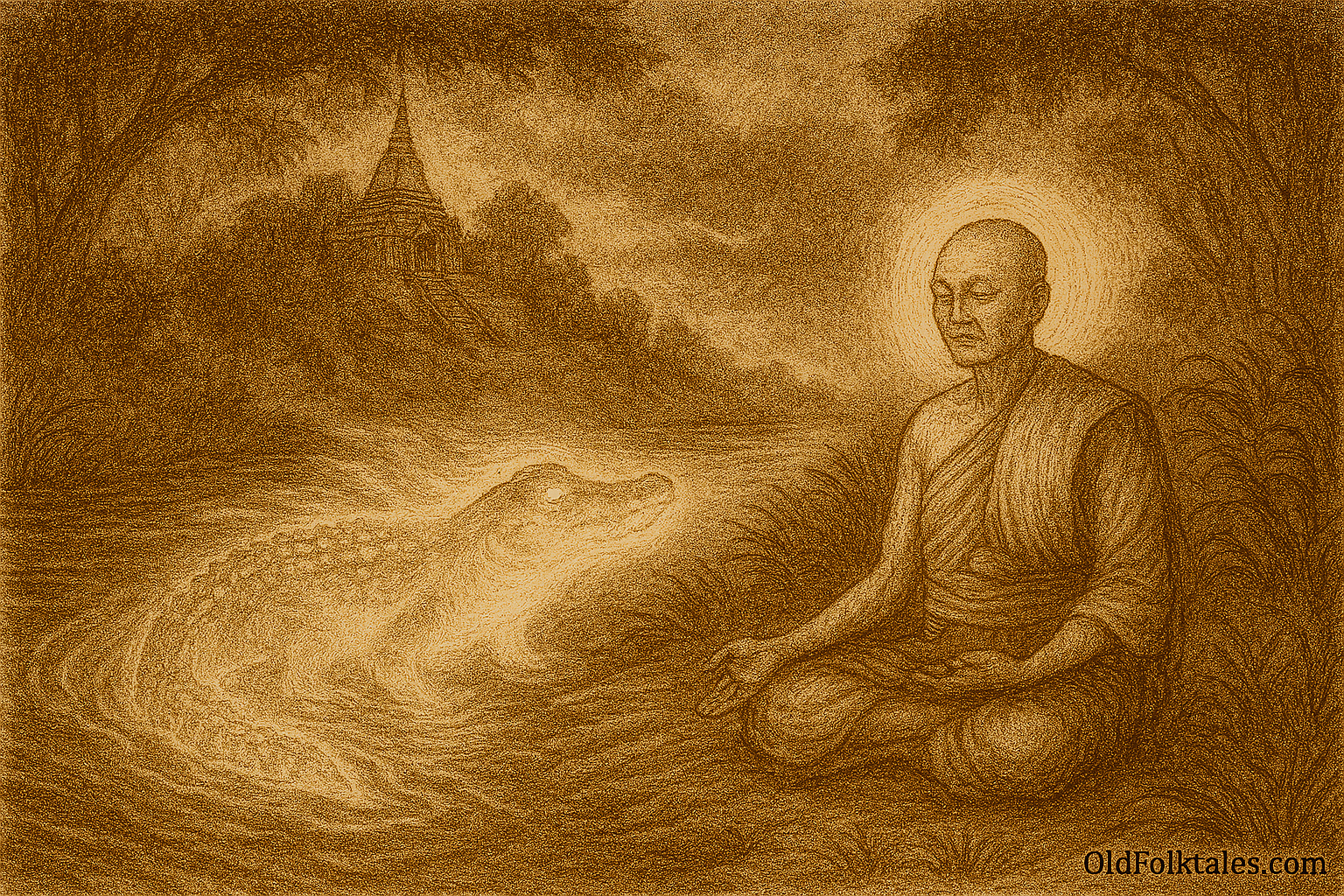
But Phra Somchai saw something in the ancient reptile that others did not a kindred spirit, another old soul inhabiting the banks of the Nan River. Each morning after his dawn prayers, the monk would walk down to the water’s edge carrying a small basket. He would sit on the smooth river stones and speak softly to the crocodile, sharing bits of fish and fruit while reciting verses from the Dhamma. At first, the creature merely watched from a distance, its eyes breaking the surface like dark stones. But gradually, over months and years, trust grew between them.
The crocodile began to approach when Phra Somchai arrived, swimming slowly to the shallows where the monk sat. Sometimes it would rest its massive head on the bank near the monk’s feet, closing its eyes as Phra Somchai’s gentle voice washed over it like a blessing. The villagers were astonished to witness this impossible friendship a holy man and a fearsome predator, sitting together in perfect harmony as the river flowed past.
“The Buddha teaches us that all beings have Buddha-nature,” Phra Somchai would explain to curious visitors. “Even this ancient one, who has lived so long in these waters, deserves compassion and kindness. He guards this river bend, keeping the currents safe for those who respect him.”
Indeed, it seemed the crocodile did guard that stretch of water. In the years of Phra Somchai’s friendship with the creature, no children drowned there, no boats capsized, no fishing accidents occurred. The villagers came to believe that the Old One watched over them, just as Phra Somchai watched over their souls.
But darkness has a way of finding even the most peaceful places.
One dry season, when the river ran lower than usual, three poachers came from a distant province. They had heard rumors of a massive crocodile in the Nan River a creature whose hide and teeth would fetch a fortune in illegal markets. They cared nothing for the warnings of local villagers or the sacred friendship between monk and beast. Greed had hardened their hearts.
The poachers came at night, setting their traps in the shallows where the crocodile often rested. They used steel cables and barbed hooks, vicious instruments designed to cause maximum suffering. When the ancient crocodile approached its usual resting place in the pre-dawn darkness, the trap sprang closed with terrible efficiency.
The creature’s roar of pain and rage echoed across the valley, waking villagers from their sleep and bringing Phra Somchai running from his meditation. By the time the monk reached the riverbank, the poachers had already done their cruel work. The ancient crocodile lay dying on the muddy bank, its lifeblood staining the water red as the rising sun painted the sky in shades of gold and crimson.
Phra Somchai fell to his knees beside his old friend, tears streaming down his weathered face. He placed his hands gently on the creature’s scarred head, feeling the fading warmth of its life. The crocodile’s ancient eyes, dimming now, fixed on the monk’s face one final time a gaze filled with what Phra Somchai could only describe as understanding and farewell.
“Forgive them,” the monk whispered, his voice breaking. “Forgive them, old friend, for they know not what they do. Go now in peace. May you find your way to a better rebirth.”
The crocodile released one final breath, and then was still.
The villagers captured the poachers and brought them to justice, but Phra Somchai’s grief was inconsolable. For seven days and seven nights, he sat by the river’s edge, neither eating nor sleeping, engaged in the deepest meditation and prayer he had ever attempted. He chanted the sutras that guide spirits through the bardos, the transitional states between death and rebirth. He made offerings of incense and flowers. He called upon the compassion of the Buddha to hear his desperate plea.
“Let this noble being continue to serve,” Phra Somchai prayed. “Let its spirit remain to guard these waters, to protect the innocent, to continue the good work it began in life. Let compassion transform death into eternal guardianship.”
On the eighth morning, as the first light of dawn touched the river’s surface, something extraordinary happened. A soft, ethereal glow began to emanate from the deep waters of the river bend. The light was gentle, like moonlight through mist, and it took the unmistakable shape of a great crocodile swimming just beneath the surface. The phantom creature glowed with a phosphorescent blue-green light, beautiful and otherworldly.
Phra Somchai stood at the water’s edge, his eyes wide with wonder and gratitude. The spirit crocodile swam in slow circles near the bank, then raised its glowing head above the water. For a moment, monk and spirit gazed at one another, and Phra Somchai felt a wave of peace and purpose wash over him. The ancient one had returned, not in flesh but in spirit, to continue its guardianship of the Nan River.
From that day forward, the phantom crocodile appeared regularly in the river bend below Wat Khao Noi. Its manifestation followed a pattern that the villagers came to recognize and respect whenever children played too close to the deep waters, whenever someone ventured carelessly into dangerous currents, the glowing spirit would appear, its luminous form clearly visible even in daylight when the conditions were right.
Children who saw it would stop in their tracks, backing away from the water’s edge in awe rather than fear. The phantom never threatened or chased, it simply appeared as a reminder, a warning, a gentle guardian nudging the vulnerable away from harm. At night, fishermen claimed the entire river bend would sometimes glow with a faint, ethereal light when the spirit was near a beacon of protection that reminded them of the sacred friendship between Phra Somchai and the ancient crocodile.
Years passed, and eventually Phra Somchai himself passed into the next life, dying peacefully in his sleep at a great age. The villagers said that on the night he died, the river glowed brighter than it ever had before, as if the spirit crocodile was paying tribute to its old friend. Some even claimed to see two glowing forms in the water that night one reptilian and one human swimming together in the depths before fading into the eternal flow of the river.
To this day, people in Nan Province speak of the phantom crocodile that guards the river bend below the old temple. Fishermen still see the mysterious glow on certain nights, and children are still taught to respect the waters where the spirit dwells. The story of Phra Somchai and his unlikely friend has become a cherished part of local folklore, a testament to the Buddhist principles of compassion, interconnectedness, and the belief that pure intention can transform even death into something beautiful and protective.
The temple of Wat Khao Noi still stands on its hill, though it has been rebuilt and expanded over the years. Monks continue to tend the shrine by the riverbank where Phra Somchai once sat with his ancient friend, and visitors leave offerings their flowers, incense, and small tokens of respect for the bond between monk and crocodile that transcended the boundaries between species and even between life and death.
Click to read all Southeast Asian Folktales — featuring legends from Thailand, Indonesia, Vietnam, and the Philippines.
The Moral Lesson
This profound tale teaches us that compassion knows no boundaries and can exist between the most unlikely companions. Phra Somchai’s genuine love and respect for a creature others feared demonstrates that all beings deserve kindness, regardless of their nature or appearance. The story also illustrates the Buddhist belief in the power of prayer, pure intention, and the interconnectedness of all life. When we act with true compassion, we create ripples that extend far beyond our own lives, transforming even death into continued service and protection for others. The phantom crocodile reminds us that love and devotion can transcend mortality, and that those who dedicate themselves to protecting others may continue their guardianship in forms we might never expect.
Knowledge Check
Q1: Who was Phra Somchai in the Thai legend of the Crocodile Monk? A: Phra Somchai was a Buddhist monk at Wat Khao Noi temple in Nan Province, Thailand, known for his profound compassion and his extraordinary friendship with an ancient crocodile. He demonstrated Buddhist principles of loving-kindness toward all beings by befriending and caring for a creature most people feared.
Q2: What role did the ancient crocodile play in the Nan River community? A: The crocodile, known as “Grandfather Crocodile” or “the Old One,” served as a guardian of the river bend. During its life and friendship with Phra Somchai, no accidents occurred in those waters no children drowned, no boats capsized. The creature protected the local community through its presence.
Q3: How did the crocodile die in the Thai Buddhist legend? A: The ancient crocodile was killed by three poachers from a distant province who set steel traps with barbed hooks to capture the creature for its valuable hide and teeth. Despite the warnings of local villagers about the sacred friendship between the monk and the crocodile, greed drove the poachers to commit this cruel act.
Q4: What Buddhist practice did Phra Somchai perform after the crocodile’s death? A: Phra Somchai meditated and prayed continuously for seven days and seven nights without eating or sleeping. He chanted sutras to guide the crocodile’s spirit through the bardos (transitional states after death) and made offerings while calling upon Buddha’s compassion to allow the spirit to continue its protective work.
Q5: How does the phantom crocodile protect people in Nan River today? A: The glowing spirit crocodile appears whenever children play too close to dangerous deep waters or when someone ventures carelessly into hazardous currents. Its luminous form serves as a gentle warning, causing people to back away from danger. The spirit never threatens it simply appears as a protective guardian.
Q6: What does the glowing river symbolize in Thai folklore and Buddhist tradition? A: The glowing river represents the transformation of death into eternal service through the power of compassion and prayer. It symbolizes Buddhist beliefs about the interconnectedness of all beings, the continuation of spiritual purpose beyond physical death, and how pure intentions can create lasting protection and blessings for a community.
Cultural Origin: Northern Thailand