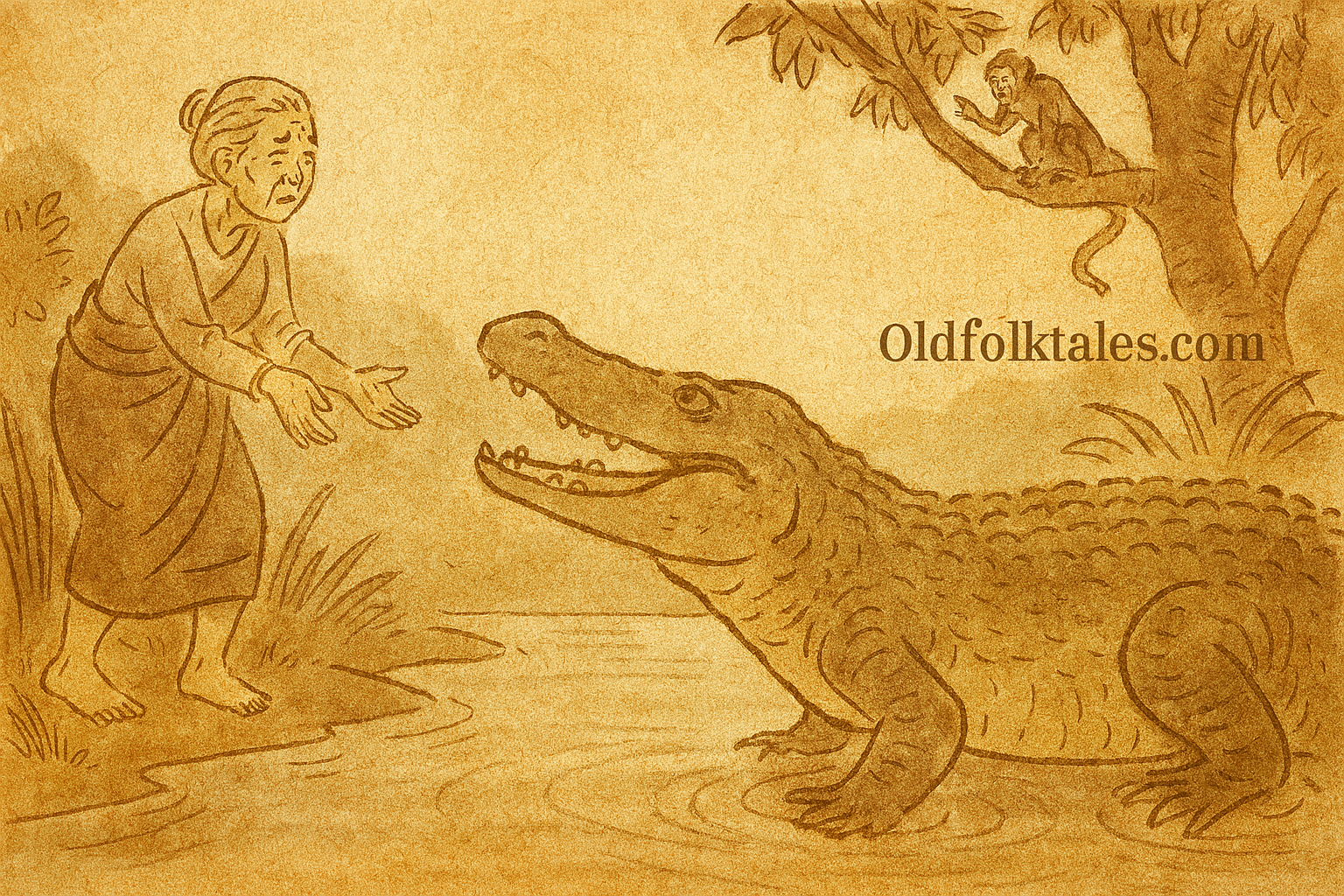
In a village tucked along the riverbanks of East Timor, where the water flowed swift and cool between jungle-clad hills, there lived an old woman who made her daily journey to fetch water for her household. Her life followed the familiar rhythms known to all village women rising with the sun, tending her small garden, preparing simple meals, and walking the worn path to the river’s edge each day with her water vessel balanced carefully in her weathered hands.
One particular morning, as she made her way down the dusty trail toward the river, she passed another old woman returning from the same destination, water vessel full and balanced upon her head. They nodded to each other in the customary greeting of neighbors, and the first old woman continued on her path.
Click to read all Southeast Asian Folktales — featuring legends from Thailand, Indonesia, Vietnam, and the Philippines.
When she arrived at the familiar spot along the riverbank where the water ran clear and the stones provided steady footing, she bent down low, preparing to dip her vessel into the flowing current. But as she leaned forward, something caught her eye, a tiny movement in the shallow water near the bank.
There, nestled among the smooth river stones and swaying water plants, was a little crocodile. It was very small, barely larger than her hand, with bright eyes that seemed to watch her with curious intelligence. The old woman stared intently at the creature, her heart unexpectedly stirred by its helpless appearance. It seemed so vulnerable, so alone in the vast river.
Without thinking of consequence or danger, moved purely by compassion, the old woman reached down and gently lifted the little crocodile into her arms. She cradled it carefully against her chest, feeling its cool scales and the slight movements of its tiny body. “I will take care of you,” she whispered softly.
She brought the little crocodile home to her dwelling and began to foster it as though it were her own child. Each day she fed it scraps of fish and meat, gave it water to drink, and watched over it with tender devotion. The crocodile grew accustomed to her presence and seemed content in her care.
Days turned to weeks, weeks to months, and months to years. The little crocodile that had once fit in the palm of her hand grew larger and larger. Its body lengthened and thickened, its jaws became powerful, its tail grew strong and muscular. But the old woman’s affection never wavered, she had raised this creature from infancy, and her heart remained stubbornly attached to it, blind to the dangerous reality of what it had become.
One day, the old woman took up her water vessel once more, for she needed to draw water from the river. As she set out along the familiar path, she was not alone. The crocodile, now fully grown and massive, followed behind her. It had grown fond of the river visits and moved with surprising grace despite its considerable size, its heavy body swaying as it walked, its clawed feet gripping the earth.
When the old woman arrived at the riverbank, she glanced back over her shoulder and noticed her crocodile companion following close behind. Her heart swelled with an emotion that was part pride, part affection, and perhaps part foolishness. She watched as the great crocodile approached the water’s edge.
Without hesitation, the crocodile slipped into the river. Its powerful tail propelled it forward, and it swam toward the middle of the river where the current ran strongest and the water grew deep and dark. The old woman stood on the bank, her water vessel forgotten at her feet. Suddenly, a terrible fear gripped her heart. Something felt wrong. The distance between them seemed to pulse with danger she had never acknowledged before.
“Come along, that we may go home!” she called out across the water, her voice trembling slightly.
The crocodile did not answer. It continued swimming, its snout barely visible above the rippling surface.
“Come along!” she called again, more urgently this time. “We must return home!”
Still the crocodile remained silent, circling slowly in the deeper water.
A third time she called, her voice now edged with desperation: “Please, come back to me! Let us go home together!”
This time, the crocodile responded. Its voice came low and rumbling across the water: “Come hither.”
The old woman, so awfully attached to the creature she had raised, so blinded by years of affection and care, began to wade into the river. The water rose around her ankles, then her calves, cold and pulling at her sarong. She moved forward, drawn by love and loyalty toward the creature that had become the focus of her devotion.
“Look here,” the crocodile called again, its voice strangely calm. “Draw nearer again.”
The old woman continued forward, the water now reaching her knees. She was willing, so willing, to draw nearer, to go to her beloved crocodile despite the danger that any reasonable person would have recognized.
But suddenly, a sharp voice rang out from the trees along the riverbank. It was a monkey, perched in the branches above, who had witnessed this entire scene with growing alarm.
“Why, old mother!” the monkey called out sharply. “Are you crazy that you want to enter into the crocodile’s place? Maybe you like to live unconcernedly in intimate contact with the crocodile, but even if you are awfully attached to him, he is not like a man! He is a wild creature of the river, and you are placing yourself in mortal danger! You had better come up to the dry land before it’s too late!”
The monkey’s words cut through the fog of the old woman’s attachment like a sharp knife through silk. For the first time, she truly saw the situation for what it was. She was standing waist-deep in a river, approaching a massive crocodile, a predator whose nature was to hunt and kill, regardless of who had raised it. Her love had blinded her to the terrible truth, but the monkey’s wisdom had opened her eyes.
The old woman turned and began struggling back toward the shore, her movements urgent now, her heart pounding with the realization of how close she had come to death.
The crocodile, angered by the monkey’s interference and the loss of its prey, turned its attention toward the creature who had ruined its plans. With terrible speed, it lunged from the water and seized the monkey’s leg in its powerful jaws as the creature jumped between branches near the water’s edge.
The monkey, feeling the crocodile’s grip tighten on his leg, did not panic. Instead, with quick wit born of desperation, he called out mockingly: “Why, dear friend! Do you think you have gripped my leg? It will be a real shame for you, because you are very stupid! You have taken hold of nothing but the root of a tree! Can you not tell the difference between living flesh and dead wood?”
The crocodile paused, confused. Could it be true? Had it grabbed merely a tree root in its fury? Doubt crept into its primitive mind, and the monkey’s confident tone made it question its own senses.
In that moment of hesitation, the crocodile released its grip, and the monkey sprang away to safety in the higher branches, chattering with relief and triumph.
From that day forward, the monkey and the crocodile lived in hostility with each other—a enmity that has continued between their kinds until the present day. The crocodile never forgave the monkey for the deception, and the monkey never forgot the crocodile’s treachery.
As for the old woman, she returned to her village with a heart both heavy and grateful. She was sore-hearted, grieving the loss of the creature she had loved and raised, mourning the bond that she now understood had been an illusion. But she was also filled with gratitude for the monkey’s wisdom that had saved her life. She had been within an ace of being killed, drawn to her death by misplaced affection and dangerous attachment.
She never went to the river alone again, and she never again brought wild creatures into her home, for she had learned a lesson written in the very fabric of nature itself: some bonds are not meant to be, and love alone cannot change the fundamental nature of a wild thing.
Journey through enchanted forests and islands in our Southeast Asian Folktales collection.
The Moral of the Story
This East Timorese tale teaches us that affection and nurturing, no matter how genuine, cannot change the essential nature of wild creatures. The old woman’s devotion to the crocodile she raised blinded her to the inherent danger it posed. The story reminds us that emotional attachment can cloud our judgment and lead us into perilous situations. It also celebrates the importance of wisdom from outside observers, the monkey’s clear-sighted warning saved the old woman’s life when her own judgment failed her. Finally, the tale shows that cleverness and quick thinking can overcome physical danger, as demonstrated by the monkey’s trick that saved him from the crocodile’s jaws. True wisdom lies in recognizing the nature of things as they are, not as we wish them to be.
Knowledge Check
Q1: What motivated the old woman to take the crocodile home in this East Timorese folktale?
A1: The old woman was moved by compassion when she saw a tiny, helpless crocodile near the riverbank. She felt tenderness toward the small creature and decided to foster it in her home, raising it as though it were her own child despite it being a wild animal.
Q2: How did the crocodile’s behavior change as it grew larger in this Timorese legend?
A2: As the crocodile grew from a tiny creature into a massive, fully-grown predator, its wild nature emerged. When it entered the river and called the old woman to come deeper into the water, it revealed its true dangerous nature, attempting to lure her to her death despite years of her nurturing care.
Q3: What role does the monkey play in this East Timorese animal tale?
A3: The monkey serves as the voice of wisdom and reason in the story. He warns the old woman that she is in danger and should not enter the crocodile’s domain in the river. His sharp warning breaks through her blind attachment and saves her life, demonstrating the importance of outside perspective when emotions cloud judgment.
Q4: How did the monkey escape from the crocodile’s grip in this folktale?
A4: The monkey used clever deception to escape. When the crocodile seized his leg, the monkey told the crocodile it had foolishly grabbed a tree root instead of his leg. The trick caused the crocodile to doubt itself and release its grip, allowing the monkey to escape to safety in the higher branches.
Q5: What does this East Timorese story teach about the nature of wild animals?
A5: The tale teaches that wild creatures retain their inherent nature regardless of how they are raised or how much affection is given to them. The crocodile, despite being fostered with love and care from infancy, still attempted to kill the old woman when the opportunity arose, showing that nurture cannot override nature in wild animals.
Q6: Why do monkeys and crocodiles live in hostility according to this Timorese legend?
A6: According to the story, monkeys and crocodiles have been enemies since the day the monkey saved the old woman and then tricked the crocodile into releasing his leg. The crocodile never forgave the monkey for the deception, establishing an eternal enmity between their species that continues to the present day.
Source: East Timorese folktale, East Timor (Timor-Leste)