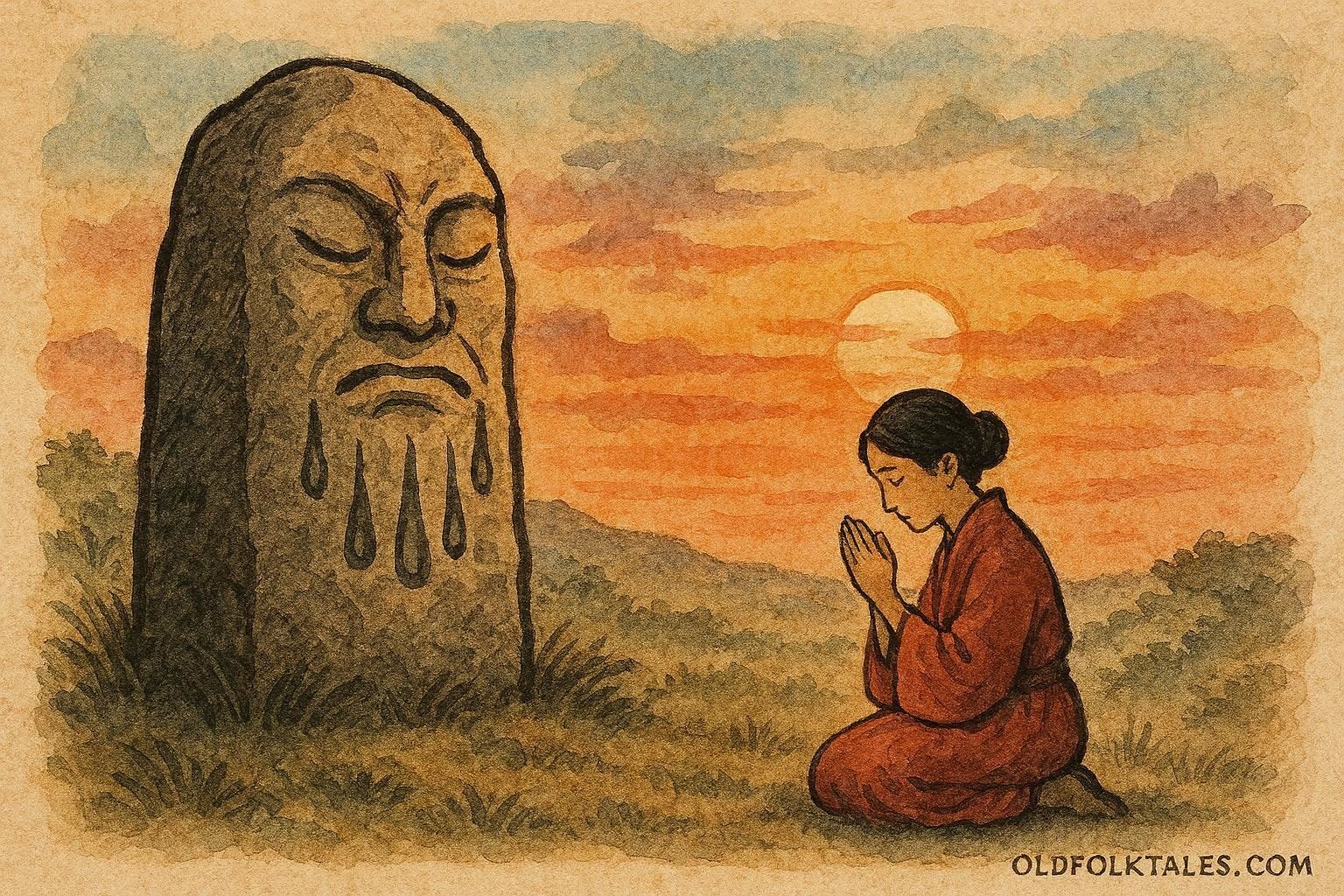
In a quiet village on the island of Okinawa there stood a large stone on a grassy rise overlooking the sea. It was shaped almost like a human face, with natural grooves that resembled closed eyes. The villagers believed it was a sacred guardian placed there by ancient spirits to watch over their land. Although it appeared still and silent most of the year there were moments when the villagers claimed it shed clear water that ran down its face like tears. Whenever this happened the elders took it as a warning that hardship or danger was approaching.
Among the villagers lived a gentle woman named Chiyo. She was known for her kindness and soft voice and she often visited the stone carrying small offerings of flowers and sea salt. She believed that the stone was alive in a quiet sacred way and she always felt a sense of peace when she stood before it. Chiyo had heard stories from her grandmother about the stone’s role in guiding their ancestors. According to the stories the stone wept when storms threatened fishing boats or when illness approached the village. Some said the stone cried when the hearts of the villagers grew troubled and divided.
One summer the air grew unusually heavy. The sea that normally shone a deep blue turned dull and restless. Fishermen returned with nearly empty nets and the village well began to produce water with an unpleasant taste. Each evening families whispered about their worries. Even the children sensed that something was wrong and stayed close to their homes instead of playing along the shore.
Journey through enchanted forests and islands in our Southeast Asian Folktales collection.
One morning Chiyo visited the stone to make her usual offering. As she approached she saw clear lines of moisture running from the grooves of the stone’s eyes. The stone was crying again. The tears shimmered in the morning light and Chiyo felt a tremor of fear. She placed her hands together and bowed deeply. She asked with sincerity why the guardian spirit was mourning. She felt compelled to stay and pray for help because she sensed the stone wished to reveal something.
A quiet breeze brushed her face as she knelt. As she prayed she felt an unexpected warmth rise from the ground beneath her. For a moment the world around her seemed to hush. Then a voice drifted through her mind. It was not a voice made of sound but a gentle presence that filled her heart. It told her that a hidden sickness was seeping through the land. Something dark had entered the village, not from the sea or the sky but from human actions. The voice asked her to be brave and to listen without fear.
Chiyo’s eyes filled with tears of her own. She asked what she must do. The presence guided her to look toward the old storage house by the edge of the village. It told her that the answer rested there. Although the message felt mysterious she trusted the stone’s guidance. She rose from her place of prayer and hurried to the storage house where unused tools and supplies were kept.
The building was dim inside and dust drifted in the sunlight that filtered through the cracks in the walls. As Chiyo stepped forward a faint smell reached her. It was unpleasant and sharp. Her heart raced as she followed the scent to a group of baskets stacked in a corner. Inside the baskets she discovered spoiled stored food, forgotten for weeks. Moisture and decay had spread through the building and flies gathered in the shadows. Chiyo realized that the strange taste in the well water and the illness that several villagers recently complained of might have been caused by this growing contamination.
She ran to the village chief and explained everything she had seen. The chief gathered the elders who confirmed that the spoiled food could indeed bring sickness. They organized the villagers to safely remove the decayed items and thoroughly clean the storage house. They then purified the area with salt and sacred prayer songs, an old Ryukyu custom for restoring balance. Over the next several days the strange taste in the well water faded and fishermen began returning with healthier catches. The heavy air that had weighed upon the village slowly lifted.
When the crisis had passed Chiyo returned to the sacred stone. She bowed and thanked the guardian spirit for revealing the hidden danger. The stone no longer wept. It stood calm beneath the warm sunlight as if watching over the village with quiet satisfaction. Chiyo whispered her gratitude and promised to continue caring for the stone as her grandmother once had.
Word of the event spread throughout the region. Many visitors came to see the crying stone and hear about the woman whose prayer had saved her village. Elders often repeated that sacred natural objects were not merely decorations of the land. They were signs of the deep relationship between people and nature. When treated with respect these objects guided and protected the community. When neglected they warned of imbalances that needed attention.
Chiyo lived the rest of her life in harmony with the land and the sea. She became known as a woman of compassion and intuition and her story became part of the village’s oral tradition. Children grew up hearing that the crying stone had wept not only for danger but for the relationships among the people. The villagers learned to watch their actions carefully and to remain united in respect. And whenever tears appeared on the stone again the villagers gathered together with humility knowing that the guardian spirit was reminding them to care for both the land and each other.
Explore timeless legends from China, Japan, and Korea in our East Asian Folktales collection.
Moral Lesson
Nature often speaks in subtle ways and those who listen with sincerity can protect their community. Compassion and respect bring harmony while neglect and carelessness invite danger.
Knowledge Check
- Why did the villagers believe the stone cried?
Answer: They believed its tears warned of approaching hardship or danger. - Why did Chiyo visit the stone regularly?
Answer: She felt peaceful there and wished to honor it with offerings. - What did Chiyo discover in the old storage house?
Answer: Spoiled food that was spreading contamination through the village. - How did the villagers respond to Chiyo’s discovery?
Answer: They cleaned the storage house and purified the area. - What happened after the danger was removed?
Answer: The well water improved, fishing became plentiful again, and the stone stopped crying. - What value does the story emphasize?
Answer: Respect for nature, spiritual awareness, and community responsibility.
Source
Adapted from University of the Ryukyus Folklore Collection, 2017.
Cultural Origin
Okinawan folklore.