On the island of Masbate, where the Visayan Sea laps against shores of black sand and volcanic rock, where coconut palms bend in the constant sea breeze and fishing boats return with the day’s catch as the sun sets in brilliant shades of orange and purple, there exists a phenomenon that has puzzled and enchanted sailors for generations. It is a sight witnessed only by those who venture out on the water at night during certain times of the year: the stilt houses along the shore begin to sway, to turn, to move in patterns that cannot be explained by wind or wave, as if the dwellings themselves have come alive and joined in some celestial celebration.
The coastal village of Barangay Binalayan has stood on its particular stretch of shoreline for countless generations. Like most fishing communities in the Visayas, the houses are built on sturdy wooden stilts driven deep into the tidal mud, their bamboo walls and nipa palm roofs rising high enough to avoid the reach of storm surges and spring tides. During the day, these houses appear ordinary: weathered by salt and sun, decorated with drying nets and hanging garlands of sampaguita flowers, filled with the sounds of children playing and women weaving mats while men mend their fishing gear.
Click to read all East Asian Folktales — including beloved stories from China, Japan, Korea, and Mongolia.
But on certain nights throughout the year, particularly during the transition between seasons when the old storytellers say the boundary between the mortal world and the realm of spirits grows thin, something extraordinary happens.
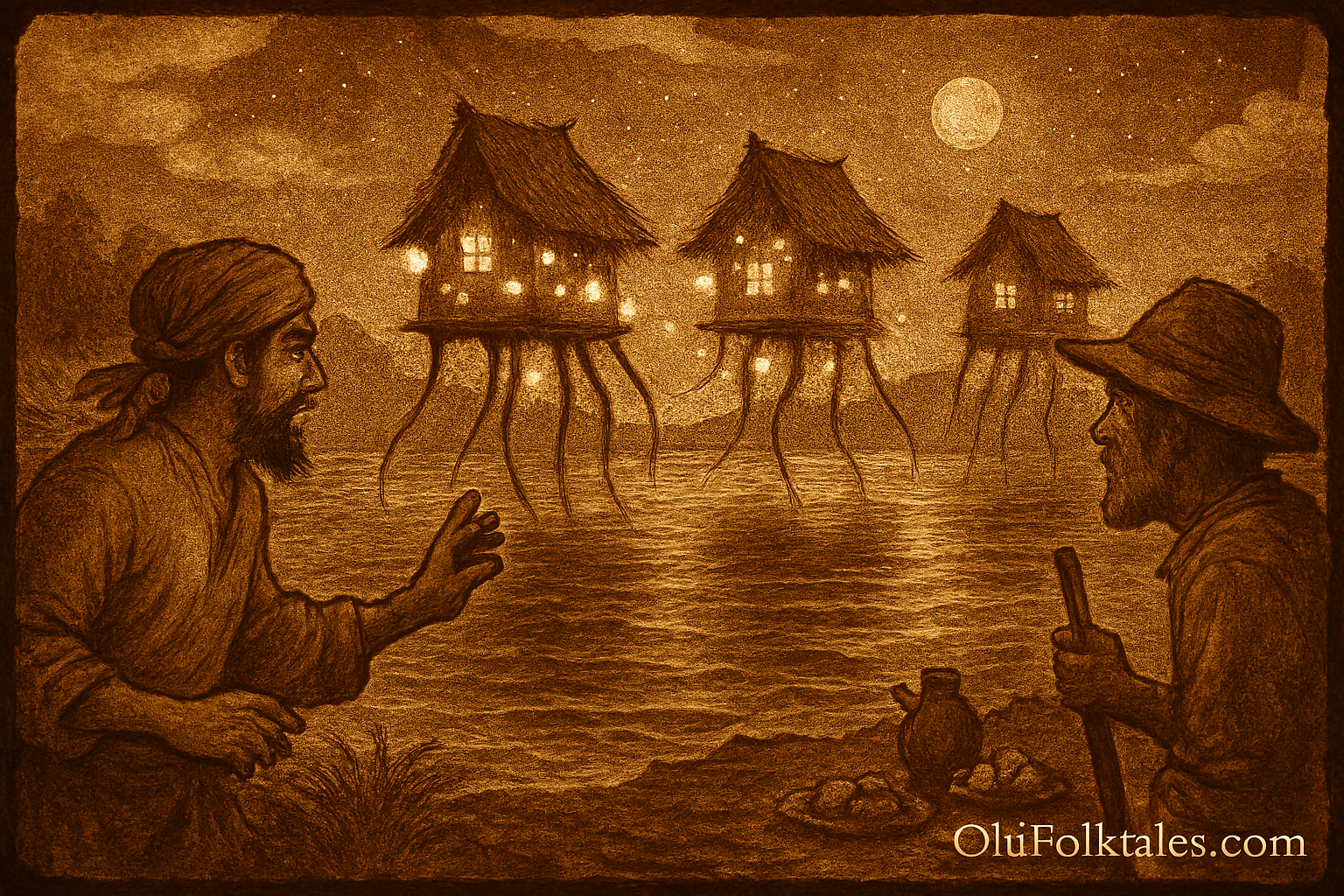
Fishermen returning late from deep-sea expeditions would be the first to notice. As they guided their bancas back toward shore, navigating by the light of kerosene lamps hung from their bows, they would see movement along the coastline that made them rub their eyes in disbelief. The stilt houses, those familiar dwellings they had known all their lives, would be swaying in perfect rhythm, turning slowly on their stilts as if engaged in an elaborate dance. Some houses would lean toward each other as though bowing in greeting, while others would spin in graceful circles, their bamboo walls creaking softly with the movement.
“Are you seeing what I am seeing?” old Mang Teroy asked his fishing companion Dong Carlos one night as they approached the shore after checking their fish traps. Both men watched in amazement as the entire row of houses along the beach moved in synchronized patterns, swaying left and right, forward and back, like dancers at a festival.
“The wind…” Dong Carlos began, but his voice trailed off. There was barely any wind that night, just a gentle breeze insufficient to move the heavy structures. And besides, wind would make houses sway randomly, not in the coordinated patterns they were witnessing.
The phenomenon was reported again and again over the years. Different fishermen, on different nights, all described the same impossible sight: the houses dancing. Some claimed to hear faint music accompanying the movements, like kulintang gongs and bamboo flutes played by invisible musicians. Others said they could see soft, glowing lights moving inside the houses, lights that were different from the usual glow of oil lamps, lights that seemed to pulse and shimmer like captured starlight.
The village elders convened to discuss the strange occurrences. Was it a sign of impending disaster? Had the community somehow angered the spirits? Should they abandon their homes and rebuild elsewhere? Fear and uncertainty spread through Barangay Binalayan as more and more people reported witnessing the dancing houses.
It was Lola Asiang, the oldest woman in the village and keeper of ancient stories passed down through countless generations, who finally provided an explanation. She called a gathering at the village plaza one evening, her ancient voice still strong and clear despite her ninety years.
“You are afraid of what you do not understand,” she said, her wrinkled face illuminated by the light of coconut oil lamps. “But there is nothing to fear. What you have witnessed is a blessing, not a curse. Let me tell you the story my grandmother told me, which her grandmother told her, reaching back to the time when our ancestors first built their homes on these shores.”
Lola Asiang explained that long ago, before the Spanish came and before even the old kingdoms rose and fell, the people of the Visayas understood that they shared the world with spirits of many kinds. Among these spirits were the bituin diwata, the star spirits, celestial beings who lived in the night sky but who occasionally descended to the mortal realm to participate in earthly celebrations.
“The star spirits love to dance,” Lola Asiang said. “It is their nature, their joy, their way of honoring the cycles of life and the turning of seasons. But they have no permanent homes in the mortal world, no places to gather and celebrate. So, during the seasonal ritual feasts, particularly during the times of planting and harvest when the boundary between worlds is thinnest, they borrow our houses.”
The gathered villagers listened with rapt attention as the old woman continued.
“They do not harm our homes or disturb our belongings. They simply need a place to gather, to dance, to celebrate the abundance of the earth and sea. The swaying you see is their dancing, performed with such grace and power that the very houses move in sympathy. The lights you witness are their celestial radiance, for star spirits cannot completely hide their luminous nature even when visiting the mortal realm.”
“But why our houses?” someone asked. “Why this village?”
Lola Asiang smiled. “Because our ancestors were wise. They built their homes with respect for the spirits, with proper rituals and offerings. They understood that we are not the only inhabitants of this world, and they made space for others. The star spirits remember this kindness, and they honor our village by choosing our homes for their celebrations. It is a sign of favor, a blessing that we should celebrate, not fear.”
“What should we do?” asked the village captain. “How should we respond to this honor?”
“We should do what our ancestors did,” Lola Asiang replied. “We should leave offerings of rice, fruits, and flowers outside our homes on nights when the star spirits might visit. We should light incense and say prayers of welcome. We should understand that when they dance in our houses, they are also dancing for us, for our prosperity, for our harvests both from field and sea. In return for hosting their celebrations, they bless our homes and ensure that our next harvest will be abundant.”
From that night forward, the people of Barangay Binalayan changed their response to the dancing houses. Instead of fear, they felt honored. On nights when the old calendar indicated a seasonal transition, families would prepare special offerings: small baskets of newly harvested rice, fresh tropical fruits, woven sampaguita garlands, and sticks of incense made from local aromatic woods. These they would place outside their homes on small bamboo platforms, along with coconut oil lamps to guide the star spirits.
And the blessings came, just as Lola Asiang had promised. In the seasons following the establishment of this practice, the fishing was exceptionally good. Nets came up heavy with fish, and the catches were of the finest quality. The rice fields that dotted the inland valleys produced abundant harvests. Children were born healthy and strong. Storms that threatened the coast seemed to change direction at the last moment, sparing the village from destruction.
The fishermen, instead of being frightened when they witnessed the dancing houses, would stop their boats at a respectful distance and watch with appreciation and wonder. Some would make the sign of the cross and whisper prayers of thanks. Others would perform the traditional gestures of respect to spirits, pressing their palms together and bowing toward the shore.
“The star spirits are celebrating,” they would say to one another. “Our harvest will be good this year.”
Word of the dancing houses spread to other islands in the Visayas. Some claimed it was merely a tale, impossible and fanciful. But sailors from other villages who happened to pass by Barangay Binalayan on the right nights would return with stories confirming what the locals had been saying: they had seen it with their own eyes, houses moving in impossible ways, swaying and turning as if alive, accompanied by strange lights and faint music that seemed to come from the stars themselves.
Neighboring villages began adopting similar practices, leaving offerings during seasonal transitions, showing respect to the unseen spirits who shared their world. Some reported experiencing similar phenomena, though never as dramatic or consistent as what occurred in Barangay Binalayan, which remained the star spirits’ favored gathering place.
To this day, the tradition continues. Modern Masbateños, even those who have moved to cities and adopted contemporary lifestyles, remember the stories of the dancing houses. During important seasonal festivals, many return to their ancestral villages to participate in the traditional offerings. The practice has become woven into the cultural fabric of the region, a reminder that the Philippines’ pre-colonial spirituality continues to exist alongside newer religious traditions.
Fishermen still report seeing the phenomenon, though it has become rarer as development changes the coastline and modern buildings replace traditional stilt houses. But in places like Barangay Binalayan where the old ways are still honored, where families still build their homes in the traditional style and remember to leave offerings for the star spirits, the dancing houses can still be witnessed by those with patient eyes and respectful hearts.
The old storytellers, carrying on the tradition that Lola Asiang preserved, continue to explain the phenomenon to each new generation. They teach children about the bituin diwata, about the importance of hospitality even to beings one cannot see, about the blessings that come from sharing one’s space with the spirits of earth and sky.
“Remember,” they say, “that we are not alone in this world. The stars above are not just distant lights but homes to living spirits who sometimes wish to walk among us, to dance and celebrate the turning of seasons. When we make space for them, when we welcome them with offerings and respect, they bless us in return. The dancing houses are not something to fear but something to celebrate, a visible sign of the invisible bonds that connect all living things, mortal and immortal, earthly and celestial.”
Click to read all Southeast Asian Folktales — featuring legends from Thailand, Indonesia, Vietnam, and the Philippines.
The Moral Lesson
This legend teaches the importance of hospitality, respect for the unseen world, and maintaining harmony with spiritual forces. The transformation from fear to celebration shows that understanding replaces terror when we learn the truth behind mysterious phenomena. The star spirits’ choice to dance in human homes represents the interconnection between celestial and earthly realms, while the blessing of abundant harvests demonstrates that generosity toward others, including spirits, returns to benefit the giver.
Knowledge Check
Q1: What unusual phenomenon occurred in Barangay Binalayan, Masbate? A: Fishermen and villagers witnessed stilt houses along the shore swaying, turning, and moving in synchronized patterns at night, as if dancing. The houses moved in coordinated ways that couldn’t be explained by wind or waves, sometimes accompanied by faint music and glowing lights that pulsed like starlight.
Q2: Who were the bituin diwata in Philippine Visayan folklore? A: The bituin diwata were star spirits, celestial beings who lived in the night sky but occasionally descended to the mortal realm during seasonal transitions. They loved to dance and needed places to gather and celebrate during ritual feasts marking planting and harvest times when the boundary between worlds grew thin.
Q3: How did Lola Asiang explain the dancing houses? A: Lola Asiang, the village’s oldest storyteller, explained that the star spirits borrowed the houses during seasonal ritual feasts to hold their celebrations. The swaying was their dancing, performed with such grace and power that the houses moved in sympathy. She revealed this was a blessing and sign of favor, not something to fear.
Q4: What offerings did the villagers leave for the star spirits? A: Villagers placed offerings outside their homes on bamboo platforms: baskets of newly harvested rice, fresh tropical fruits, woven sampaguita garlands, incense sticks made from aromatic woods, and coconut oil lamps to guide the star spirits. These were left on nights when seasonal transitions occurred.
Q5: What blessings did the village receive after honoring the star spirits? A: After beginning the offering practice, Barangay Binalayan experienced exceptionally good fishing with heavy catches, abundant rice harvests in the inland valleys, healthy children being born, and storms changing direction to spare the village from destruction. Their generosity toward the spirits resulted in prosperity.
Q6: What does this legend reveal about pre-colonial Philippine spirituality? A: The legend demonstrates the pre-colonial Filipino belief in sharing the world with various spirits, the importance of maintaining harmonious relationships with unseen beings, and the practice of hospitality extending beyond the human realm. It shows how seasonal rituals connected earthly abundance with celestial blessings, and how respect for spirits was believed to ensure community prosperity.
Source: Adapted from Folktales from the Visayas by Damiana Eugenio
Cultural Origin: Masbate Island, Visayas region, Philippines