In a quiet Palestinian farming village, where olive trees lined the fields and stone houses clustered close for warmth and safety, there lived a hardworking farmer with his family. Like many households of the countryside, the family depended not only on the strength of their hands but also on the loyalty and labor of their animals. Among them were a dog and a donkey, each valued for a different purpose, each serving the household in a way shaped by long custom and necessity.
The dog slept near the doorway every night. His ears were sharp, his nose keen, and his bark loud enough to echo through the courtyard. When strangers passed too close or thieves crept in the dark, the dog’s warning voice rose immediately, alerting the family and keeping danger away. Each morning, the farmer praised the dog, patting his head and offering him scraps with kind words. “Good guardian,” the farmer would say. “Because of you, we sleep in peace.”
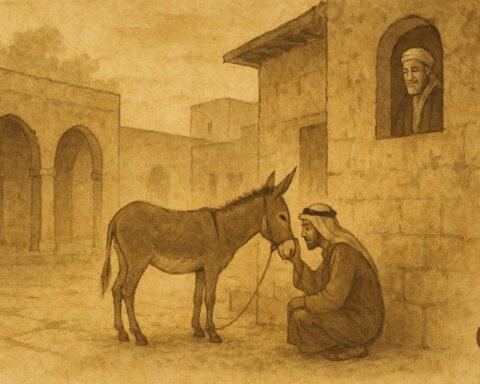
The donkey lived in the stable at the edge of the yard. By day, he carried heavy loads of firewood, water jars, and sacks of grain. He walked patiently along narrow paths and endured the sun without complaint. Though his work was hard, it was quiet, and when the evening came, no one spoke of it with excitement. The donkey received his feed and water, but rarely praise.
As days passed, jealousy began to stir in the donkey’s heart. He watched how the dog was admired for his barking, how the family laughed fondly at him and spoke his name with gratitude. “Why is his work valued more than mine?” the donkey thought. “I carry burdens from dawn to dusk, yet no one calls me brave or clever.”
The donkey’s thoughts grew darker as he brooded over them. One night, while chewing his feed, an idea formed in his mind. “If barking brings praise,” he reasoned, “then I too will bark. I will guard the house, and they will honor me as they honor the dog.”
That night, the moon rose pale above the rooftops, and the village fell silent. The dog took his place by the door, alert but calm. The donkey waited until all was still. Then, gathering his breath, he let out a terrible bray, loud and shrill, shaking the walls of the stable. He stamped his hooves wildly, kicking over buckets and rattling the wooden posts.
The noise was nothing like a dog’s bark. It was deeper, harsher, and filled the darkness with terror. The family woke in panic. “A monster,” cried one. “A thief,” shouted another. The children screamed as the farmer seized a stick and ran into the yard.
The dog barked sharply, confused by the chaos, but it was the donkey’s terrible braying that dominated the night. In the flickering light of a lantern, the farmer saw the donkey rearing and stomping, eyes wide and wild. Believing that some great danger threatened his home, the farmer struck the donkey again and again until the animal collapsed, trembling and silent.
When the noise finally ceased, the truth became clear. There was no monster, no thief, only the donkey who had tried to do the work of another. The farmer shook his head in anger and disappointment. “You foolish creature,” he said. “You were not made for guarding. Your strength is for carrying, not frightening.”
The donkey lay still, aching in body and spirit. In his pain, he understood his mistake. He had not failed because he was weak, but because he had abandoned the task given to him by nature and custom. The dog resumed his place at the door, watchful and steady, while the night returned to its quiet order.
From that day on, the donkey no longer envied the dog. He carried his loads with renewed patience, accepting that every creature has its own purpose, and that harmony depends on each one fulfilling it.
Moral Lesson
This folktale teaches that envy leads to disorder, and that peace is maintained when each individual understands and respects their natural role. Attempting to imitate another’s duty without the right nature or skill brings harm rather than honor.
Knowledge Check
-
What role does the dog serve in the story?
The dog is the household guardian, protecting the family by barking at danger. -
Why does the donkey become jealous of the dog?
The donkey envies the praise the dog receives and feels his own labor is overlooked. -
What action does the donkey take because of his jealousy?
He tries to imitate the dog by braying loudly at night to guard the house. -
How does the farmer react to the donkey’s braying?
He believes a monster or threat is present and beats the donkey in fear. -
What mistake does the donkey realize he made?
He understands that he overstepped his natural role and caused chaos. -
What cultural lesson does the tale convey?
That social harmony depends on individuals respecting their proper roles.
Source
Adapted from Palestinian agricultural folktales archived as animal fables, reflecting rural village life and traditional moral instruction, as documented in regional folklore collections.