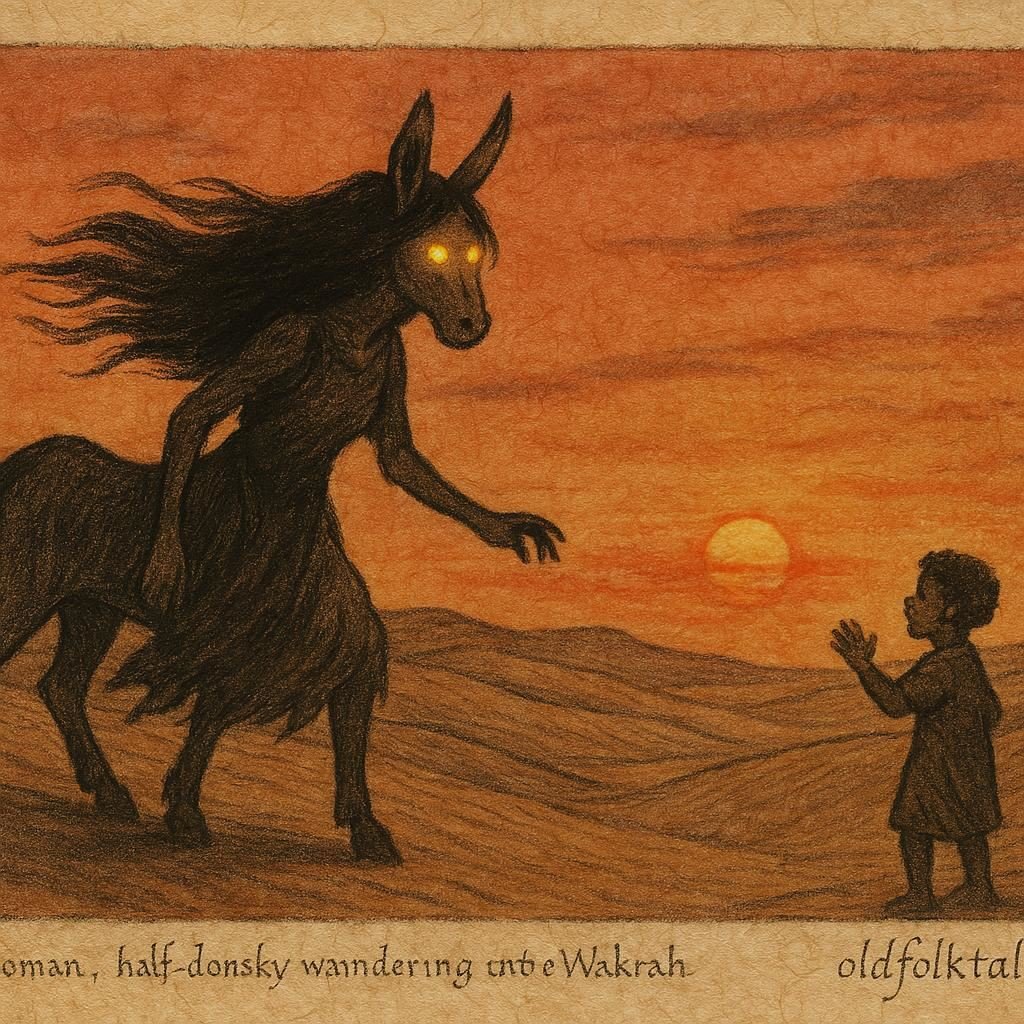
In the quiet coastal town of Al Wakrah, where the golden dunes meet the whispering sea, stories have long travelled on the evening breeze. Among them, few are as haunting as that of Set al-Himar, the Donkey Lady, whose tale has warned generations of children to speak the truth.
Long ago, in a small village surrounded by palm groves and desert sands, there lived a woman whose cruelty was known to all. Her heart, once soft and kind, had turned bitter over time. She scolded her children for every small mistake, struck them when they spoke, and mocked their tears. Neighbours whispered that her anger was darker than the desert night.
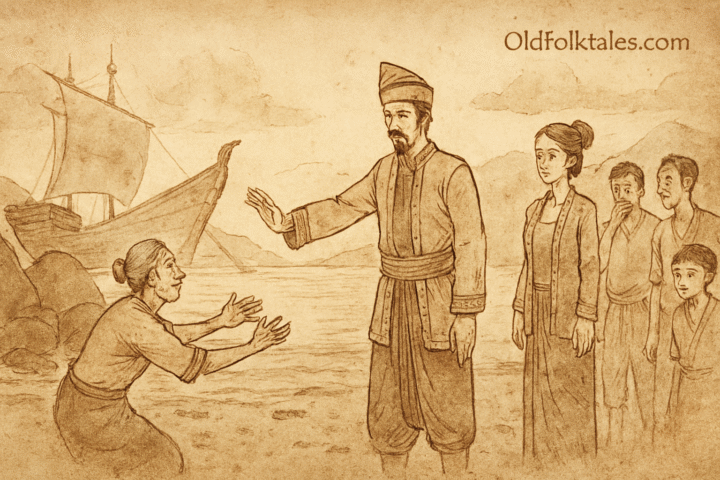
At last, unable to bear her temper and cruelty any longer, her own children ran away into the dunes, leaving her alone with her rage. When she discovered they were gone, she stood in the centre of the village, her hair wild and her voice shaking with fury. Raising her arms to the sky, she cursed the villagers:
“May your children bray like donkeys if they ever tell a lie!”
Her words echoed across the sands, carried by the wind until even the camels stirred uneasily in their pens.
From that day, strange things began to happen. Children who lied to their parents found their voices cracking and trembling, and some claimed they could hear faint braying at night when they were dishonest. The villagers grew fearful, for it was said that the woman had vanished into the desert, cursed by her own bitterness and transformed into something neither human nor beast.
They said she wandered the dunes at sunset, half-woman and half-donkey, her eyes glowing red like embers in the twilight. Her hair, black as pitch, trailed behind her like a cloak of night. The sound of her hooves striking the sand was said to echo between the dunes, a slow, dreadful rhythm that chilled the hearts of all who heard it.
Mothers warned their children not to lie or disobey, for Set al-Himar would come when the moon was thin and the wind blew from the west.
“Do not wander after sunset,” they would say, “and always speak the truth. The Donkey Lady listens.”
Many tales tell of travellers who saw her shadow at dusk. Some claimed to have heard her braying cry, half-human and half-animal, drifting through the palm groves. Others swore that they saw her reflection in the shallow waters near the shore, her fiery eyes staring back before fading into ripples.
But the most frightening stories were those told by children who had met her.
It was said that if Set al-Himar crossed paths with a child wandering alone, she would approach silently through the dust. Her steps made no sound, but her presence brought with it a sudden stillness, the crickets ceased to sing, and even the air seemed to hold its breath.
Then, in a voice rough like the desert wind, she would ask:
“Are you truthful?”
If the child trembled and lied, their words would twist into a bray, their human voice lost to the curse. Those who lied could speak no more, for deception had taken their tongue. But if the child answered with honesty and courage, the Donkey Lady would gaze at them for a moment, her fiery eyes dimming. Then she would vanish, leaving behind only a whisper of sand.
No one knew whether she sought redemption or revenge. Some elders said that her soul could never rest, doomed to test the honesty of others until her curse was undone. Others believed she guarded the village still, punishing deceit to protect the innocent.
Even now, as the sun sinks behind the dunes of Al Wakrah, the elders say that her spirit roams the desert paths. The Donkey Lady remains a symbol of truth and fear, her legend passed down through generations as a warning: lies dishonour not only the family but also the soul.
So when the evening wind rustles through the palm leaves and the dunes shimmer under the moon, children listen closely, and promise never to lie. For somewhere beyond the dunes, a faint braying may still be heard.
Moral Lesson
Lies carry consequences that echo beyond the moment. Honesty preserves dignity, while deceit dishonours both family and spirit. Truth is the light that keeps darkness away.
Knowledge Check
-
Who is Set al-Himar in the Qatari folktale?
She is the Donkey Lady, a half-woman, half-donkey spirit who punishes lying children. -
What caused the woman to become Set al-Himar?
Her cruelty and curse upon the villagers led to her transformation. -
Where is this folktale from?
It originates from Al Wakrah, a coastal town in Qatar. -
What question does the Donkey Lady ask the children she meets?
She asks, “Are you truthful?” to test their honesty. -
What happens if a child lies to the Donkey Lady?
They bray like a donkey and lose their voice as punishment for dishonesty. -
What is the main moral of this Qatari legend?
It teaches that truth and respect are sacred, and deceit brings spiritual shame.
Source: Adapted from Hazawy: Qatari Folklore and Enduring Tales: The Qatari Oral Tradition
Cultural Origin: Qatar (Hazawi oral folklore tradition)