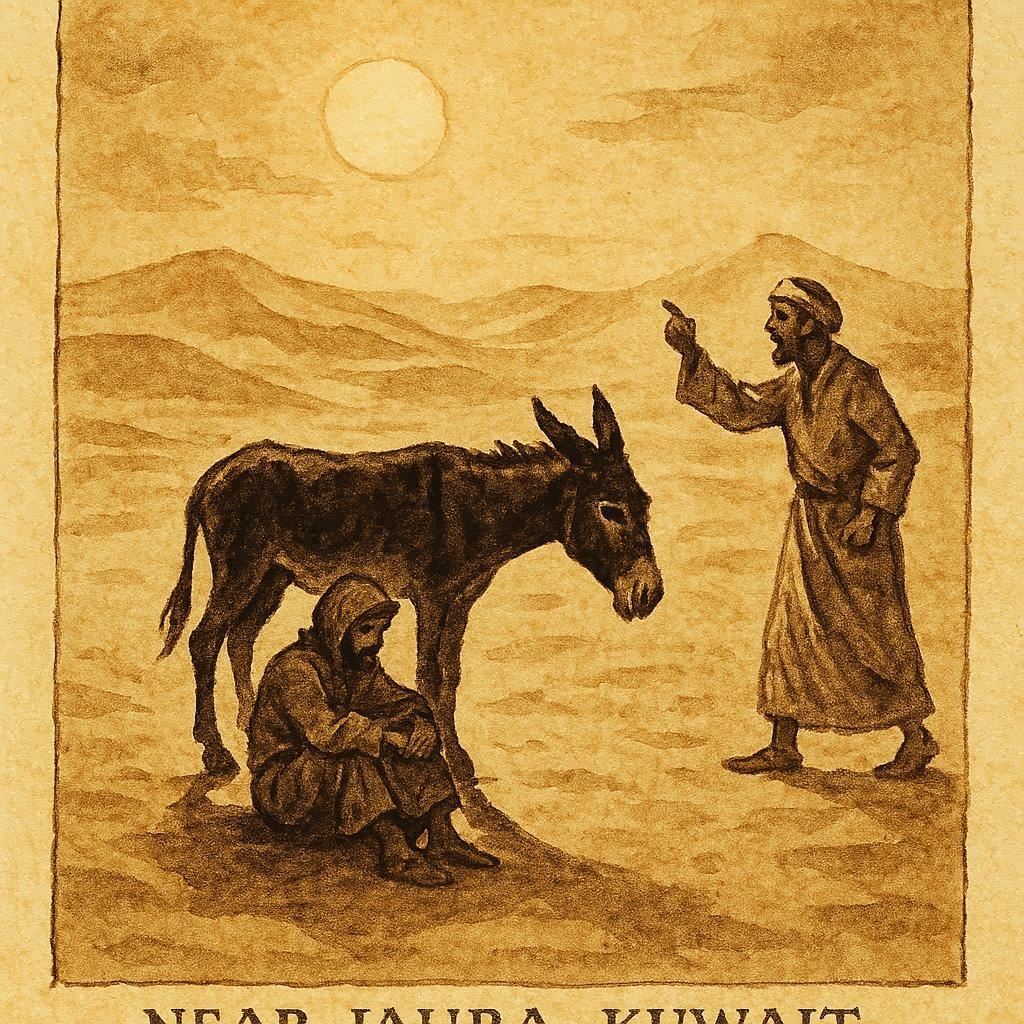
On a scorching afternoon in the desert plains between Jahra and Kuwait City, a traveller sought passage across the shimmering sands. The sun blazed mercilessly above, turning the world into a furnace of light and silence. To make his journey easier, the man decided to hire a donkey, a humble yet enduring creature known across the region for its patience and strength.
He approached a donkey owner, a shrewd man who made his living by renting his beasts to weary travellers. After a brief exchange, they agreed on a price, and the traveller mounted the donkey. The owner, pleased with his bargain, followed alongside to ensure the animal returned safely.
As they set out, the shadow of the donkey stretched long and dark across the sand, a thin, moving patch of relief in the relentless sun. For hours, they travelled in silence until the heat grew almost unbearable. The traveller’s mouth was parched, his throat dry as dust, and the fiery air seemed to dance before his eyes. When at last the sun stood high overhead, he could bear it no longer.
“Let us rest,” he said, sliding from the donkey’s back. Seeking shade, he sat in the donkey’s shadow, the only cool spot within miles.
But the owner objected at once. “Hold on! You hired my donkey, not its shadow,” he protested, crossing his arms firmly.
The traveller, too exhausted to argue, lifted his head slowly. “What nonsense is this? The donkey and its shadow are one. When I hired the animal, I hired its shade as well.”
The owner’s eyes flashed. “Not so! You paid to ride the donkey, not to sit beneath its shadow. If you wish to rest there, you must pay more.”
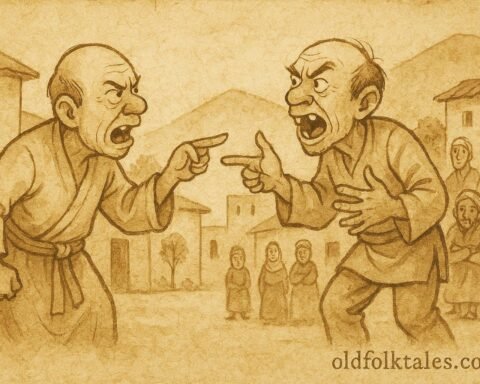
Their quarrel rose like a sandstorm. Words turned sharp and tempers flared. They accused, mocked, and shouted until passers-by stopped to stare. By the time they reached Kuwait City, the pair’s argument had become the talk of the marketplace.
Curious townsfolk gathered in a circle as they brought the matter before the qadi, the local judge. With his white beard and calm eyes, the qadi listened patiently to their tale. The traveller pleaded his case first, declaring the absurdity of separating a donkey from its shadow. The owner followed, insisting on his right to extra payment for the shadow’s use.
When both men had spoken, the qadi stroked his beard thoughtfully. Then, with a small smile, he said, “If you rented the donkey, you indeed rented its shadow, for the two cannot be divided. But,” he added, his tone suddenly sharp, “since both of you have wasted your time and mine, arguing over nothing, you shall each pay a fine for disturbing the peace of the market.”
The crowd erupted in laughter. The two men, red-faced and silent now, paid their fines and walked away, their pride wounded but their foolishness cured.
From that day, the tale of The Donkey’s Shadow became a favourite in Kuwait’s coffee houses and gatherings, a gentle reminder that pride and greed often blind us to reason.
Moral Lesson
Those who quarrel over trivial things lose both peace and dignity. Wisdom lies not in possession but in perspective.
Knowledge Check
1. What is the main lesson in The Donkey’s Shadow Kuwaiti folktale?
It teaches that arguing over worthless things only leads to foolishness and loss of peace.
2. Who are the main characters in The Donkey’s Shadow?
The story features a traveller, a donkey owner, and a wise qadi (judge).
3. What cultural value does this Kuwaiti folktale highlight?
It reflects the importance of wisdom, fairness, and humility in resolving conflicts.
4. Why did the men argue in The Donkey’s Shadow?
They argued about whether the traveller had rented just the donkey or also its shadow.
5. How does the judge resolve the dispute in the story?
He declares that the donkey and its shadow cannot be separated and fines both men for foolishness.
6. What symbolism does the donkey’s shadow hold in the tale?
It symbolises human folly, the tendency to fight over things without real value.
Source: Adapted from the Kuwaiti folktale “The Donkey’s Shadow” in Folktales from the Arabian Peninsula (Taibah & MacDonald, 2016).
Cultural Origin: Kuwait (oral humour tale, Middle Eastern folklore).