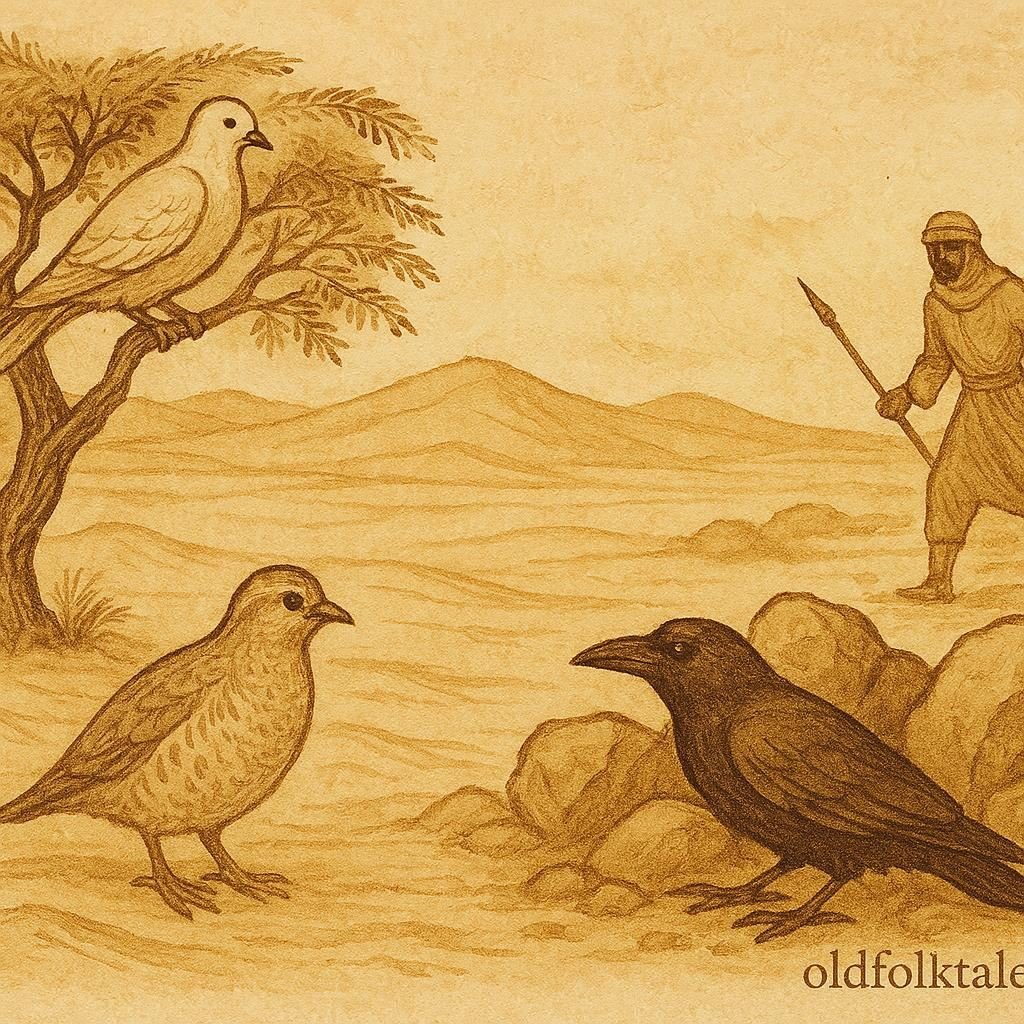
In the golden heart of the Arabian Peninsula, where the sand stretches like a sea of light and the date palms whisper secrets to the desert wind, there once lived three birds who were as different in nature as they were in voice: a dove, a partridge, and a crow.
The dove, soft and graceful, made her home in a quiet acacia tree that grew beside a trickling spring. She was gentle and cautious, never leaving her nest without first surveying the sky. The partridge, quick and proud, lived among the rocks near the foot of a dune. She loved to boast of her beauty and speed, claiming that no hunter’s arrow could ever touch her feathers. The crow, dark and clever, perched wherever he pleased, often in the highest branches or on the edge of a wandering camel’s pack. He liked to speak loudly of his wit, though few believed he had as much wisdom as he claimed.
One afternoon, the three friends met at the spring. The sun burned high above them, and the wind carried the smell of rain far off in the distance. The partridge fluttered her wings proudly and said, “See how my feathers shine even under this harsh sun? I could outfly any falcon that dares to chase me.”
The crow gave a rough laugh. “Outfly a falcon? You might escape a lazy hunter, perhaps, but never a bird of prey.”
The dove, gentle and mild, tried to calm them. “Pride leads to danger,” she cooed. “When one speaks too much of their strength, fate may choose to test it.”
The partridge tossed her head. “You, dove, are too timid. Life is for those who take risks.”
“Perhaps,” said the crow with a glint in his eye, “but sometimes the talkers fall before the bold.”
Their words hung in the air like heat above the dunes. Before long, the sound of approaching footsteps reached their ears, a hunter, moving silently through the sand. His bow was strung, and his arrows gleamed like slivers of sunlight.
The dove’s heart quivered. “Fly!” she whispered. “Hide before it’s too late.”
Without another word, she rose swiftly to the top of the tallest acacia tree, where the leaves hid her silver feathers.
The crow, using his cunning, darted behind a cluster of rocks and crouched low, his dark body blending perfectly with the shadows.
But the partridge, full of pride, strutted boldly into the open. “Let him come,” she said. “I will show him how fast I can run.”
The hunter drew his bow, his arrow flying straight and sharp. Before the partridge could take a second step, the arrow struck her wing. She fell with a cry that echoed across the valley.
The dove trembled in her nest, whispering a prayer for her friend. The crow watched in silence, his clever eyes full of understanding. The hunter approached, took the partridge, and disappeared beyond the dunes. When all was quiet again, the crow flew up to the dove’s tree.
“Your words were true,” he croaked softly. “Pride has its price.”
The dove bowed her head. “Yes. And wisdom often speaks softly, but those who scorn it must learn through sorrow.”
For days the crow and the dove mourned their friend. The desert seemed emptier without her laughter. Yet, in time, her story became a lesson among the creatures of the wild, a tale whispered from palm grove to palm grove: the one who boasts invites misfortune, but the one who watches and waits endures.
Thus, the dove continued to live peacefully by the spring, cautious yet content. The crow, though still proud of his cleverness, learned to speak less and listen more. And when the desert wind carried the faint call of a hunter’s horn, they would look at one another and remember the partridge who had trusted too much in her own wings.
Moral Lesson
Wisdom lies not in boasting but in knowing when to be silent. Caution and humility protect us where pride brings downfall.
Knowledge Check
1. Who are the main characters in “The Dove, the Partridge, and the Crow”?
The story features a dove, a partridge, and a crow, three birds whose actions teach different lessons about wisdom and pride.
2. What lesson does the partridge learn in the story?
She learns that arrogance and boasting can lead to one’s downfall, as she ignores warnings and is caught by the hunter.
3. How does the dove represent wisdom in this Saudi folktale?
The dove symbolises prudence and modesty, surviving by being cautious and avoiding unnecessary risks.
4. What does the crow’s behaviour symbolise?
The crow represents cleverness and adaptability, he hides wisely and survives, showing that intelligence can balance pride.
5. What moral value does this folktale promote?
The tale promotes humility, caution, and the virtue of thinking before acting or speaking.
6. What is the cultural origin of this story?
This folktale originates from Saudi Arabia, part of the traditional Animal Tales collected in Arabian folklore.
Source: Adapted from “The Dove, the Partridge, and the Crow” in Folktales from the Arabian Peninsula, Saudi Arabia: Animal Tales, collected by Nadia Jameel Taibah.
Cultural Origin: Saudi Arabia (Arabian folklore)