In the vast and windswept highlands of Tibet, where the snow-capped mountains meet the endless sky, there lived a hero whose name echoed across generations, King Gesar of Ling. He was no ordinary man, but a divine being sent by the gods to restore balance and justice to a world ruled by greed, corruption, and darkness. His story, sung for centuries by bards and nomads, became the greatest epic of Tibetan culture. The Epic of King Gesar of Ling.
Long ago, the kingdom of Ling was plagued by evil spirits and rival warlords. The land that once bloomed with peace and plenty fell under the shadow of cruelty and deception. The gods, seeing the suffering of humanity, held counsel upon the shining peaks of Mount Tisé. “The world is drowning in wickedness,” said one celestial voice. “Let us send a champion, one who will bring back righteousness and restore harmony among men.”
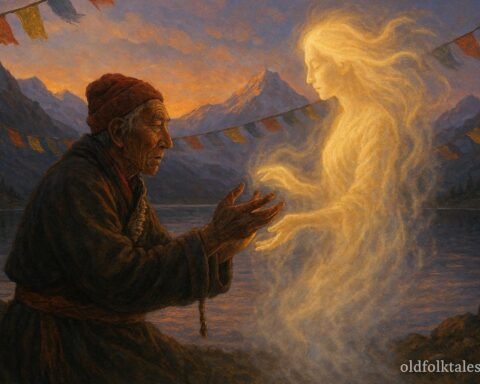
From the radiance of the gods descended a spirit child, born not of mortal flesh, but of divine light. He came to earth as a humble boy named Gesar, the son of a widowed woman who lived in the remote valley of Ling. His birth was accompanied by omens, thunder that spoke like a drum, clouds that took the shape of galloping horses, and a rainbow circling the sky.
Discover the wisdom of Persian poets and Arabian storytellers in Western Asian Folktales.
Even as a child, Gesar showed uncommon wisdom and courage. He tamed wild horses with a glance, spoke kindly to animals, and taught the village children to share and speak truth. Yet, not everyone admired him. His uncle, jealous of his growing strength, banished him and his mother to the wild mountains. There, in exile, the boy trained his body and spirit, guided by visions from the gods.
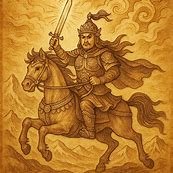
One night, as the moon rose over the peaks, a radiant horse appeared before him, Kyang Go Karkar, the celestial steed. “I am sent by the gods,” the horse said. “Mount me, and together we shall bring justice to the world.” Gesar leapt upon the horse’s back, and they rode like wind and thunder across the sky.
News soon spread across the valleys that the gods had chosen a new champion. The people of Ling, weary of oppression, prayed for his return. At last, Gesar rode back into Ling wearing armor that gleamed like the sun. He challenged the evil usurper, King Gurkar, who ruled with cruelty and fear. Their battle raged for seven days and nights, thunder shook the mountains, and fire lit the plains. On the dawn of the eighth day, Gesar struck down the tyrant and reclaimed the throne of Ling.
But Gesar’s mission did not end there. Guided by his divine calling, he rode forth to defeat the demon kings who plagued the land, the demon of Greed in Hor, the demon of Lust in Tagzig, the demon of Deceit in Mon, and many others. Each victory was not just a triumph of strength, but of spirit. He taught his people compassion, courage, and the wisdom to live in harmony with nature and one another.
In every village and monastery, his name became a song Gesar, the protector of the weak, the warrior of compassion, the king of the righteous heart. Children grew up hearing how his sword cut through lies as easily as through steel, and how he forgave those who repented. His mother, now honored as the mother of light, watched from her simple hut as her son’s legend spread across the roof of the world.
It is said that after many great battles, Gesar rode east toward the sunrise and disappeared beyond the snow peaks, promising to return when the world once again falls into darkness. Some say his spirit still rides upon the winds, watching over the highlands of Tibet. Others believe that every time justice triumphs over cruelty, it is King Gesar’s blessing returning to the world.
To this day, the Epic of King Gesar of Ling is sung by bards across Tibet, Mongolia, and Bhutan. Each performance, whether in a smoky tent or before a sacred shrine keeps alive the spirit of the divine hero. The epic, spanning thousands of verses, is not merely a tale of battles but a lesson in courage, humility, and compassion, the moral heart of Tibetan identity.
Discover more East Asian Folktales from the lands of dragons, cherry blossoms, and mountain spirits.
Moral Lesson
The Epic of King Gesar teaches that true heroism comes not from power alone, but from wisdom, mercy, and justice. A ruler’s strength lies in compassion for his people and the courage to fight evil without hatred.
Knowledge Check
-
Who was King Gesar of Ling believed to be?
He was a divine warrior sent by the gods to protect humanity from evil and restore justice. -
What made Gesar’s birth special?
He was born from divine light and surrounded by supernatural signs, such as thunder and rainbows. -
What was the name of King Gesar’s magical horse?
His celestial steed was named Kyang Go Karkar. -
What lesson did Gesar teach through his victories?
That courage and compassion must guide strength, and true justice comes from mercy. -
Why was Gesar exiled as a boy?
His jealous uncle feared his growing power and wisdom and sent him away. -
What promise did King Gesar make before disappearing?
That he would return when the world once again falls into darkness.
Source:
Adapted from The Epic of King Gesar of Ling, collected and translated by Alexandra David-Neel and Lama Yongden (1933), London: Routledge & Sons.
Cultural Origin: Tibet (Oirat and Kham oral epic tradition)