High in the misty mountains of Laos, where the Hmong people have carved their villages into the slopes for countless generations, there lived a boy who had neither mother nor father to call his own. The villagers knew him simply as the orphan, for his parents had died when he was still too young to remember their faces. He lived on the charity of others, sleeping in the corner of a storage hut, eating whatever scraps were left after the village families had fed their own children.
The Hmong hills were a place of breathtaking beauty and harsh reality. Terraced fields climbed the mountainsides like giant steps reaching toward the clouds. Morning mists clung to the valleys, and the forests whispered with spirits both benevolent and dangerous. The villagers knew that the visible world and the spirit world existed side by side, separated by a veil as thin as rice paper. They understood that some people possessed the gift to see beyond that veil, to communicate with the spirits, to walk between worlds.
Click to read all East Asian Folktales — including beloved stories from China, Japan, Korea, and Mongolia.
The orphan boy was one such person, though the villagers did not realize it at first. They saw only a ragged child with hollow cheeks and clothes patched many times over. They gave him the leftover rice from their pots, the vegetables too bruised to sell at market, the corners of their huts where the rain leaked through. Some felt pity for him. Others felt nothing at all. And some, those whose hearts harbored cruelty, mocked him openly.
These cruel villagers would laugh as he passed, calling him worthless and cursed. They said his parents must have done something terrible to die so young, leaving such bad luck behind. They told him he would never amount to anything, that he was destined to remain a beggar all his days. The children, learning from their parents, would throw stones at him and run away laughing. The orphan endured all of this in silence, his dark eyes watching, his spirit learning the nature of human hearts.
But the orphan possessed something the villagers did not know about. Inside a small, dried gourd that he kept tied to his waist with a piece of worn rope, there lived a fire spirit. No one knew how the boy had come to possess such a powerful guardian. Some say his mother, who had been a shamaness before her death, had bound the spirit to protect her son. Others whisper that the orphan himself had called the spirit from the flames during a lonely night when he contemplated ending his suffering.
The fire spirit was small but ancient, a being of pure elemental force contained within the humble gourd. It could sense the intentions and nature of human souls. It knew which hearts beat with kindness and which ones harbored wickedness. And it waited, patient as only spirits can be, for the moment when it would be needed.
That moment came during the harvest festival, when the entire village gathered to celebrate the year’s bounty. Tables groaned under the weight of food, and rice wine flowed freely. The orphan sat at the edge of the celebration, as always, watching the families laugh and feast together. He had been given a small bowl of rice and some vegetables, more than usual because of the festival spirit, but still he remained apart.
As the evening wore on and the wine loosened tongues, some of the cruel villagers began their mockery again. They called out to the orphan, their voices thick with drink and malice. They told him he was polluting the festival with his presence, that his bad luck would ruin the harvest, that he should leave and never return. Others laughed and joined in, their cruelty feeding on itself like fire feeds on dry wood.
The village chief, a man named Txawj Pov, sat at the head table and did nothing to stop them. He had never been openly cruel to the orphan, but neither had he defended him. He was a man who valued peace and his own comfort above justice.
The orphan boy stood slowly, his hand touching the gourd at his waist. His voice, when he finally spoke, was quiet but clear enough for all to hear. “You judge me by my clothes and my circumstances. You think you know my worth. But the spirits see what humans cannot. They see the truth of every heart.”
The cruel villagers laughed louder, thinking the orphan boy had lost his mind. But their laughter died when the boy unstoppered the gourd.
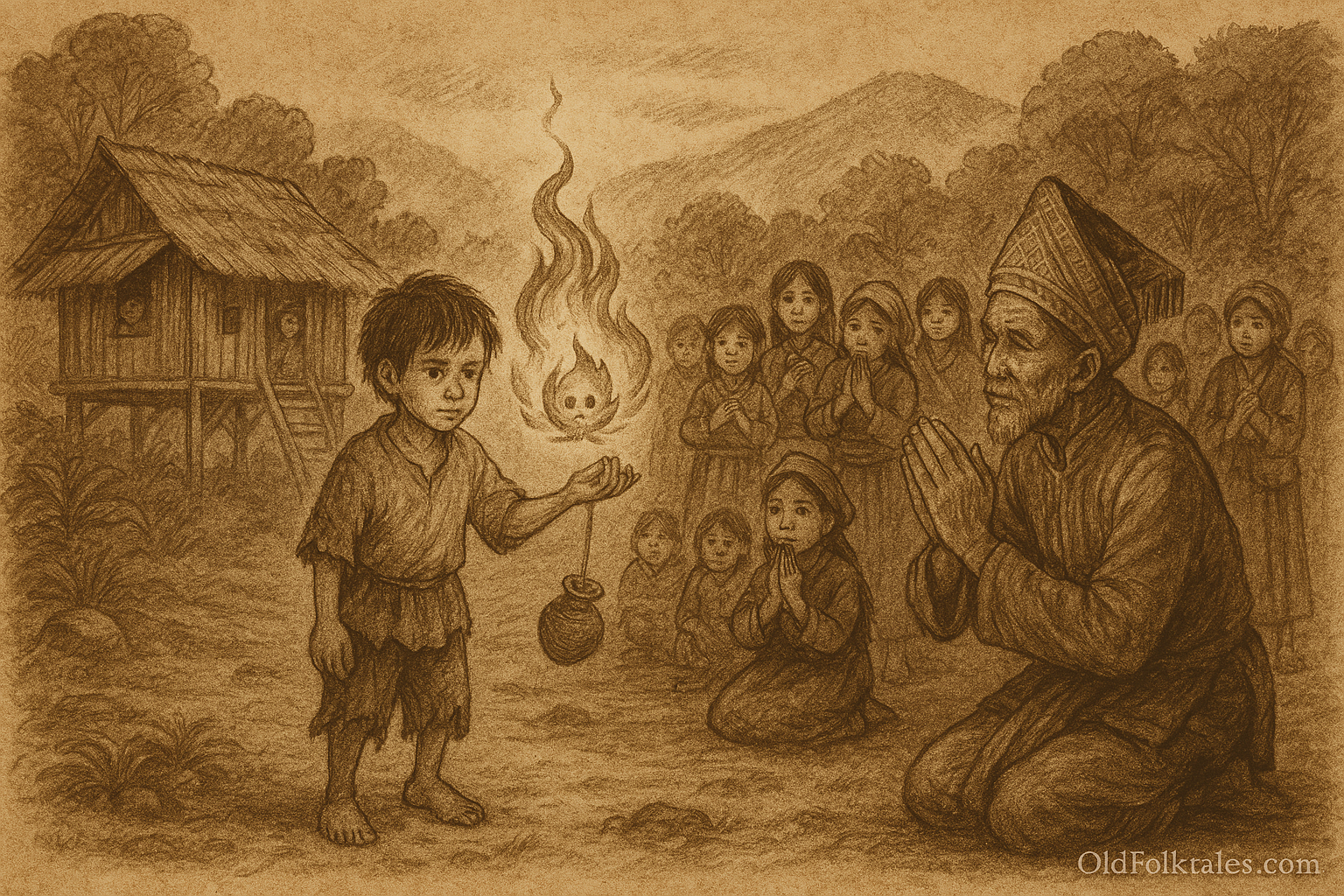
A small flame emerged, no larger than a butterfly, hovering in the air above the boy’s outstretched palm. It glowed with an intensity that seemed impossible for such a tiny fire, pulsing with colors that shifted from orange to blue to a white so bright it hurt to look at directly. The fire spirit had been released.
The spirit rose into the air, circling above the gathered villagers like a burning star. Then, with purposeful intent, it began to move through the village. It flew to the house of the man who had thrown the cruelest insults, touched the thatched roof, and flames erupted instantly. It moved to the home of the woman who had struck the orphan with a stick when he asked for water. Fire consumed her dwelling in moments. One by one, the spirit visited the houses of those whose hearts harbored genuine wickedness, those who had not just ignored the orphan but had actively sought to cause him pain and humiliation.
The villagers panicked, running to fetch water, but the fires burned with supernatural intensity. Yet strangely, the flames did not spread. They consumed only the houses they had been meant for, leaving neighboring homes untouched even when they stood just an arm’s length away. And more miraculous still, no one was injured. The spirit burned houses but spared lives, as if its purpose was justice, not vengeance.
Chief Txawj Pov watched in horror as several homes burned while others remained pristine. He understood then what he should have known all along: this orphan boy possessed spiritual power beyond anything the village had recognized. The fire spirit’s selective burning had revealed the truth of every heart, showing clearly who had harbored wickedness and who had not.
When the flames finally died down, leaving only smoking ruins of certain houses, the fire spirit returned to the orphan boy and disappeared back into the gourd. The boy stoppered it carefully and looked at the chief with eyes that held no anger, only a deep sadness.
Chief Txawj Pov approached the orphan and, before the entire village, lowered himself to his knees. “Forgive me,” he said, his voice breaking. “I have been blind. I saw only what my eyes showed me and ignored what my spirit should have known. You possess great power, and we have treated you shamefully. I apologize for myself and for my village.”
The orphan boy looked at the kneeling chief and then at the gathered villagers, many of whom now wore expressions of shame and fear. “I do not seek revenge,” the boy said. “I seek only to be seen for what I am, not what I appear to be. The spirits chose to reveal the truth. I merely opened the door.”
From that day forward, the orphan boy was no longer treated as worthless. The villagers recognized him as someone touched by the spirit world, someone who could see and speak truths that others could not. They built him a proper house, gave him good food and clothes, and most importantly, they gave him respect.
In time, the boy grew into a powerful shaman, one of the most revered spiritual leaders the Hmong hills had ever known. He used his gifts to heal the sick, communicate with ancestors, and guide his people through times of trouble. He never forgot his days as an orphan, and he always showed special kindness to those whom society overlooked. And the fire spirit remained his constant companion, a reminder that true power lies not in wealth or status but in the ability to see and speak truth, even when that truth burns away comfortable lies.
Click to read all Southeast Asian Folktales — featuring legends from Thailand, Indonesia, Vietnam, and the Philippines.
The Moral Lesson
The tale of the Fire Orphan teaches that appearances deceive and that treating others with cruelty reveals the darkness within our own hearts rather than any fault in those we mock. The Hmong boy’s poverty said nothing about his worth, but the villagers’ treatment of him revealed everything about theirs. The fire spirit’s selective burning demonstrates that wickedness cannot hide from spiritual truth, and that justice, when it comes, distinguishes between thoughtless neglect and active cruelty. Most importantly, this story reminds us that those whom society deems powerless may possess the greatest gifts, and that recognizing spiritual worth requires looking beyond material circumstances to see the truth of someone’s soul.
Knowledge Check
Q1: Who was the Fire Orphan in this Hmong folktale from Laos and what made him special?
A1: The Fire Orphan was a parentless Hmong boy who lived in poverty in a mountain village in Laos, surviving on charity and enduring mockery from cruel villagers. What made him special was his possession of a fire spirit contained within a gourd and his ability to communicate with the spirit world. Despite his humble appearance, he possessed powerful spiritual gifts that would eventually reveal him as a shamanic figure, demonstrating that spiritual power has nothing to do with material circumstances.
Q2: What was the fire spirit kept inside the gourd and what abilities did it possess?
A2: The fire spirit was an ancient elemental being of pure force contained within a dried gourd that the orphan kept tied at his waist. The spirit possessed the supernatural ability to sense the true nature of human hearts, distinguishing between kindness and wickedness. When released, it could manifest as a small but intensely bright flame that burned with supernatural power, capable of consuming buildings selectively based on the moral character of their owners while leaving innocent structures and people unharmed.
Q3: Why did the fire spirit only burn certain houses during the harvest festival in this Laotian tale?
A3: The fire spirit burned only the houses of villagers whose hearts harbored genuine wickedness and cruelty toward the orphan boy. It did not punish those who had merely ignored him or shown passive neglect, but specifically targeted those who had actively mocked, abused, and sought to cause him pain and humiliation. This selective burning served as divine justice, revealing the true character of each villager and demonstrating that spiritual forces can discern between thoughtless behavior and intentional cruelty.
Q4: What role does Chief Txawj Pov play in this Hmong story and what does he represent?
A4: Chief Txawj Pov represents the passive enabler who values personal comfort and social peace over justice. He never actively harmed the orphan but failed to defend him when others did, choosing comfortable inaction over moral courage. His eventual apology and recognition of the orphan’s spiritual power represents the awakening that can come when truth is undeniably revealed. He symbolizes how authority figures who tolerate injustice share responsibility for the harm that occurs under their watch.
Q5: How does the orphan boy’s transformation into a revered shaman reflect Hmong spiritual beliefs?
A5: The transformation reflects the Hmong belief that spiritual power is bestowed by forces beyond human control and cannot be predicted by social status or material wealth. In Hmong tradition, shamans are chosen by spirits rather than through inheritance or training alone, and they serve as bridges between the visible and spirit worlds. The orphan’s journey from despised outcast to honored spiritual leader demonstrates that the spirit world recognizes worth that human society often overlooks, and that true shamanic power comes from genuine connection with spiritual forces rather than worldly position.
Q6: What is the symbolic meaning of fire in this Laotian Hmong folktale?
A6: Fire in this tale symbolizes purification, revelation, and divine judgment. It burns away falsehood and hypocrisy, revealing the true nature of human hearts through its selective destruction. The fire spirit’s ability to distinguish between the wicked and innocent represents how spiritual truth exposes hidden character that social appearances conceal. Fire also symbolizes transformation, as the burning of certain houses marks the moment when the village’s perception transforms, recognizing the orphan’s true worth and beginning their own journey from ignorance to understanding.
Source: Adapted from The Hmong of Laos: Traditions and Folk Narratives by Jean Mottin
Cultural Origin: Hmong people, mountainous regions of Laos