The sound of hammer striking iron had long been part of the village’s heartbeat. Each morning before the sun cleared the treetops, sparks leapt from the forge at the edge of the settlement. The blacksmith’s fire glowed steadily, neither roaring wildly nor fading weakly, as if it breathed in rhythm with the man who tended it. Travelers often said they could smell the forge before they saw the village, and that scent of heated metal and charcoal meant safety, tools, and honest work.
The blacksmith was a quiet man who spoke little and listened carefully. He treated his tools as companions rather than objects. Before lighting the fire, he swept the floor and set aside a bowl of water and a pinch of rice near the hearth. He did not speak prayers aloud, yet his movements carried respect. Elders whispered that his forge never burned out of control, even during the hottest season.
Others in the village saw only the surface of his success. His tools were strong and lasted many years. Farmers trusted his blades. Builders relied on his nails and hinges. As his reputation grew, envy followed close behind.
Discover more East Asian Folktales from the lands of dragons, cherry blossoms, and mountain spirits.
One year, a group of merchants arrived seeking quick profit. They offered to buy metal tools in large quantities and promised wealth beyond anything the village had known. Several villagers urged the blacksmith to increase production and cut corners. They suggested cheaper materials and faster methods. They laughed at his rituals and mocked the small offerings placed near the fire.
The blacksmith refused. He explained that fire was not a servant to be commanded but a force to be guided. His words were dismissed as superstition. Eventually, another man built a second forge nearby, eager to accept the merchants’ demands. He worked through the night, feeding the flames aggressively and ignoring warnings.
At first, the new forge produced tools quickly. The merchants praised it, and villagers watched with mixed feelings. Yet strange things began to happen. The fire burned unevenly. Metal warped unexpectedly. Sparks flew farther than they should. The forge seemed restless.
One night, a sharp crack split the air. Flames surged suddenly, leaping beyond the hearth. The fire consumed tools, wood, and cloth with unnatural hunger. The forge collapsed, leaving only scorched earth. No one was harmed, but fear settled heavily over the village.
The next morning, the humble blacksmith returned to his work as usual. His fire burned calmly, as it always had. When villagers asked how disaster had been avoided at his forge, he answered simply that fire remembers how it is treated.
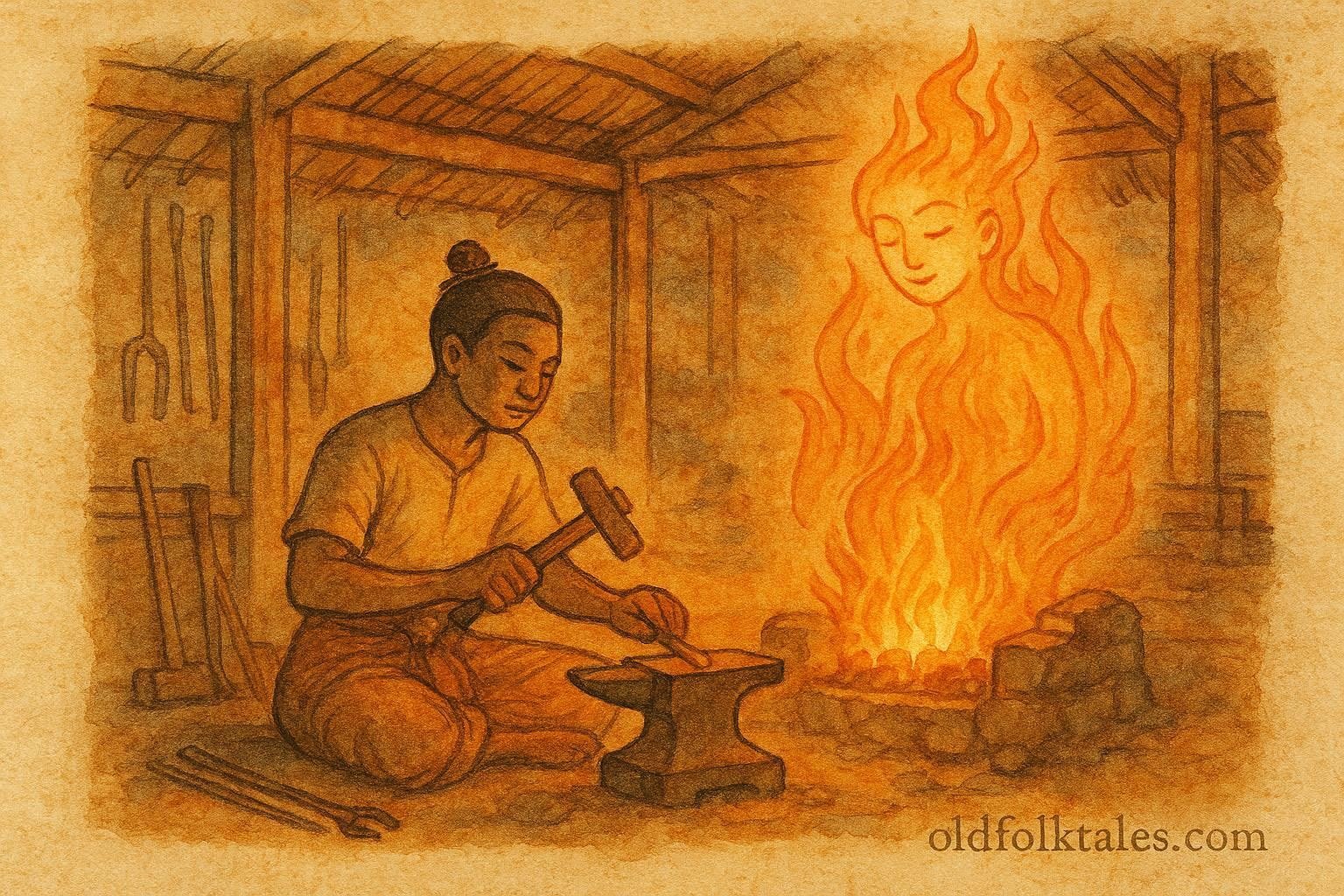
That evening, a figure appeared within the glow of the forge. It was not fully formed, neither flame nor shadow, yet its presence was unmistakable. The blacksmith did not recoil. He lowered his hammer and bowed his head.
The fire spirit spoke without sound, its meaning settling directly into the blacksmith’s thoughts. It reminded him that fire sustains life when honored and destroys when abused. It thanked him for patience, balance, and humility. As a sign of gratitude, the spirit strengthened the forge, ensuring its flame would never betray him.
News spread quickly. Villagers began to approach their work differently. Farmers handled fire carefully when clearing fields. Potters watched their kilns with renewed respect. Children were taught that fire was alive in its own way.
The merchants left soon after, unwilling to accept slower work guided by care rather than greed. Life returned to its steady rhythm. The blacksmith never spoke of the spirit again, but each morning he continued to sweep the floor, offer rice, and tend the flame as one would tend a living thing.
Over time, the forge became a place of quiet teaching. Apprentices learned not only how to shape metal but how to shape their intentions. They were taught that mastery did not come from force but from understanding limits.
Long after the blacksmith’s hair turned white, the forge still burned evenly. Travelers continued to smell it before seeing the village, and they said the scent carried something more than metal and smoke. It carried trust.
Journey through enchanted forests and islands in our Southeast Asian Folktales collection.
Moral Lesson
True craftsmanship is guided by respect, patience, and responsibility. Power used without understanding leads to destruction, while power guided by humility sustains communities. When people honor the forces they depend on, balance is preserved and prosperity follows naturally.
Knowledge Check
- Why was the blacksmith’s forge respected by the villagers?
Answer: Because it produced reliable tools and was tended with care and respect. - What mistake did the second forge owner make?
Answer: He tried to force the fire and ignored balance and caution. - How did the fire spirit respond to misuse of fire?
Answer: It caused destruction to stop reckless behavior. - Why did the fire spirit reward the humble blacksmith?
Answer: Because he treated fire with patience and respect. - What change occurred in the village after the disaster?
Answer: People became more mindful of how they used fire in their work. - What lasting lesson did apprentices learn at the forge?
Answer: That true mastery comes from understanding limits and responsibility.
Source
Adapted from Mandalay Region Ethnographic Folklore Collection, 2016.
Cultural Origin
Burmese Artisan Guild Folklore.