On the verdant island of Marinduque, where mountains rise like emerald crowns and forests whisper ancient secrets, there once lived a maiden whose beauty was matched only by the depth of her heart. Her name was Lila, and she dwelled in a small village nestled between the hills and the sea, where coconut palms swayed in the tropical breeze and the scent of sampaguita flowers perfumed the evening air.
Lila was known throughout the village for her gentle spirit and her enchanting voice. When she sang while weaving beside her window, even the birds would fall silent to listen. Her dark eyes held the warmth of candlelight, and her laughter could lift the heaviest of hearts. But of all who admired her, none loved her more deeply than Datu, a young hunter whose skill with bow and spear was legendary among his people.
Click to read all East Asian Folktales — including beloved stories from China, Japan, Korea, and Mongolia.
Datu was strong and brave, with hands that could draw a bowstring taut and a heart that beat only for Lila. He would venture deep into the forest each day, tracking deer and wild boar through the dense undergrowth, but his thoughts were always with the maiden who waited in the village. Each evening, he would return with his catch and lay the finest portions at her family’s door, a silent offering of his devotion.
Their love blossomed like the white gumamela flowers that grew wild along the forest paths. They would meet at twilight beneath the ancient balete tree at the edge of the village, where they would speak of their dreams and watch the sun sink into the western sea. Datu would tell her of his plans to build them a house on the hillside, where they could see both the forest and the ocean. Lila would weave him garlands of sampaguita and speak of the children they would one day raise together.
But the world was not always kind to those who loved deeply. One fateful day, raiders from across the sea descended upon Marinduque. Their boats appeared on the horizon like dark omens, and by the time the village spotted them, it was too late to flee. The raiders came seeking plunder and captives, their weapons flashing in the harsh sunlight.
Datu fought with the ferocity of a wounded tiger, defending his village and the woman he loved. His arrows flew true, and his spear found its mark again and again. But he was outnumbered, and the raiders were seasoned warriors. As the sun climbed toward its zenith, Datu fell, struck down by a blade he never saw coming. His blood stained the earth red, and his final breath carried Lila’s name across the battlefield.
When Lila found him, her anguished cry echoed through the ravaged village. She cradled his body in her arms, her tears falling like rain upon his still face. The raiders had been driven back, but at terrible cost. Datu, her beloved, her future, lay cold and lifeless in her embrace.
For days, Lila could not eat or sleep. She withdrew to her room, staring out the window toward the forest where Datu had once hunted, toward the balete tree where they had shared their dreams. The village elders tried to comfort her, but grief had wrapped around her heart like chains. At night, she would kneel by her window and pray to the spirits of the forest, to the ancient deities who dwelt in the mountains and the sea.
“Please,” she whispered into the darkness, her voice breaking with sorrow. “Let me see him again. Just once more. I would give anything to know he still exists somewhere beyond this world of pain.”
The spirits, moved by such profound love and grief, heard her prayer. They could not restore life to the dead, for such was beyond even their power. But they could offer something else a transformation, a bridge between the world of the living and the realm of souls.
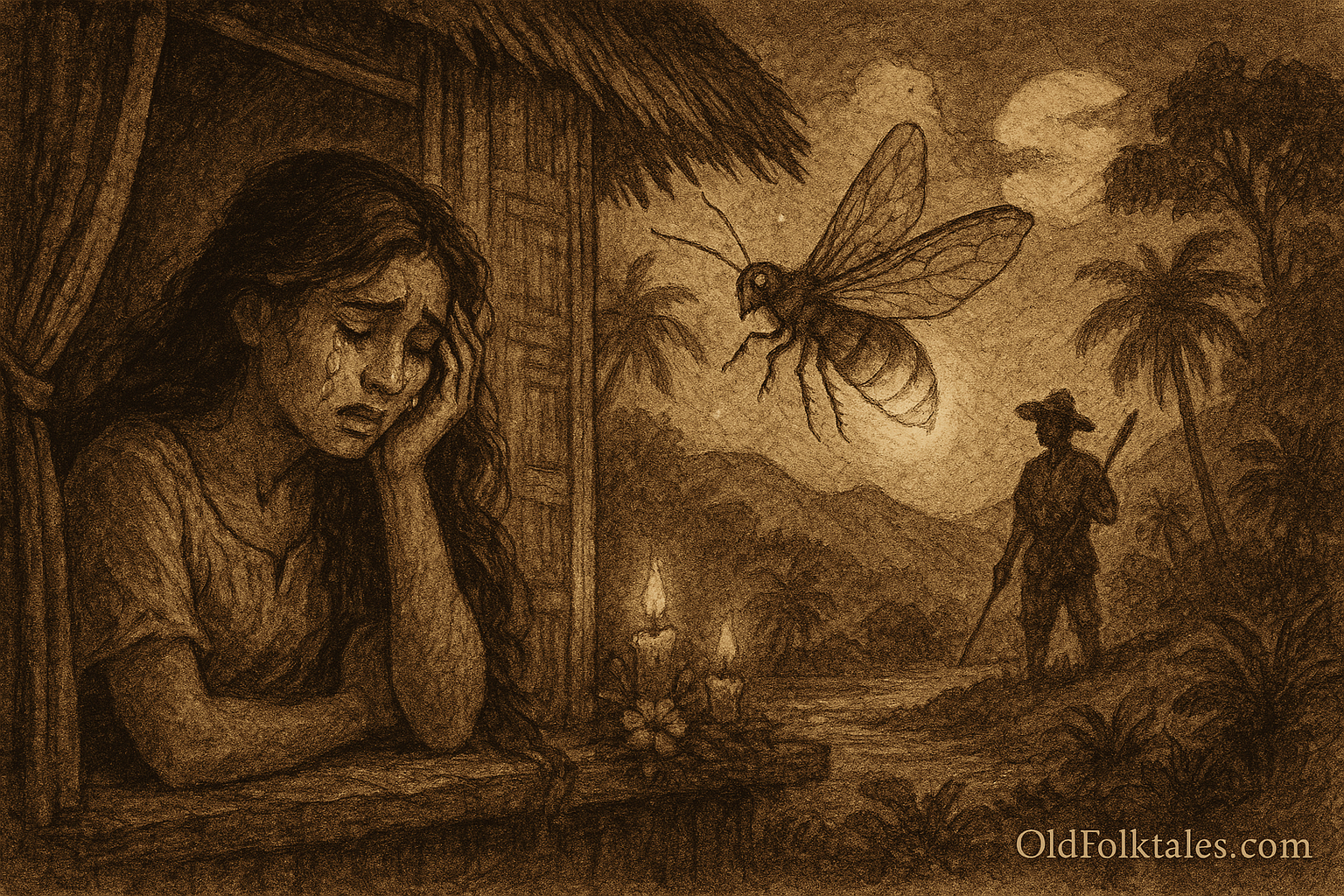
On the seventh night after Datu’s death, as Lila sat weeping by her window, she noticed a strange glow in the darkness. A single firefly, larger and brighter than any she had ever seen, drifted toward her window. Its light pulsed with a warm, golden radiance that seemed to carry within it all the tenderness of a lover’s gaze.
The firefly circled her window three times, then settled on the sill. As Lila watched through her tears, she felt a presence familiar, beloved, and unmistakable. In the gentle glow of that luminous insect, she recognized the essence of Datu’s soul. The way it moved, the rhythm of its light, even the warmth it seemed to emanate all spoke to her heart in a language beyond words.
From that night forward, the glowing firefly returned to Lila’s window each evening. It would dance in the air before her, its light painting patterns in the darkness, as if Datu was trying to tell her that love does not end with death. Lila would sing to the firefly, the same songs she had once sung for Datu beneath the balete tree, and the creature would pulse its light in response, a conversation of luminescence and melody.
Word of the miracle spread throughout Marinduque. The villagers began to call the fireflies in their forests “the lover’s lanterns,” believing that each carried within it the soul of someone who had loved deeply in life. Parents would point to the glowing insects and tell their children stories of Lila and Datu, of love so powerful that not even death could extinguish it.
Lila lived many more years, and though she never married another, she was not unhappy. Each night brought her beloved back to her, transformed but present, a living testament to the enduring nature of true love. And when she finally closed her eyes for the last time, many years later, the villagers swore they saw two fireflies dancing together in the darkness one that had visited her window for decades, and another, newly transformed, rising to join it.
To this day, in the forests and fields of Marinduque, fireflies dance through the tropical nights. The old people still call them “the lover’s lanterns,” and young couples who see them glowing in the darkness are reminded that love, once kindled, burns eternal a light that transcends the boundary between life and death, shining on through the ages.
Click to read all Southeast Asian Folktales — featuring legends from Thailand, Indonesia, Vietnam, and the Philippines.
The Moral Lesson
The legend of the Firefly Lover teaches us that genuine love transcends the physical boundaries of life and death. Lila’s devotion and Datu’s transformed presence remind us that the bonds we forge through deep emotional connection cannot be severed by mortality. The story emphasizes that love, in its purest form, is a spiritual force that endures beyond earthly existence. It also illustrates the power of faith and prayer, showing how sincere grief and devotion can move even the spirits to offer comfort. The fireflies of Marinduque serve as eternal reminders that those we love are never truly lost they remain with us in ways that transcend our understanding.
Knowledge Check
Q1: Who were Lila and Datu in the Marinduque firefly legend?
A: Lila was a beautiful maiden known for her gentle spirit and enchanting voice, while Datu was a skilled young hunter who loved her deeply. They were betrothed lovers planning to build a life together on the island of Marinduque.
Q2: How did Datu die in the Philippine folklore tale?
A: Datu was killed by raiders from across the sea who attacked the village. He died defending his village and Lila, fighting bravely but being outnumbered by the seasoned warriors.
Q3: What did Lila pray to the spirits for after Datu’s death?
A: Lila prayed to the forest spirits and ancient deities for seven nights, begging them to let her see Datu again, saying she would give anything to know he still existed somewhere beyond the world of pain.
Q4: How did the spirits answer Lila’s prayers in this legend?
A: The spirits transformed Datu’s soul into a large, luminous firefly that visited Lila’s window each night, allowing the lovers to maintain their connection across the boundary between life and death.
Q5: What are fireflies called in Marinduque folklore because of this story?
A: Fireflies in Marinduque are called “the lover’s lanterns” because of the belief that each firefly carries within it the soul of someone who loved deeply in life, inspired by Lila and Datu’s story.
Q6: What does the firefly symbolize in this Philippine legend?
A: The firefly symbolizes eternal love, the endurance of the soul beyond death, and the spiritual connection between lovers that transcends physical boundaries. It represents hope, transformation, and the belief that love never truly dies.
Source: Adapted from Nicomedes Márquez Joaquín, Marinduque Folk Narratives
Cultural Origin: Marinduque Island, Philippines