Along the sunlit coast of Sur, where the turquoise waves of the Arabian Sea lap gently against wooden dhows, lived a humble fisherman named Yusuf. Every dawn, before even the first gulls stirred, he walked toward the shore carrying his worn net, the shabaka, slung over his shoulder. His income was small, barely enough to buy dates and flour for his family, yet he worked with quiet dignity and a heart full of gratitude.
But on one fateful morning, the sea felt strangely still. Yusuf cast his net once, then twice, and each time it rose from the water empty, dripping only with the briny scent of the tide. The third cast felt heavier, as though the ocean itself held it down. Yusuf braced his feet in the wet sand and pulled with all his strength. At last the net emerged, not with fish, but with an ancient, green-stained copper jar, a jarra sealed with a thick layer of lead.
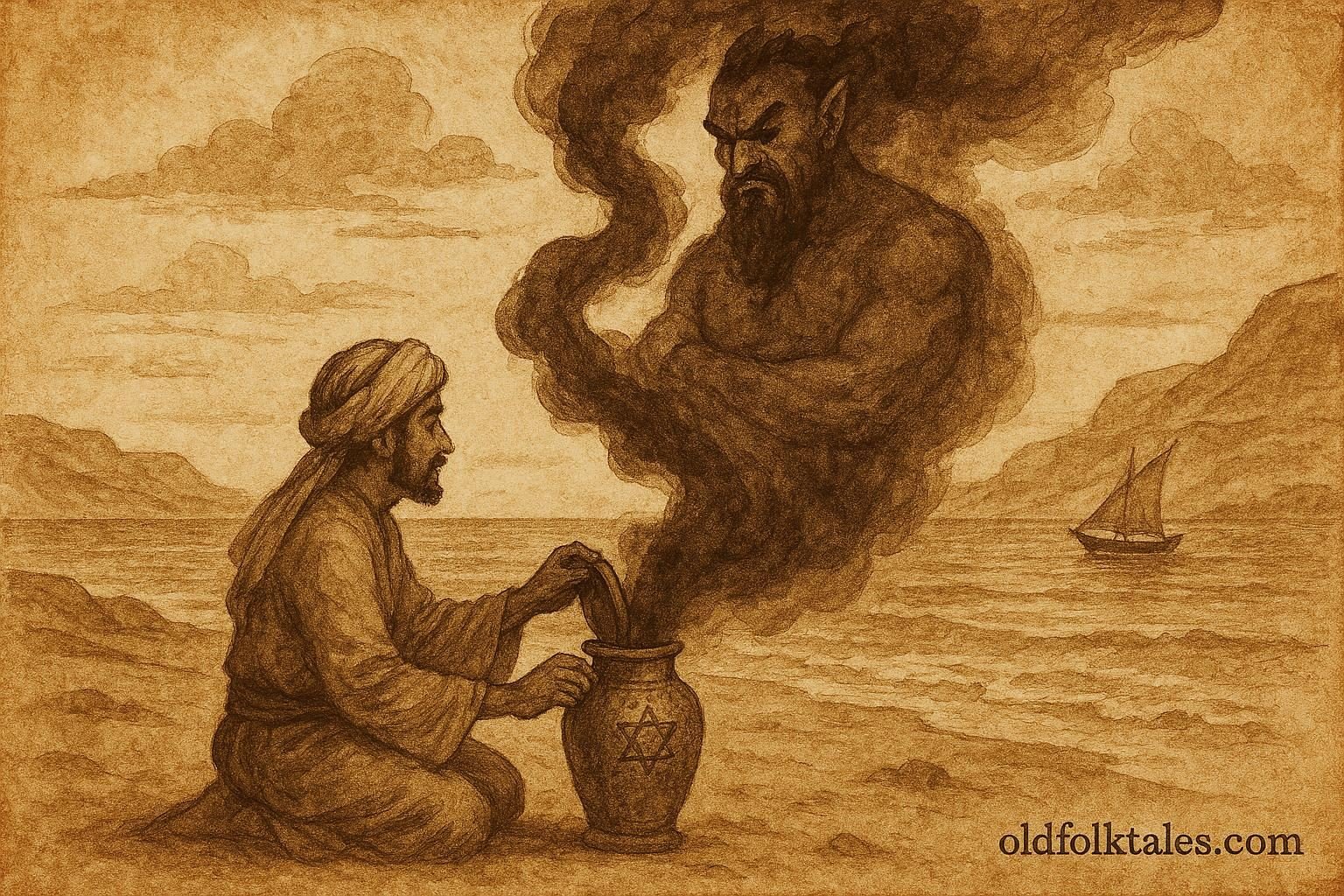
Inscribed upon its surface was the unmistakable mark of Khatam Sulayman, the Seal of Solomon. Yusuf’s heart raced. Perhaps it contained treasure from forgotten caravans or the wealth of drowned kingdoms.
He pried at the seal with a knife and, with a sudden metallic crack, the lid flew open.
From within the jar surged a mass of black smoke, twisting, churning, rising higher than the palms along the shore. The air trembled as the smoke took form: an enormous jinni with blazing eyes and a voice like thunder.
“Praise the Almighty!” the jinni roared. “I am free after one thousand years!”
Yusuf collapsed to his knees, trembling.
The jinni continued, “For the first five hundred years, I swore to grant my rescuer three wishes. But none came. For the next five hundred years, my fury grew. I swore that whoever freed me would be slain. You, fisherman, arrive in my years of wrath. Prepare for death!”
Yusuf felt the strength drain from his limbs. Yet even in terror, his mind worked quickly. He knew the tales of Sur well, jinn were mighty, but pride could blind them.
Keeping his voice steady, Yusuf lowered his gaze. “If death is my fate, then I accept it. But before I give myself to it, allow me one moment of clarity.”
The jinni narrowed his fiery eyes.
Yusuf continued, “Forgive my doubt, O mighty one, but it is difficult for a simple fisherman to believe that such a vast, powerful being could have fit inside this small jar. Before I die, let me see this miracle for myself.”
The jinni threw back his head and laughed, a sound rolling like thunder across the waves.
“You doubt me? Watch, mortal!”
With a furious swirl, the giant form dissolved into smoke again, coiling downward and squeezing itself through the jar’s narrow opening. In an instant, the entire jinni had returned inside the vessel.
Yusuf acted immediately.
He slammed the lead seal shut and pressed his body weight atop it. The jar rattled violently as the jinni realized the trick.
“Open this jar, human!” the muffled voice boomed. “You deceived me!”
Yusuf steadied his breath. “O mighty jinni,” he said, “you have spoken of death, but I offer you a different path. Swear an oath, Billahi al-‘Atheem, by the Most High, that if I free you again, you will reward kindness with kindness and harm me no more.”
The jar fell silent. Jinn could twist words, but an oath by the Most High could not be broken.
At last, the jinni said, “I swear by the Most High and bind myself with a yameen: I will reward you if you release me.”
Only then did Yusuf reopen the jar.
This time the jinni rose gently, his form smaller, calmer, bound by his oath. “Come,” he said, “and I shall show you what no fisherman has seen.”
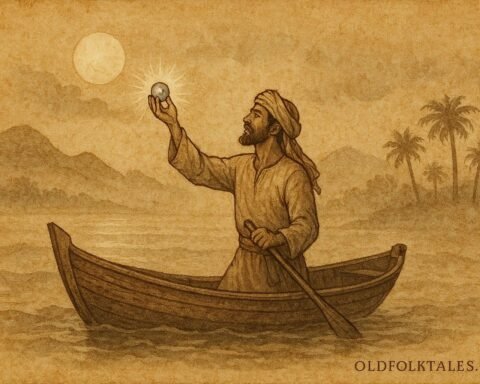
He led Yusuf along the coast to a hidden inlet, a khor where the water shimmered like molten silver. They dove beneath the surface, and Yusuf followed the jinni into a submerged cave glowing with an otherworldly light.
Inside lay a bed of oysters unlike any he had known, each one holding pearls the color of rose petals at dusk.
“These,” the jinni said, “are the pearls of the deep caravans. Take only one each full moon. If you take more, the cave will vanish forever.”
Yusuf obeyed. Month after month, he returned for a single pearl. Soon he became one of Sur’s most respected pearl merchants, but he never forgot the vow that safeguarded his fortune. His honesty became known across the coast, and people would say:
“The mind of a wise man is sharper than the sword of a jinni.”
Moral of the Story
The tale teaches that wit and calm thinking can overcome overwhelming danger, and that blessings endure only when approached with humility, discipline, and respect for sacred agreements.
Knowledge Check
1. Who is the main character in this Omani folktale?
Yusuf, a humble fisherman from the coastal city of Sur.
2. What object did Yusuf pull from the sea?
An ancient copper jar sealed with lead and marked with Solomon’s seal.
3. Why did the jinni want to kill Yusuf at first?
Because he had spent five centuries in anger, vowing death on whoever freed him.
4. How did Yusuf trick the jinni back into the jar?
He pretended not to believe the jinni could fit inside and asked for proof.
5. What reward did the jinni give Yusuf after the oath?
Access to a hidden underwater cave filled with rare rose-colored pearl oysters.
6. What is the main lesson of the folktale?
Wisdom, patience, and clever thinking can overcome even supernatural threats.
Source
Adapted from UNESCO Tales from Oman (Page 23), Coastal Folklore of Sur.