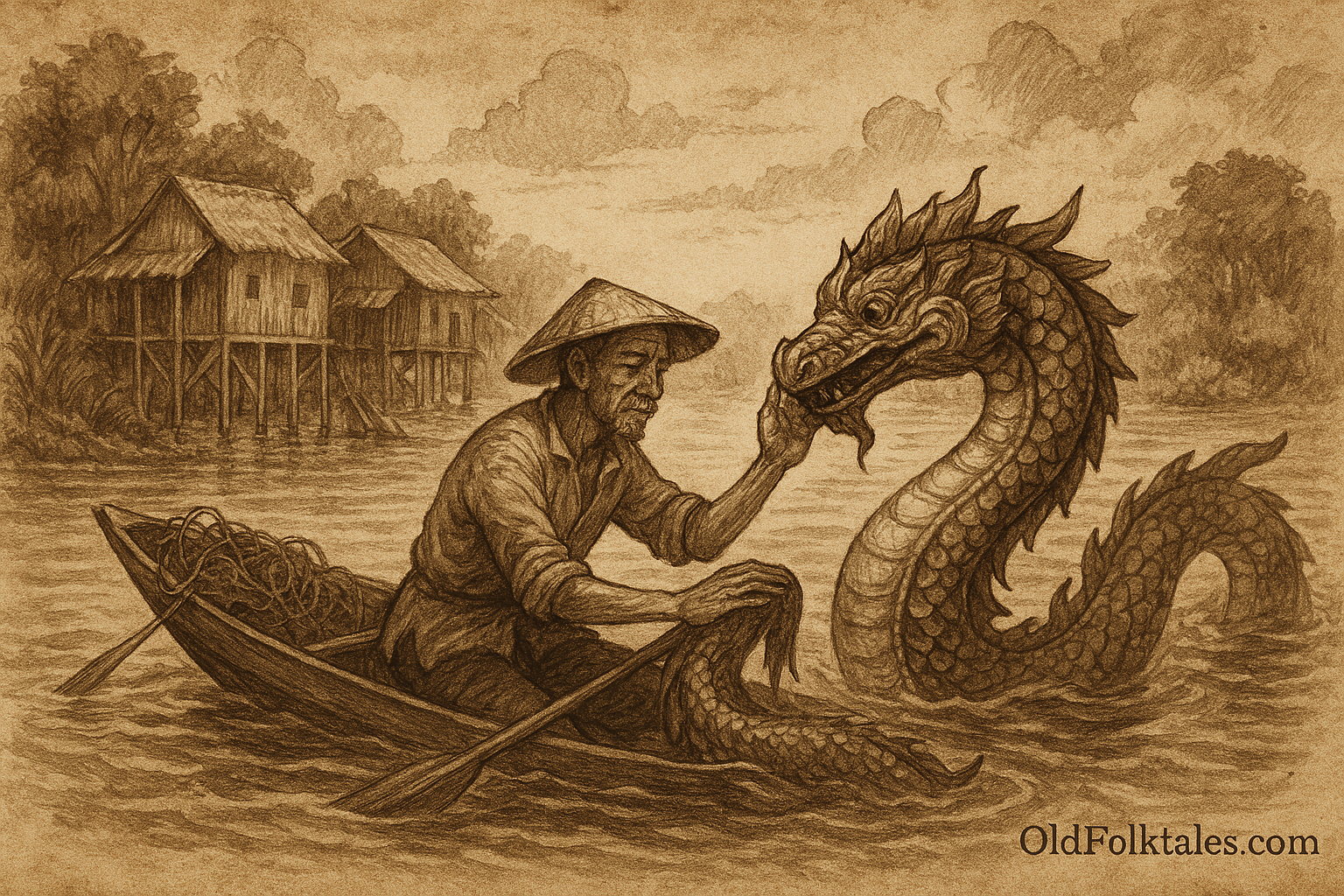
In a small fishing village along the shores of the great Tonle Sap lake in Cambodia, where wooden houses stood on tall stilts above the water and families lived their lives according to the rhythms of the fish and the seasons, there dwelt a humble fisherman named Kosal. Each morning before dawn, he would push his narrow boat into the dark waters, his nets folded carefully beside him, and paddle out to the fishing grounds where his father and grandfather had cast their nets before him.
Kosal was neither rich nor poor by the village’s modest standards. He caught enough fish to feed his family and sell a portion at the market, though he never seemed to have quite enough to repair his aging boat or buy new nets when the old ones frayed. Still, he harbored no bitterness in his heart. He greeted each sunrise with quiet gratitude, thanking the spirits of the water for whatever they chose to provide.
Click to read all East Asian Folktales — including beloved stories from China, Japan, Korea, and Mongolia.
One misty morning, as pale light began to paint the eastern sky in shades of pearl and rose, Kosal noticed something strange tangled in his nets. At first, he thought it was a large python or perhaps a piece of driftwood wrapped in water plants. But as he drew closer, his breath caught in his throat.
It was a naga, a serpent spirit of the waters, and it was wounded. The creature’s scales shimmered with iridescent blues and greens even in the dim light, but a deep gash marred its side where something sharp had torn its flesh. The naga’s eyes, ancient and intelligent, regarded Kosal with a mixture of pain and wariness. Most humans would have recoiled in fear, for nagas were powerful beings, neither fully of the earthly realm nor entirely belonging to the spirit world.
But Kosal felt only compassion. He carefully freed the magnificent creature from his nets, working gently to avoid causing further injury. The naga remained still, watching him with those fathomless eyes. When it was finally free, Kosal tore a strip of cloth from his own shirt and bound the creature’s wound as best he could, murmuring soft words of comfort.
“Great spirit,” Kosal said respectfully, bowing his head, “I do not know what injured you, but I hope this small kindness helps your healing. The waters are your home, and I am merely a guest here. Please accept my humble assistance.”
The naga studied him for a long moment, its forked tongue tasting the air. Then, in a voice that seemed to come from the water itself, it spoke: “You have shown me mercy when you could have shown fear or sought to capture me for your own gain. Such kindness is rare among humans. I am Neak Poan, guardian of these waters, and I will not forget what you have done.”
Before Kosal could respond, the naga slipped beneath the surface, disappearing into the depths with barely a ripple. The fisherman sat in his boat, wondering if the encounter had been real or merely a dream born of the early morning mist.
But it had been real, and the naga kept its word. From that day forward, Kosal’s fortunes changed dramatically. His nets grew heavy with fish of the finest quality. When storms threatened other boats, his small vessel always found safe harbor. His family never went hungry, and he began to accumulate modest savings that allowed him to repair his boat and purchase new equipment.
The naga appeared to him occasionally, rising from the water at dawn to speak of the lake’s moods and the movements of the fish. A friendship of sorts developed between the human and the spirit, built on mutual respect and the memory of that first act of compassion. Neak Poan also granted Kosal a special protection: whenever danger threatened him on the water, a shimmer would appear on the waves, warning him to seek safety.
For several years, Kosal kept this blessing to himself, saying nothing to his neighbors about the source of his good fortune. He shared his abundant catches with those in need and helped other fishermen when their luck failed, but he never revealed the secret of the naga’s friendship.
But gratitude, like water held in cupped hands, can be difficult to contain indefinitely. One evening, after helping rescue a neighbor whose boat had capsized in sudden winds, Kosal made a fateful mistake. The rescued man pressed him repeatedly about his uncanny ability to predict dangerous weather and always find the best fishing spots.
“How do you know these things, brother Kosal?” the man insisted. “You must have a secret. We have been friends since childhood. Surely you can share it with me?”
Worn down by the man’s persistence and feeling generous after several cups of palm wine, Kosal finally confessed the truth about the naga and the bond they shared.
The neighbor’s eyes widened with greed even as he smiled and thanked Kosal for his confidence. “A naga!” he exclaimed. “Think of the blessings such a creature could bestow on all of us! You must tell the other villagers. We could all prosper!”
Despite Kosal’s immediate regret and his pleas for discretion, the neighbor spread the tale throughout the village by the next morning. Soon, dozens of fishermen were searching the waters for nagas, hoping to secure their own magical benefactors. Some carried offerings of fruit and incense, but others came with nets and spears, thinking to capture a naga and force it to grant wishes.
The waters of Tonle Sap grew turbulent and muddy as boats crisscrossed its surface day and night. Fishermen argued and fought over territory, each claiming the best spots for encountering nagas. The respectful quiet that had once characterized their work transformed into chaotic greed.
Kosal watched this transformation with growing horror and shame. He tried to explain to his neighbors that the naga had blessed him because of compassion and respect, not because of demands or offerings. But in their fever of desire, no one listened.
One dawn, Neak Poan appeared before Kosal for the last time. The great serpent spirit’s expression was sorrowful rather than angry.
“You saved my life once,” the naga said quietly, “and for that, I gave you my friendship and protection. But you betrayed the sacred trust between us by revealing our bond to those who cannot understand it. Look at what your words have brought. The waters are disturbed, the fish are frightened, and men have turned from honest work to scheming for magical shortcuts to prosperity.”
“I am deeply sorry,” Kosal whispered, tears streaming down his weathered face. “I was foolish and weak. I should have guarded our friendship as the treasure it was.”
“Yes,” Neak Poan agreed. “Some gifts are meant to remain hidden, for in the revealing, they lose their power. Not because spirits are cruel, but because the sacred requires discretion to survive in a world of human greed and carelessness.”
The naga dove beneath the surface one final time, and Kosal never saw it again. His special blessings vanished immediately. His catches returned to being merely ordinary, his intuition about weather no better than any experienced fisherman. The shimmer of protection on the waves disappeared.
Worse still, the entire village’s fortune declined. The disruption caused by treasure-seeking boats had driven away the fish, and none of the villagers who sought nagas ever found them. The spirits of the waters withdrew their general benevolence, and the fishing village that had once prospered fell on hard times.
Kosal lived the rest of his days with the weight of his mistake, working harder than ever just to earn what he had once received as a blessing. He became an old man with a sorrowful face, who would sometimes sit by the water at dawn, gazing at the waves with longing and regret.
And the villagers learned, too late, that some gifts are meant to remain between the giver and the receiver, that discretion is often the price of magic, and that greed transforms blessings into curses.
Click to read all Southeast Asian Folktales — featuring legends from Thailand, Indonesia, Vietnam, and the Philippines.
The Moral Lesson
This tale teaches that discretion and gratitude are essential when receiving gifts from the sacred realm. Special blessings come not from seeking magic but from acts of genuine compassion and respect, and these gifts lose their power when exploited or exposed to the greed of others. The story warns that revealing sacred secrets transforms spiritual relationships into objects of exploitation, destroying the very trust that made the blessings possible. True wisdom lies in recognizing that some treasures must remain hidden to preserve their value, and that sharing good fortune through generous actions is better than sharing the secrets that produced it.
Knowledge Check
Q1: Who was Kosal and what was his life like before meeting the naga?
A1: Kosal was a humble fisherman living in a village on the shores of Cambodia’s Tonle Sap lake. He lived a simple, modest life, catching just enough fish to feed his family and sell at market, never quite having enough for major repairs or new equipment, but maintaining a grateful heart and respectful attitude toward the water spirits.
Q2: How did Kosal first encounter the naga and what did he do?
A2: Kosal found the naga, named Neak Poan, wounded and tangled in his fishing nets early one misty morning. Instead of reacting with fear or trying to exploit the powerful spirit, he carefully freed it from the nets, tore cloth from his own shirt to bind its wound, and spoke respectfully, showing pure compassion without expecting reward.
Q3: What blessings did the naga grant Kosal after he saved its life?
A3: The naga blessed Kosal with abundant fish catches of the finest quality, protection from storms and dangers on the water, a special shimmer on the waves that warned of approaching danger, and occasional visits to share wisdom about the lake’s conditions. These blessings brought prosperity and safety to Kosal and his family.
Q4: What fatal mistake did Kosal make regarding his relationship with the naga?
A4: After years of keeping the secret, Kosal revealed the source of his good fortune to a persistent neighbor who had been pressing him for answers. Despite knowing he should maintain discretion, he confessed about the naga after drinking palm wine, and the neighbor immediately spread the tale throughout the village, transforming sacred trust into public knowledge.
Q5: What happened to the village after Kosal’s secret was revealed?
A5: The village descended into chaos as greedy fishermen searched obsessively for nagas, some with offerings but others with nets and spears. The waters became turbulent and disturbed, fish were frightened away, and the naga withdrew its blessings from Kosal. The entire village’s fortune declined because the spirits of the waters withdrew their general benevolence due to the disrespect and greed displayed by the treasure-seeking villagers.
Q6: What does the naga symbolize in Cambodian folklore and culture?
A6: In Cambodian culture, nagas are powerful serpent spirits that guard waters and represent the connection between earthly and spiritual realms. They symbolize natural forces that can bless or withhold prosperity, the importance of respecting sacred beings, and the belief that spiritual relationships require proper conduct, discretion, and genuine reverence rather than exploitation or greed.
Source: Adapted from traditional Cambodian folklore and naga legends documented in “Cambodian Buddhism: History and Practice” by Ian Harris
Cultural Origin: Khmer, Tonle Sap Region, Cambodia