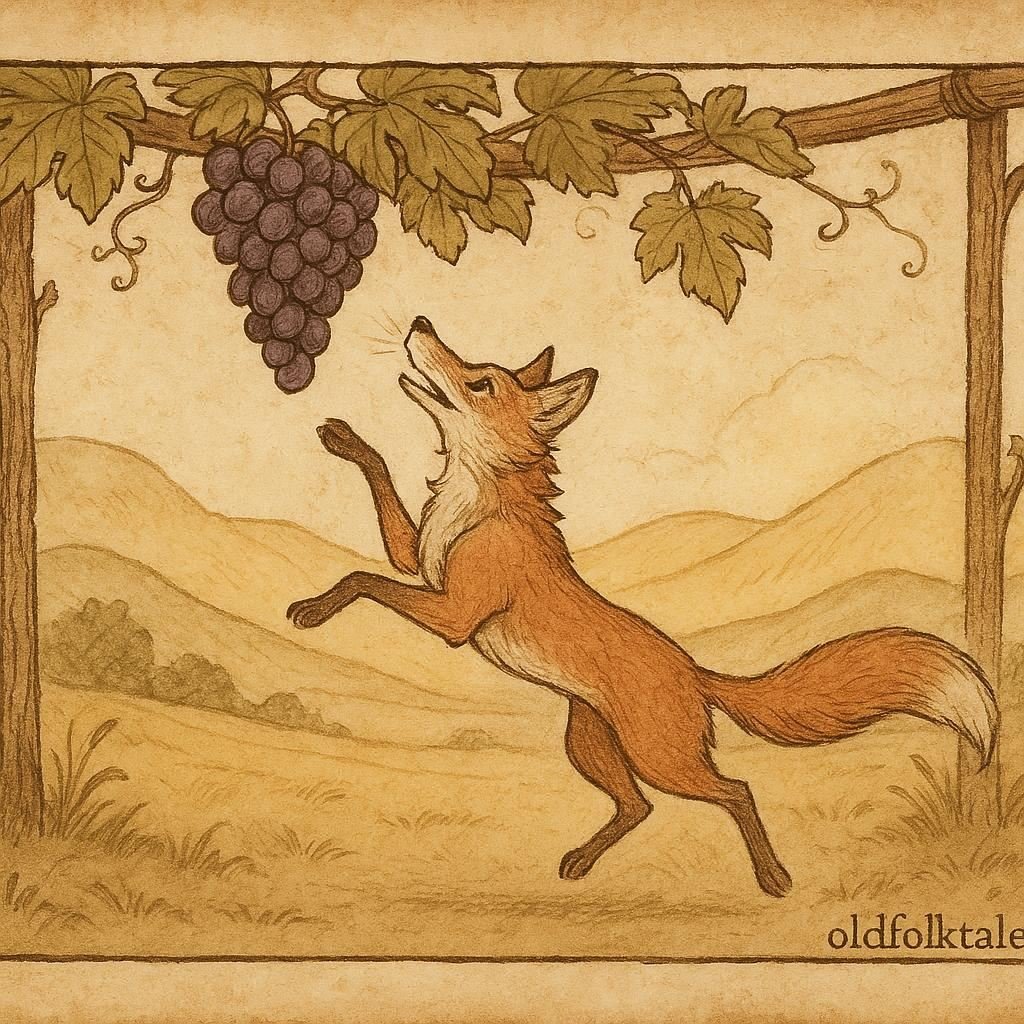
Under the soft gold of a Tajik afternoon, a lone fox wandered through a quiet valley. The air shimmered with heat, and the scent of ripened fruit drifted from the vineyards nearby. The fox’s paws were sore from travel, and his stomach rumbled with hunger. His sharp eyes darted across the hills in search of food, a fallen fruit, a stray berry, anything to ease his empty belly.
Then, as he lifted his head, he saw them, a cluster of grapes hanging high on a vine that trailed across a wooden trellis. The grapes glistened like amethysts in the sun, their skins plump and full. The fox’s mouth watered at the sight.
Explore desert legends and palace tales in our Western Asian Folktales archive.
“Ah,” he said to himself, licking his lips, “such fine grapes, surely they were meant for me.”
He trotted closer and stood beneath the vine. The grapes hung just above his reach. The fox crouched low, then sprang upward, but his paws closed on air. He landed in the dust, blinking in surprise.
Undeterred, he circled the vine, studying it from all sides. “A clever fox like me cannot be outsmarted by a fruit,” he muttered.
He jumped again, higher this time, stretching his limbs and snapping his jaws. But once again, he missed. The grapes swayed gently, as if mocking his efforts.
Panting in the afternoon heat, the fox stepped back. He thought hard, his tail flicking. Then, with a determined grunt, he made a running leap. His claws brushed a single leaf, but not the fruit. He tumbled into the dirt, tangled in weeds and pride.
Fuming, the fox glared up at the vine. “Those grapes mock me!” he growled. Yet something inside refused to give up. He tried again, one last time, mustering every ounce of strength left in his legs. He soared upward, jaws wide, heart pounding. But when he landed, the grapes were still far beyond his grasp.
Defeated and dusty, he sat down, catching his breath. For a long moment, he stared at the unreachable fruit. Then, with a disdainful snort, he rose and shook out his fur.
“Bah!” he declared, turning away. “Those grapes are probably sour anyway. Not worth my effort.”
And with that, he strutted off into the fading sunlight, tail high, pretending not to care. Behind him, the grapes hung ripe and sweet, their scent drifting gently on the breeze, a silent truth the fox refused to acknowledge.
Moral Lesson
This Tajik folktale teaches lessons on pride and self-deception. It reminds us that when we fail to achieve what we desire, we often protect our pride by pretending we never wanted it. True wisdom lies in humility, accepting our limits and learning from failure instead of denying it.
Knowledge Check
1. What drives the fox’s actions in the story?
The fox’s hunger and desire for the ripe grapes motivate him to keep trying.
2. What lesson does the story teach about pride?
It warns that pride can lead to self-deception, causing us to deny our true feelings or failures.
3. Why does the fox call the grapes sour?
He says it to protect his pride and justify his inability to reach them.
4. What do the grapes symbolize?
They symbolize desire, ambition, and the unreachable goals that test one’s humility.
5. How does this tale reflect human nature?
It mirrors how people sometimes pretend not to care about goals they fail to achieve.
6. What value does the story express in Tajik culture?
It upholds honesty, self-awareness, and modesty as virtues central to moral growth.
Source: Tajik folktale, Tajikistan.
Adapted from the Silkroad Foundation’s collection of Tajik folk tales.