High in the green-terraced mountains of Ibb, where morning mists curl around stone paths and shepherds guide their flocks through steep passes, there lived a gentle nanny goat known throughout the valley for her calm nature. Each day, she climbed the narrow ridges to graze among the wild thyme and tender mountain grass, always keeping a careful ear out for the dangers that roamed the highlands.
One late afternoon, as the sun slid behind the qat-covered hills and shadows stretched long across the pass, the goat found herself suddenly confronted by a lurking hyena. His coarse fur bristled, and his yellow eyes glowed with hunger. He had been waiting behind a boulder for hours, hoping for such an opportunity.
With a low growl he stepped forward, blocking her path.
“Your time has come,” he snarled. “I have hunted all day, and you will satisfy my hunger.”
Terrified but still thinking of her children, the nanny goat lowered her head in supplication. “Hyena, I beg you. My udder is heavy with milk for my kids waiting at home. Spare me for tonight. Let me feed my little ones at dawn. After that, you may take me. I will not run.”
The hyena paused. Hunger gnawed at every bone in his body, but the goat’s plea stirred a flicker of cunning. He did not trust her.
“Very well,” he said slowly, “but not without guarantee. You must leave me your kid as collateral. If you fail to return, the young one will be mine.”
The goat trembled. To hand over her child seemed unbearable, yet refusing meant certain death. Reluctantly, she agreed.
The next morning, after feeding her kids and returning faithfully, the goat found the hyena waiting, but now a second dispute rose: he not only wanted her, but also insisted the kid should still be his.
Fearing injustice, the nanny goat hurried to the one creature known far and wide for wisdom and fairness, the fox. In Yemeni folktales, the fox is not merely cunning but also a skilled mediator, able to outthink beasts far stronger than himself.
She found him resting beneath a juniper tree, tail wrapped neatly around his paws.
“Fox,” she pleaded, “you are known for justice. Help me. The hyena seeks to claim both my life and my child.”
The fox listened without interruption, his sharp ears twitching thoughtfully. When she finished, he nodded.
“Bring the hyena here. I will judge between you.”
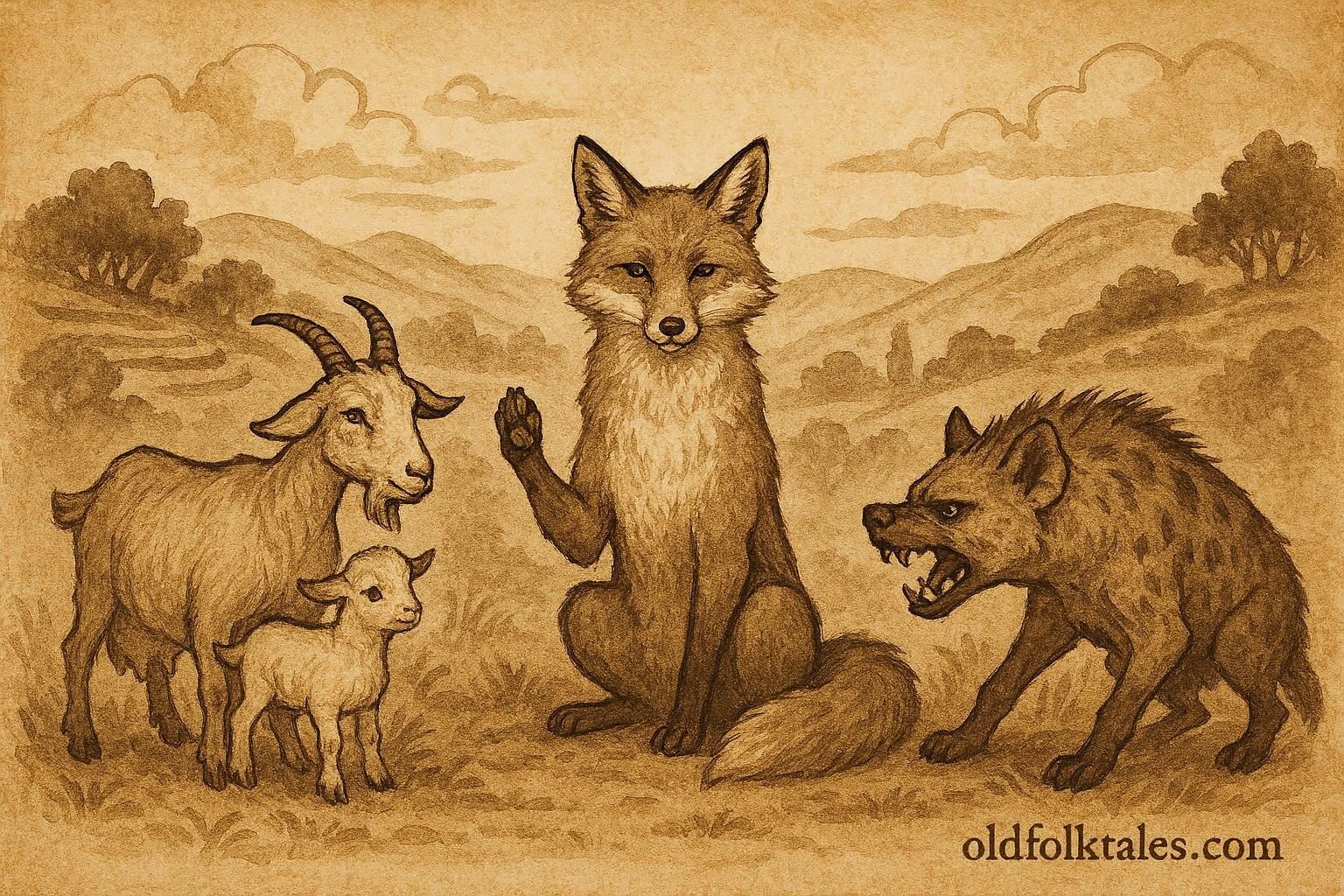
Soon the three animals stood in a circle beneath the mountain’s shade, the trembling goat, the snarling hyena, and the fox whose calm eyes held the authority of a judge.
The hyena declared loudly, “Both mother and child belong to me! She offered the kid as collateral. The kid is mine.”
The goat protested, “I returned as promised. He wants more than his due!”
The fox raised his tail for silence.
“There is a simple test,” he said. “Let the kid walk freely between you. Whoever the little one runs to is the rightful owner.”
The hyena grinned, certain the kid would fear him. The goat stood quietly, heart pounding. When the fox released the young goat, the kid hesitated only a moment before running straight to his mother, pressing himself against her belly in fear.
The fox nodded solemnly.
“The bond of milk,” he declared, “is stronger than the bond of hunger. The child belongs to its mother, and the mother has fulfilled her promise. Hyena, you have no claim.”
His voice echoed with the timeless wisdom of the mountains.
Enraged and humiliated, the hyena lunged forward as if to attack them both, but the fox stepped calmly aside and said, “If you truly want fairness, I have a task for you. Only a beast of great strength can guard the moon’s reflection. It waits for you in the waterhole.”
Confused but eager to regain some dignity, the hyena hurried to the waterhole. There, on the still surface, shimmered the bright reflection of the full moon.
“Watch it closely,” the fox instructed. “Do not let it escape.”
As the hyena leaned over the pond, mesmerized by the glowing disk, the fox gave a subtle push. The hyena lost balance and tumbled into the deep pit beside the waterhole, an old trap used by hunters. Mud splashed, and the moon’s reflection rippled away.
“Stay there,” the fox called. “Guard what you can catch.”
Satisfied, he guided the nanny goat and her child safely back to their mountain path. Justice had been served, not through force, but through wisdom.
And so, in the highlands of Ibb, the tale is told to teach that clever judgment can overcome brute strength, and that the bond of a mother’s love is stronger than greed.
Moral Lesson
The story teaches that true justice recognizes natural bonds, especially the bond between mother and child. Wisdom and fairness triumph over hunger, force, and deceit.
Knowledge Check
1. What is the main conflict in The Fox Who Judged the Hyena and the Goat?
The hyena attempts to claim both the nanny goat and her kid despite their agreement.
2. Why does the goat seek the fox’s judgment in the Yemeni folktale?
She knows the fox is a wise mediator respected for fair arbitration.
3. What cultural lesson does the story highlight from the Yemeni highlands?
It emphasizes the value of maternal duty, justice, and clever problem-solving.
4. What test does the fox use to determine the kid’s rightful owner?
He lets the kid walk freely; it chooses its mother, proving the bond of milk.
5. How does the fox punish the greedy hyena in the folktale?
He tricks the hyena into falling into a pit while “guarding the moon’s reflection.”
6. What moral does the Yemeni folktale teach young readers?
That wisdom and fairness are stronger than brute force and selfish hunger.
Source
Adapted from the Yemeni folktale “The Fox Who Judged the Hyena and the Goat” in حكايات شعبية يمنية, Ahmed Al-Saqqaf, pp. 14–18.