In the farmlands outside Herat, after a long, harsh winter, a hungry fox wandered cautiously among the bare trees and snow-dusted fields. News had spread through the animal kingdom that a wolf, strong, greedy, and ruthless, had been terrorizing the local creatures, stealing food from the weak and intimidating anyone who dared cross his path.
The fox, small but clever, realized that strength alone would not win survival this season. Instead, he relied on cunning and wit. Pretending to be weak and ill, he limped along the edge of a forest trail, groaning in apparent exhaustion. When the wolf, curious and greedy, approached, the fox whispered, “I know where a human has hidden a massive cache of meat. I can lead you… but only if you protect me.”
Discover the wisdom of Persian poets and Arabian storytellers in Western Asian Folktales.
The wolf, whose appetite was as large as his pride, agreed eagerly, imagining himself feasting without resistance. The fox led him across the open fields, pausing dramatically to sniff the air, claiming that the scent of treasure grew stronger at every step. The wolf, impatient and ravenous, stumbled after him, eyes fixed on the imagined prize.
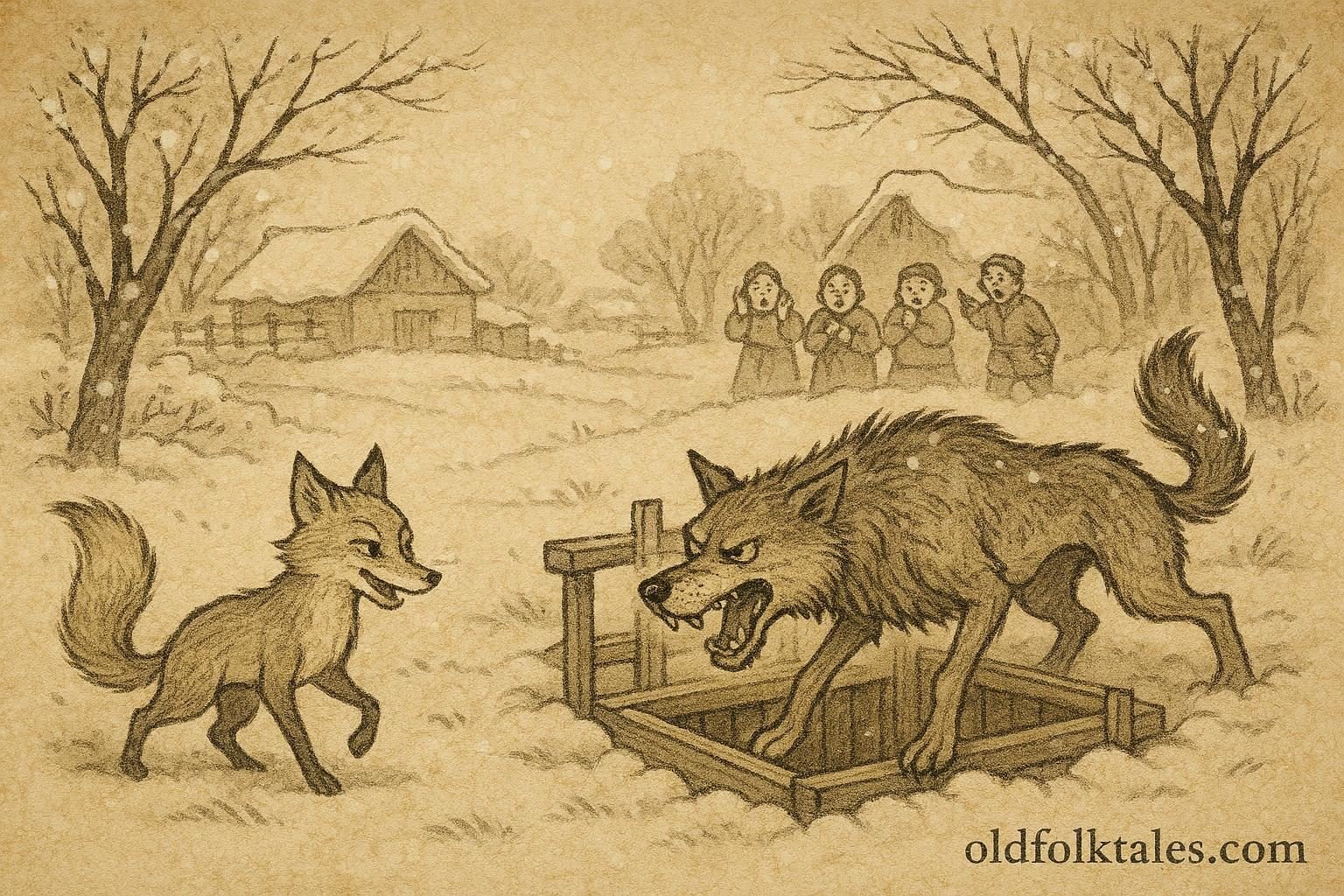
Finally, the fox stopped at the edge of a butcher’s house. “It is here,” he said solemnly, pointing behind the building to a deep storage pit used for scraps and cooling hides. The wolf leapt in without a second thought, certain that he would claim the treasure. At that precise moment, the fox scratched at the door, as if startled by some urgent noise. The butcher, awakened, rushed outside and was surprised to find a wolf trapped in his pit. After a few blows and much shouting, the wolf scrambled out, bruised and humiliated, while the fox disappeared into the snow, silently chuckling.
But the wolf’s pride would not let him rest. Days later, he found the fox and demanded an explanation. The fox feigned ignorance, “Perhaps the humans moved the meat. I know of another hiding place.” Greed clouded the wolf’s judgment, and he believed the fox once more. This time, the fox led him to a dry well, a forgotten tannery vat where nothing but shadows lingered. The wolf, frantic with hunger, dove in again and found himself trapped, unable to climb out. The fox called down from above, “Your hunger has led you to your doom. Learn patience… if you can.”
As villagers approached, the fox slipped away into the woods, leaving the wolf humiliated, hungry, and wiser only in his own folly. In this brief tale, the small and clever outwit the strong, and greed is always punished before intelligence.
Moral Lesson
Greed blinds the powerful; cleverness and patience protect the weak.
Knowledge Check
-
Who is the main character in this Afghan folktale?
The clever fox who uses wit to outsmart the greedy wolf.
-
What does the wolf symbolize in the story?
Greed and arrogance, showing how power without wisdom leads to downfall.
-
What role does the fox play in Afghan folklore?
The fox represents cleverness, strategy, and survival through intelligence rather than strength.
-
What lesson does the story teach about patience and cunning?
That careful planning and wit can overcome raw power and selfishness.
-
Where is this folktale culturally located?
Herat region, Afghanistan; part of Herati trickster story cycles.
-
Why are traps like the pit and tannery vat significant?
They illustrate how greed leads to self-destruction, emphasizing cause and effect in moral teaching.
Source: Adapted from Afghan & Herati animal folktales, collected in regional oral traditions of the Afghan highlands and Herati. Appears in anthologies of Afghan folklore and Herati narrative cycles.
Cultural Origin: Afghanistan (Herati/Afghan folklore)