In the upland regions remembered in Jewish Kurdish tradition and later preserved in Israel, there lived a solitary hunter whose life was shaped by the land and its creatures. He knew the valleys where gazelles grazed at dawn and the wooded slopes where silence carried meaning. Though skilled and respected, he lived alone, his home quiet at night, his heart unfulfilled.
One morning, while tracking game across a secluded plain, the hunter encountered a gazelle of unusual grace. Her movements were deliberate, her presence calm rather than fearful. When he raised his bow, she met his gaze. Something in her eyes unsettled him. His hand lowered, and he allowed her to pass unharmed, watching as she vanished into the tall grass.
That evening, upon returning home, the hunter found a woman seated by his hearth. She showed no fear and spoke gently, as if her presence required no explanation. She told him she wished to be his wife and to share his household. There was one condition only: he must never speak of her origin or refer to what she truly was. If he broke this rule, their life together would end.
Trusting her words, the hunter agreed. They were married, and harmony entered his home. By night, his wife lived fully as a woman, tending the household and speaking with warmth and wisdom. By day, she disappeared into the landscape, and he did not ask where she went. His prosperity grew, and his days were peaceful.
Over time, comfort dulled caution. One evening, during a moment of anger, the hunter spoke carelessly. Forgetting the vow that bound their happiness, he called his wife a gazelle. The air seemed to freeze. Sorrow passed across her face, and without speaking, she turned away. Before he could reach her, her form shifted, and she fled as a gazelle into the night.
Realizing what he had done, the hunter set out in despair. He wandered far beyond familiar paths, driven by remorse. He crossed valleys and plains, guided by signs in the natural world. The wind carried him forward. Streams allowed him passage. Birds seemed to draw him toward distant grazing lands.
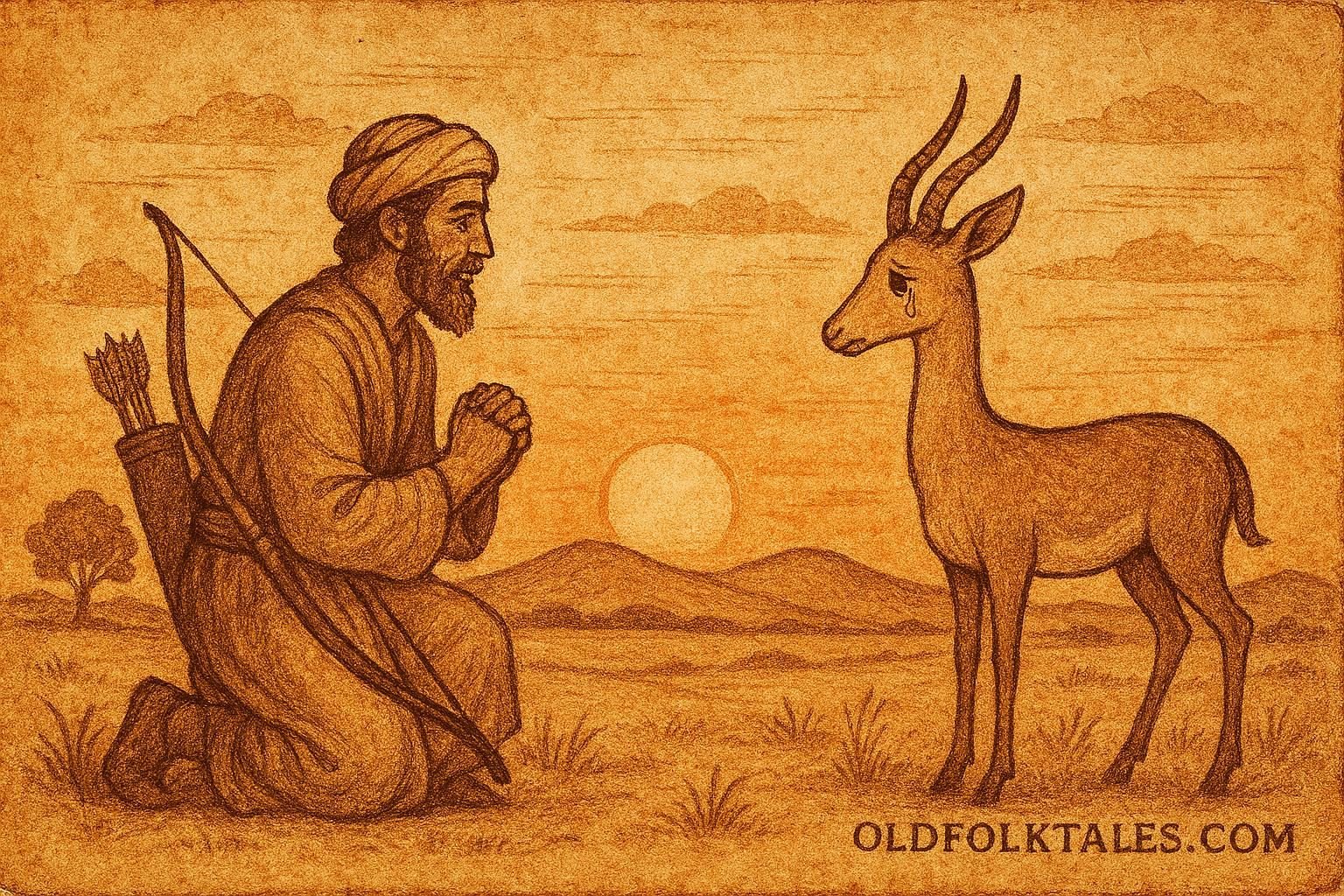
At last, he reached a wide plain filled with grazing gazelles. Among them, he noticed one whose eye glistened with a tear. Approaching slowly, he spoke no forbidden words, only regret and humility. At sunset, the spell broke. She returned to him in human form, and together they returned home, their bond restored through understanding rather than speech.
From that day forward, the hunter guarded his words carefully. The blessing he had nearly lost endured because he learned that sacred vows demand restraint and reverence.
Moral Lesson
This folktale teaches that blessings rooted in trust are fragile when disrespected. Speech carries power, and redemption requires humility, patience, and unwavering respect for sacred promises.
Knowledge Check
-
What is the central condition of the hunter’s marriage?
He must never speak of his wife’s true origin. -
What causes the gazelle-woman to leave?
The hunter breaks his vow by naming her true nature. -
How does the hunter recognize her again?
By the tear in her eye among a herd of gazelles. -
What folkloric type does this tale belong to?
The Swan Maiden cycle, ATU 400. -
What cultural theme is emphasized in this story?
The sacredness of vows and the consequences of careless speech. -
Where was this version of the tale recorded?
In Israel, preserved by the Israel Folktale Archives.
Cultural Source & Origin
Source: Israel Folktale Archives (IFA), University of Haifa. IFA 8765
Origin: Collected from Simha Haim, born in the Jewish Kurdish community. Recorded in Jerusalem, Israel, 1978.