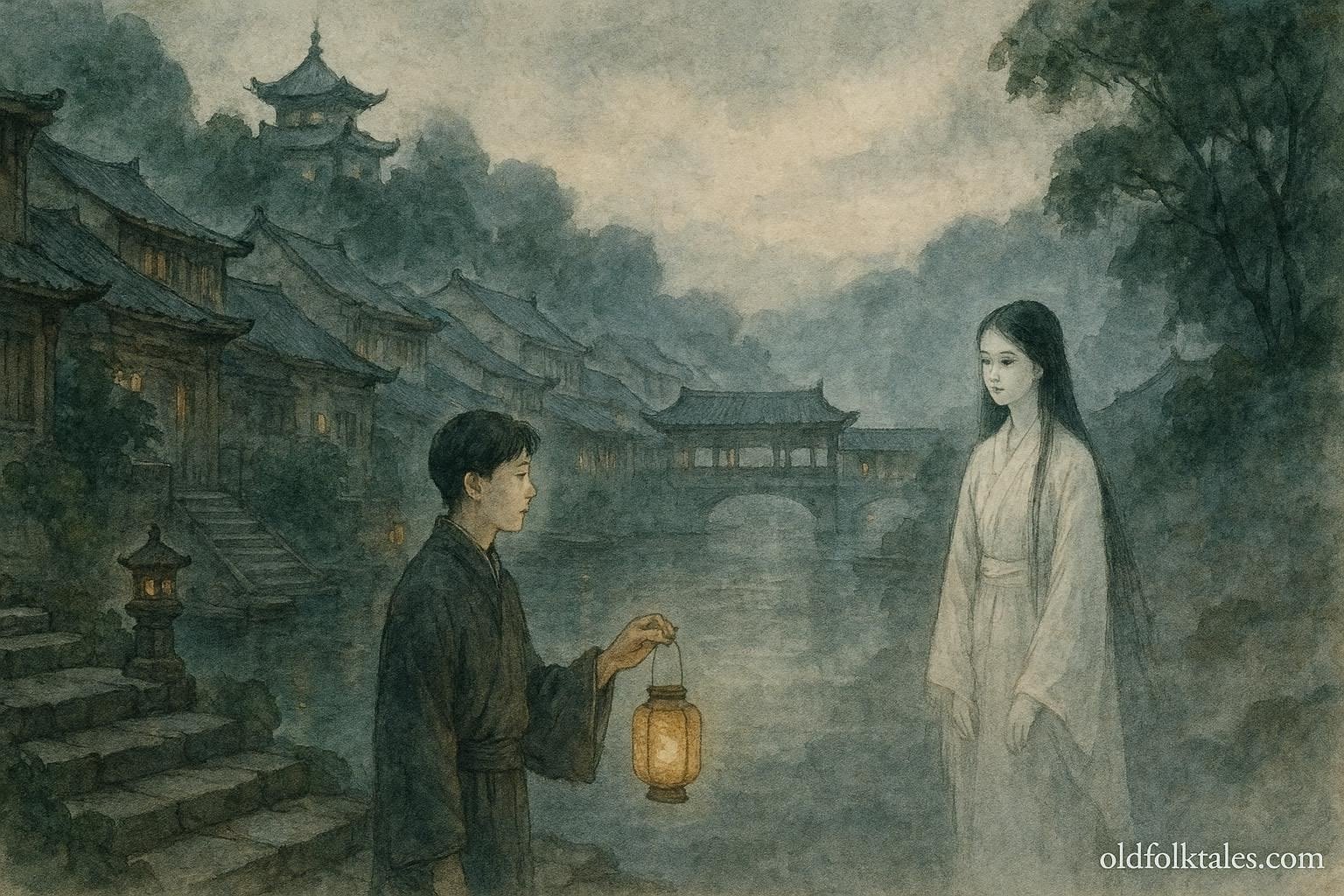
Mist rolled slowly through the river valleys surrounding Fengdu, clinging to stone steps and temple walls as though reluctant to leave the world of the living. The town had long been known as a threshold place, where the boundary between human life and the spirit realm felt thinner than elsewhere. Travelers spoke in lowered voices here. Residents burned incense with particular care. Yet for Li Wen, a young paper merchant, Fengdu was simply home.
Li Wen lived an unremarkable life by ordinary measures. He inherited his father’s small shop near the river ferry, selling paper for writing, packaging, and ritual offerings. He rose early, swept his storefront, greeted neighbors politely, and retired each night with little more than honest fatigue. His kindness was quiet and consistent, not dramatic. He helped elderly neighbors carry bundles. He never cheated customers. He bowed respectfully at temples even when no one watched.
One evening, after returning from a delivery to a nearby village, Li Wen discovered a woman waiting outside his shop. She stood beneath the lantern light, dressed in plain white garments that looked newly washed but strangely old fashioned. Her posture was modest, her eyes lowered.
Explore ancient tales from Thailand, Cambodia, and the Philippines in Southeast Asian Folktales.
She introduced herself as Madam Lin and explained that she had been promised to him through an arrangement made long ago. Li Wen was stunned. His parents had died years earlier, and no such promise had ever been mentioned. Sensing his confusion, the woman bowed deeply and apologized for arriving unannounced. She said only that circumstances required urgency and that she had nowhere else to go.
Li Wen hesitated. Fengdu was not a place where one dismissed unusual encounters lightly. Seeing her trembling slightly in the evening chill, he offered her shelter for the night. He prepared tea and gave her his late mother’s room. He slept restlessly, troubled by dreams of winding staircases and doors that opened into darkness.
The following days passed quietly. Madam Lin helped with household chores but avoided sunlight, preferring to work in shaded rooms. She ate little and spoke softly. At times, Li Wen noticed that her reflection did not appear clearly in polished surfaces. Each observation unsettled him, yet he did not confront her.
One night, while delivering paper offerings to a temple dedicated to underworld judges, Li Wen overheard priests discussing a wandering spirit bride unable to cross fully into the afterlife due to an unfulfilled bond. The description chilled him. Returning home, he lit incense and respectfully asked Madam Lin to speak honestly.
She knelt before him and revealed the truth. She had died years earlier during a famine. Before her death, her family arranged a symbolic marriage to ensure she would not wander alone in the afterlife. Through a twist of fate and ritual error, her spirit had been bound not to a tablet but to his household line. She had not chosen him deliberately but had been guided by unseen forces.
Li Wen felt fear, sorrow, and compassion intertwine. He realized she had never harmed him, never demanded wealth or indulgence. She sought only recognition and release.
Rather than banish her or seek exorcism, Li Wen consulted temple elders. They warned him that mingling with spirits risked imbalance. Yet they also acknowledged that kindness shown to the dead carried merit. They instructed him in proper rites, emphasizing respect for both realms.
That winter, Li Wen performed ceremonies each new moon. He burned paper offerings carefully, spoke Madam Lin’s name with sincerity, and listened as she shared memories of her life. He learned of her love for embroidery, her fear during the famine, her regret at dying without farewell. Through listening, he honored her humanity rather than her ghostly state.
Gradually, changes occurred. Madam Lin began to appear more solid during daylight hours. The chill around her lessened. Her sadness softened into calm. Yet she also grew more distant, spending long hours gazing toward the river where fog thickened at dawn.
One evening, she told Li Wen that the time for separation approached. Her peace depended on crossing fully into the underworld, guided by acknowledgment rather than attachment. She thanked him for seeing her as a person, not a curse.
Li Wen felt a quiet ache but did not resist. He understood that compassion did not mean possession. On the appointed night, he followed ritual instructions precisely. He prepared a symbolic wedding farewell rather than a binding ceremony. He invited monks to chant not for union but for release. He placed her name tablet beside the river with offerings meant to guide, not anchor.
As the final incense burned low, Madam Lin bowed deeply. For the first time, she smiled fully. Her form faded with the lantern light, leaving behind only a faint warmth in the air.
After her departure, Li Wen’s life returned to its simple rhythm. Yet subtle changes remained. His dreams were peaceful. His shop prospered modestly. Neighbors remarked on the calm that seemed to surround his home.
Word of the ghost bride spread through Fengdu, though details varied. Some spoke of danger avoided. Others emphasized the blessing earned through kindness. Temple elders later taught the story to apprentices as a lesson in moral boundaries. They said Li Wen succeeded because he neither denied the spirit world nor clung to it. He honored compassion while respecting cosmic order.
Years later, Li Wen married a living woman and raised children. Each year, during the Ghost Festival, he burned incense quietly by the river. He did not pray for return. He prayed for harmony.
In Fengdu, elders still say that the living and the dead walk close, but harmony depends on knowing when to open the door and when to let it close.
Moral Lesson
True compassion respects boundaries. Kindness offered without attachment allows both the living and the dead to find peace. Moral harmony is preserved not through fear of the spirit world but through ethical conduct, sincerity, and understanding of natural order.
Knowledge Check
- Why was Fengdu considered a special place in the story?
Because it was believed to be close to the boundary between the living and the spirit world. - What made Li Wen different from others in how he treated Madam Lin?
He treated her with respect and humanity rather than fear. - Why could Madam Lin not initially pass fully into the afterlife?
Because of an unresolved ritual bond tied to a symbolic marriage. - What risk did Li Wen avoid by seeking guidance from temple elders?
Disrupting the balance between the living and spirit realms. - Why was the final ceremony focused on release rather than union?
Because true peace required letting go rather than attachment. - What lasting effect did the experience have on Li Wen’s life?
It brought calm, moral clarity, and quiet prosperity.
Source
Adapted from Sichuan University Folk Belief Digital Archive, 2014.
Cultural Origin
Southwestern Chinese ghost and underworld folklore.