
In the misty highlands of northern Vietnam, where limestone karsts rise like ancient dragons from the rice paddies and the Day River winds through valleys shrouded in legend, there stands one of the nation’s most sacred sites Chùa Hương, the Perfume Pagoda. For centuries, pilgrims have journeyed to this holy complex of Buddhist temples and shrines, carved into the Huong Tich Cave and scattered across the mountainside like pearls on a string. But to reach the highest shrine, one must climb a formidable stairway of stone steps that seem to stretch endlessly upward, testing the body, the will, and as many have discovered the spirit itself.
The steps are ancient, worn smooth by countless feet over generations. They rise steeply through groves of bamboo and beneath the shadows of banyan trees whose roots grip the mountainside like gnarled fingers. During the pilgrimage season, which reaches its peak during the Perfume Pagoda Festival from the first to the third lunar month, thousands make the arduous climb, their prayers carried upward on incense smoke and whispered mantras.
Click to read all East Asian Folktales — including beloved stories from China, Japan, Korea, and Mongolia.
It is on these very steps that an extraordinary phenomenon has been reported for as long as the oldest monks can remember the appearance of a mysterious old man who offers assistance to weary pilgrims struggling with the climb.
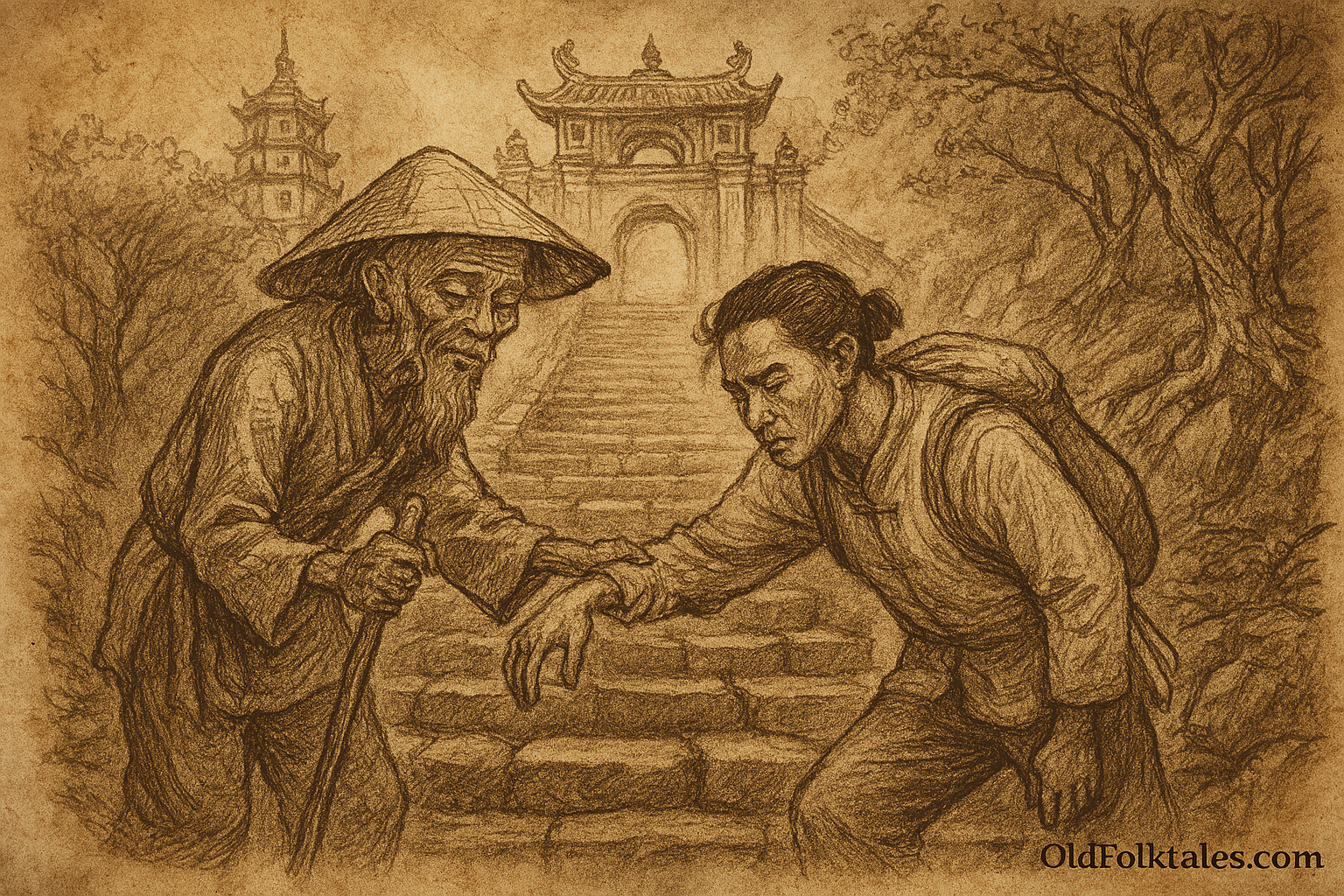
The old man is described consistently by those who encounter him: small in stature, bent with age, wearing the simple clothes of a peasant farmer dark trousers and a faded tunic, sometimes a conical nón lá hat to shield his face from the sun. His skin is weathered like old parchment, creased with deep lines that speak of a lifetime of toil. He carries a walking stick carved from bamboo, and his eyes, when they meet yours, hold an expression that is both gentle and somehow measuring, as if he sees not just your face but your very soul.
Pilgrims encounter him at different points along the ascent, usually when exhaustion has begun to set in, when legs tremble and breath comes in ragged gasps, when the summit seems impossibly distant and the temptation to turn back grows strong. He appears quietly, as if he has always been there, sitting on a stone beside the path or leaning on his stick, watching the climbers pass.
“Elder grandmother,” he will call softly to an elderly woman struggling with her burden. “Elder brother,” he will say to a young man whose pride keeps him climbing despite obvious fatigue. “Let me help you. The steps are steep, and I know them well. I have climbed them many times.”
It is at this moment that the test begins, though the pilgrims do not know it.
Those who accept his offer who bow with gratitude and allow the old man to take their arm, or carry their offering basket, or simply walk beside them offering encouragement find that the remainder of their climb becomes mysteriously easier. The steps seem less steep. The distance seems shorter. Their legs find renewed strength, and their breathing steadies. Some report feeling as if they are floating upward, their feet barely touching the stone. Before they know it, they have reached the shrine at the summit, feeling refreshed and energized rather than exhausted, their hearts filled with peace and wonder.
When they turn to thank the old man, he has vanished. No one sees him leave. He is simply no longer there, disappeared like morning mist when the sun rises. The pilgrims ask the monks at the shrine about him, describing his appearance and his kindness, and the monks smile knowingly.
“You have been blessed,” they say. “You have met the guardian spirit of the steps. He appears to test the humility of those who climb to worship. You showed respect and accepted help with grace, and so you were carried on your journey.”
But not all pilgrims respond to the old man’s offer with humility and gratitude.
There are those who, despite their exhaustion, refuse his help. Some are young and proud, unwilling to admit they need assistance from one so old and frail-looking. “I don’t need help from an old beggar,” they might mutter, pushing past him. Others are wealthy pilgrims who look down on the old man’s simple clothes and assume he has nothing to offer them. Some are simply too absorbed in their own suffering to show courtesy, ignoring his offer without even a polite refusal.
For these pilgrims, the mountain has a different experience in store.
After they refuse the old man’s help and continue climbing, they find that the steps seem to multiply beneath their feet. Where there should be fifty steps remaining to a resting platform, there appear to be a hundred. They climb and climb, yet the next landing never seems to get closer. Their legs grow heavier, their breath more labored, and a strange confusion clouds their minds. Some pilgrims have reported climbing for hours, certain they should have reached the summit, only to find themselves at the same stone marker they passed what feels like hours before.
The steps have lengthened not in physical reality, but in the experience of walking them. Time stretches. Distance distorts. The mountain itself seems to resist their progress, teaching them a lesson about pride and the importance of humility.
Eventually, exhausted and humbled, many of these pilgrims will sit down in defeat, tears of frustration and shame running down their faces. It is often at this moment of surrender, when pride has finally broken and genuine humility emerges, that the old man appears again.
“The steps are difficult,” he says gently, as if nothing had passed between them. “Let me help you.”
This time, recognizing their error, the pilgrims accept with bowed heads and grateful hearts. And this time, the steps return to their normal length and difficulty. The summit, which had seemed impossibly distant, becomes reachable once more.
One such story is told by a wealthy merchant from Hanoi who made the pilgrimage many years ago. He had come to the Perfume Pagoda to pray for increased fortune, his hands empty of offerings but his pockets heavy with gold. When the old man offered help, the merchant had laughed dismissively.
“I need no help from a peasant,” he had said coldly. “Save your strength for someone who needs it.”
For three hours, the merchant climbed, growing more and more confused and angry as the summit refused to appear. His expensive shoes rubbed blisters on his feet. His silk clothes became soaked with sweat. His legs cramped and his chest burned with each breath. Finally, he collapsed on the steps, weeping with exhaustion and frustration.
The old man appeared beside him, his expression peaceful and without judgment.
“Perhaps now you would accept some help?” he asked.
The merchant, all pride stripped away, could only nod. The old man helped him to his feet and accompanied him up the remaining steps which now took only minutes to climb. At the summit, the merchant turned to thank his benefactor and found himself alone. But he was changed. He made his offerings at the shrine not for increased wealth, but in gratitude for the lesson in humility he had received.
The monks who tend the Perfume Pagoda have recorded dozens of such encounters over the years. They say the old man is the spirit of a devoted pilgrim who, centuries ago, died while making the climb. His humility and devotion were so pure that he was granted the privilege of remaining at the holy site, not as a restless ghost, but as a guardian who tests the hearts of those who seek to worship there.
Some believe he is a manifestation of the Bodhisattva of Compassion, appearing in humble form to teach that true spiritual progress requires humility. Others say he is a mountain spirit, ancient as the limestone itself, who ensures that only those with proper reverence reach the highest shrines.
Whatever his true nature, the ghost of the Perfume Pagoda steps continues his work. During every pilgrimage season, stories circulate of encounters with the mysterious old man. Families share warnings with their children: “If an old man offers help on the steps, accept with gratitude. Show respect to all you meet, for you never know when you are being tested.”
The phenomenon has become so well-known that some skeptical pilgrims climb the steps deliberately hoping to encounter the spirit, curious to experience the test for themselves. But the old man, it seems, cannot be summoned by curiosity alone. He appears according to his own mysterious criteria, choosing whom to test and when.
Today, as thousands continue to make the pilgrimage to Chùa Hương each year, the legend of the ghost on the steps remains a living tradition. Pilgrims still report encounters with a kind old man who offers help. Some accept and are blessed with an easy completion of their climb. Others refuse and find themselves lost in a strange lengthening of the path, until humility opens their hearts to accept the assistance they had spurned.
The steps of the Perfume Pagoda continue to rise toward the sacred shrines, worn smooth by generations of pilgrims’ feet. And somewhere on those ancient stones, an old man with a bamboo walking stick waits patiently, ready to offer help to the weary and to teach the proud that the longest journey is not measured in steps, but in the distance between arrogance and humility.
Click to read all Southeast Asian Folktales — featuring legends from Thailand, Indonesia, Vietnam, and the Philippines.
The Moral Lesson
This profound tale teaches that humility is essential to spiritual progress and that pride creates obstacles where none need exist. The ghost of the Perfume Pagoda demonstrates that accepting help with grace and gratitude, regardless of the helper’s appearance or status, opens paths that pride closes. The story reminds us that we are often tested in unexpected ways and that true wisdom lies in recognizing that all people regardless of how they appear deserve our respect and courtesy. Those who approach life’s challenges with humility will find their burdens lightened, while those who cling to pride will find even simple tasks becoming impossibly difficult. The lengthening and shortening of the steps is a powerful metaphor for how our attitudes shape our experiences of reality itself.
Knowledge Check
Q1: What is the Perfume Pagoda and why is it significant in Vietnamese culture? A: The Perfume Pagoda (Chùa Hương) is a sacred Buddhist pilgrimage site in northern Vietnam, consisting of temples and shrines built into the Huong Tich Cave and scattered across the mountainside. It is one of Vietnam’s most important religious sites, attracting thousands of pilgrims especially during the Perfume Pagoda Festival from the first to third lunar month.
Q2: Who is the mysterious old man on the Perfume Pagoda steps? A: The old man is believed to be a guardian spirit who appears to test the humility of pilgrims climbing to the shrine. He is described as small, elderly, wearing simple peasant clothes and carrying a bamboo walking stick. Some believe he is the spirit of a devoted pilgrim who died on the climb, while others think he is a manifestation of the Bodhisattva of Compassion or an ancient mountain spirit.
Q3: What happens to pilgrims who accept the old man’s help? A: Pilgrims who accept the old man’s offer with gratitude and humility find that their climb becomes mysteriously easier. The steps seem less steep, the distance shorter, and they reach the summit feeling refreshed and energized rather than exhausted. When they turn to thank him, he has vanished without a trace, leaving them blessed by the encounter.
Q4: What is the consequence for pilgrims who refuse the old man’s assistance? A: Those who refuse help due to pride, arrogance, or disrespect find that the steps seem to multiply and lengthen endlessly. They climb for hours without making progress, experiencing confusion and exhaustion as the mountain itself appears to resist their journey. Only when they are truly humbled and accept help does the path return to normal.
Q5: What spiritual lesson does the ghost teach through his test? A: The ghost teaches that humility is essential to spiritual progress and that pride creates unnecessary obstacles in life. He demonstrates that we should accept help graciously regardless of the helper’s appearance, show respect to all people, and recognize that our attitudes directly influence our experiences. The test reveals whether pilgrims are truly ready to approach the sacred shrine with the proper reverence.
Q6: How does this legend reflect Vietnamese Buddhist values? A: The legend embodies core Buddhist principles including humility, compassion, non-attachment to pride, and the belief that spiritual tests often come in unexpected forms. It reflects the Vietnamese cultural emphasis on respect for elders and the humble,and teaches that outer appearances can be deceiving an old peasant may be a divine being in disguise. The story reinforces that true spiritual advancement requires inner transformation, not just physical pilgrimage.
Source: Adapted from Northern Sacred Site Legends compiled by the Vietnam Institute of Culture & Arts.
Cultural Origin: Northern Vietnam








