In the vast, shimmering expanse of the Uqair salt flats, just south of the ancient port, tales of the supernatural drifted like the desert winds. Fishermen whispered of a ghoul, a restless spirit, that haunted the flats after sunset. It was said to mimic the cries of drowning sailors, luring the unwary into the salt-crusted plains where no soul returned. Locals crossed themselves and hurried past as night fell, keeping to the safety of their homes or boats.
Mansour, a young fisherman known for his skill and steady hand, had long listened to these stories with a mixture of awe and skepticism. Many called him brave, others foolish. One evening, driven by a desire to prove his courage, he rowed his small boat into the heart of the flats as the sun dipped below the horizon, painting the salt with streaks of rose and gold. The air was heavy and still, broken only by the distant cry of a gull. Soon, an unnatural wail echoed across the flatlands, shrill and haunting. Mansour’s grip tightened on the oars, but he did not retreat. The wail repeated, closer this time, accompanied by a faint flicker of light dancing across the white salt.
Discover more East Asian Folktales from the lands of dragons, cherry blossoms, and mountain spirits.
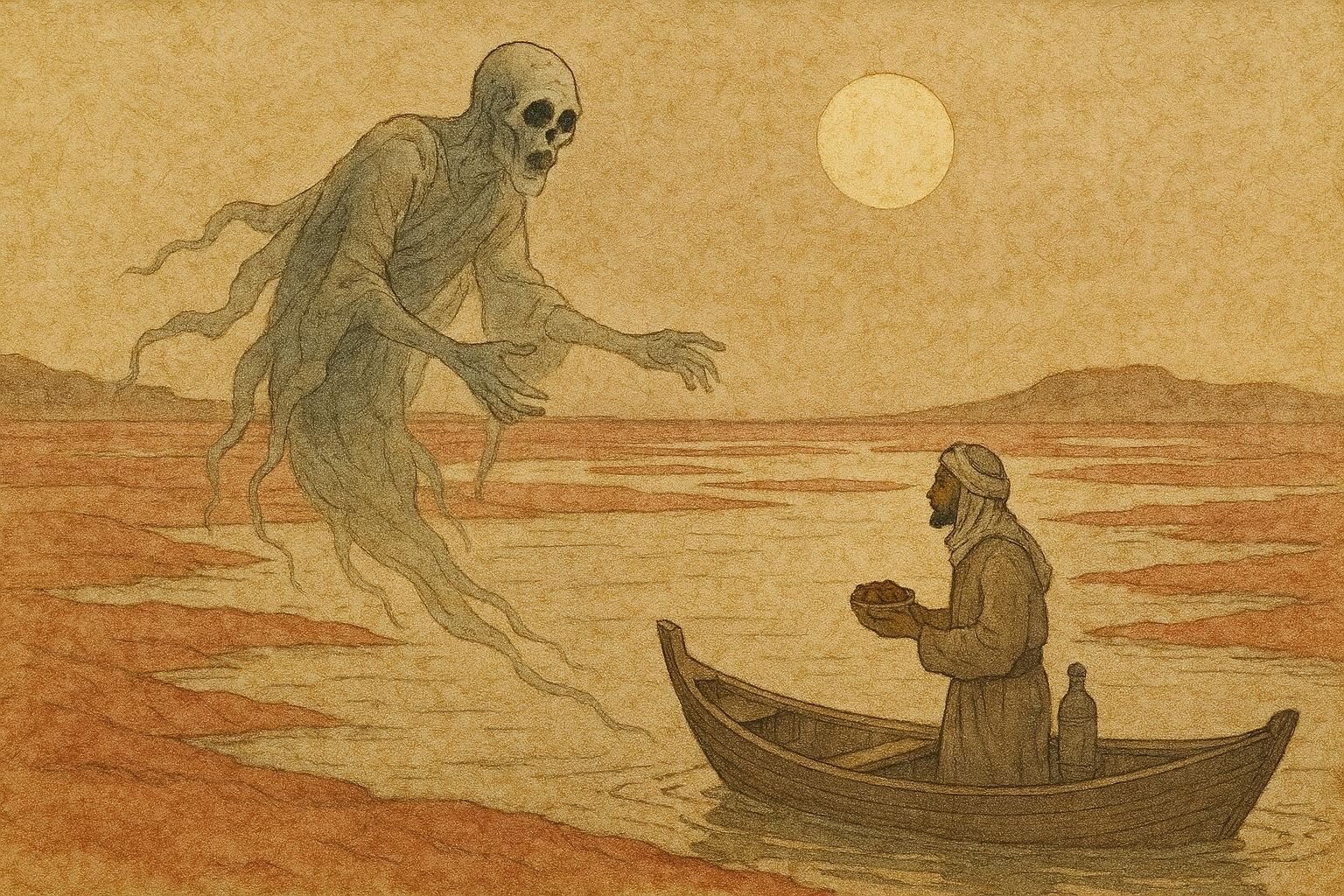
The ghoul revealed itself gradually, a translucent figure of a drowned man, hair and garments flowing as if underwater. His eyes glowed faintly with sorrow, and his mouth opened again in a silent scream that filled the night with despair. Most would have fled in terror, but Mansour, guided by his faith and compassion, called out, “I have dates and water for the distressed! Come, rest and find comfort!”
The spectral figure paused, and the wailing ceased. The ghoul’s form solidified enough to speak, his voice trembling like wind over dry sand: “My body lies beneath the salt crust. My soul cannot rest. Bury me in the red sands of the flats, and my torment will end.”
Though fear gnawed at him, Mansour nodded. He rowed carefully along the faint trail of flickering light, until he came upon a mound of salt that shimmered unnaturally. Digging with hands raw and tired, he uncovered skeletal remains, bleached and fragile, entwined with fragments of rope and coral—the remnants of a pearl diver lost to the sea many years before. Mansour wrapped the bones in a cloth, carrying them to a nearby patch of red sand. There, he performed a simple but respectful Muslim burial, whispering prayers for the departed soul.
As the final handful of sand fell, the air shifted. The oppressive chill lifted. The flickering light vanished, and the haunting cries were replaced by silence, deep and serene. Mansour returned to his village, where fishermen no longer feared the flats at night. Stories of the ghoul lingered, but now as a reminder that courage and compassion could heal even the most tormented spirits.
Mansour never sought glory, and the locals remembered his deed not for bravery alone, but for the humility and care that had freed a soul long trapped between the sea and the salt.
Discover the wisdom of Persian poets and Arabian storytellers in Western Asian Folktales.
Moral Lesson: True courage is not the absence of fear but the presence of compassion. Acting with empathy, even in terrifying circumstances, can restore peace to others and oneself.
Knowledge Check
-
Who is the main character of the folktale?
Mansour, a young fisherman from the Uqair coast. -
What supernatural figure haunts the Uqair salt flats?
A ghoul, mimicking the cries of drowning sailors. -
How does Mansour confront the ghoul?
With compassion, offering food and water, and promising to honor the drowned diver. -
What cultural practice is shown in the story?
Performing a respectful Muslim burial to bring peace to a restless spirit. -
What does the ghoul symbolize in the tale?
Unresolved death and the need for compassion to restore balance. -
What lesson does the folktale convey?
Courage coupled with empathy can break curses and bring resolution.
Source & Cultural Origin: Adapted from coastal folklore of the Eastern Saudi Arabian coast, documented in Darah’s collection of regional legends, Uqair port region, Saudi Arabia.