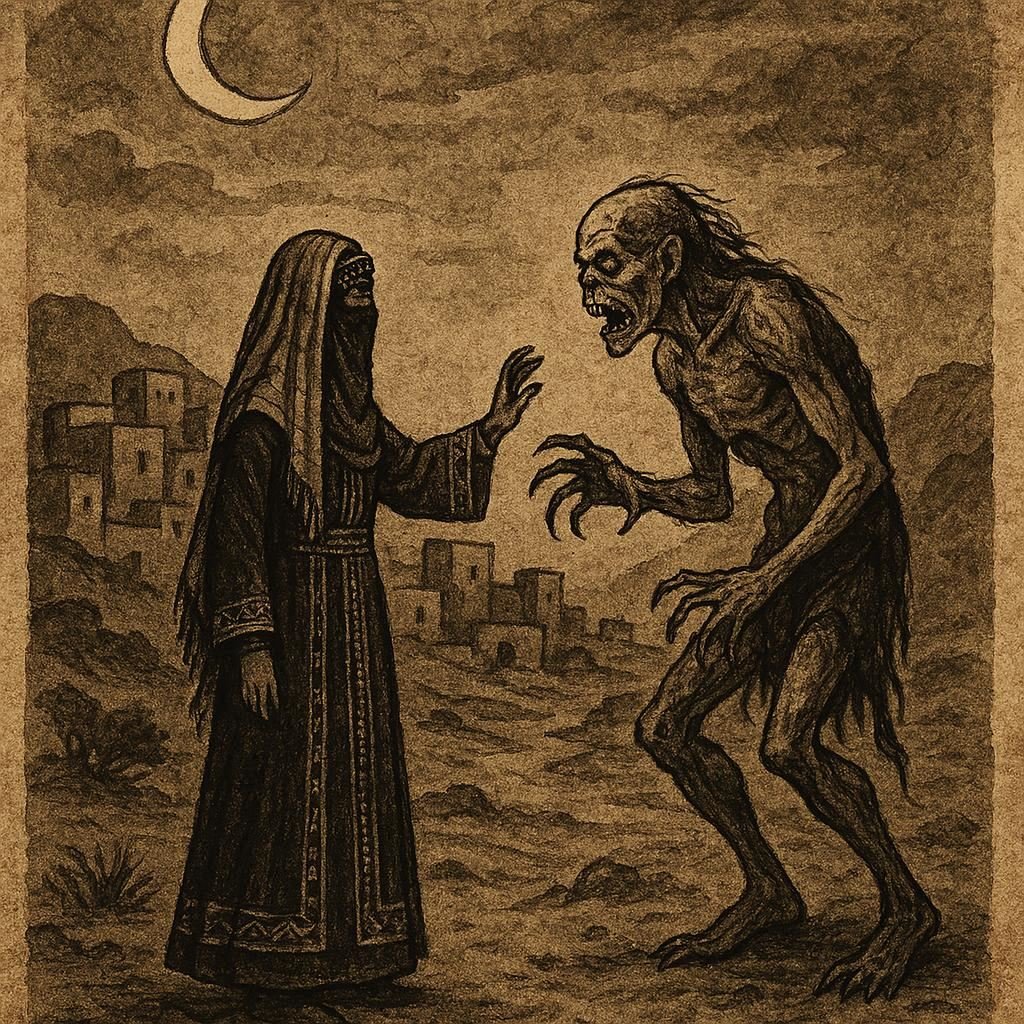
In the rugged hills of old Jordan, where olive trees whisper to the desert wind, there lived a merchant’s daughter of uncommon beauty and wisdom. Her name was Layla, and though her people admired her gentleness, it was her quiet strength that would soon be tested. For beyond her village’s safety, there roamed a ghoul, a vile creature of the night, known to feast on the flesh of the lost and lonely.
One evening, as Layla journeyed with her companions to visit distant kin, they lost their way in the barren wilderness. Dusk fell, and from the shadows emerged a tall man draped in fine robes. His eyes glowed faintly red, his smile too wide to be human. “Come,” he said softly, “rest in my home before the night grows colder.” Unaware of his true nature, the travellers followed.
In the ghoul’s house, a strange chill filled the air. The man’s servants were silent, their faces pale as wax. At supper, Layla noticed her host’s strange aversion to salt and his trembling hands when he spoke of prayer. When night came, she heard muffled sobs from a locked chamber. Peering through a crack, she saw what made her blood freeze, a heap of bones and torn garments. Her companions had vanished.
Terrified but unbroken, Layla fled into the night, clutching a silver pomegranate charm given by her late mother. The ghoul pursued her, his footsteps echoing like thunder across the rocks. As dawn broke, she stumbled into a shepherd’s camp, fainting in their care. The kind folk hid her and sent word to the king. When she awoke, the ghoul was gone, but her ordeal was far from over.
The king, upon hearing her tale, was moved by her bravery and wisdom. He took her into his palace, where she found kindness and peace. In time, he asked her hand in marriage. Yet during the wedding feast, as laughter filled the hall, a dark shadow slipped through the gates, the ghoul, disguised as a holy man, had come for vengeance.
Layla alone recognised the glint of his crimson eyes. Acting swiftly, she dropped her silver charm into the goblet of wine meant for the ghoul. The moment he drank, he shrieked, his true form revealed, his skin grey, his teeth long and cruel. The guards rushed to strike him down, and the king’s men burned his remains beyond the city walls.
Peace returned to the land, and Layla became beloved not only as a queen but as a symbol of courage, the woman who outwitted death itself. In the years that followed, mothers would hush their children with tales of the ghoul, reminding them that evil may disguise itself in beauty, but truth and courage will always unmask it.
Moral Lesson
True bravery lies not in strength but in discernment and faith. Even the darkest evil cannot endure in the presence of wisdom and courage.
Knowledge Check
1. Who is the main character in “The Ghoul’s Bride”?
Layla, a wise and courageous young woman who outwits a ghoul.
2. What is a ghoul in Jordanian folklore?
A ghoul is a supernatural creature that feeds on human flesh and often disguises itself as a human.
3. How does Layla defeat the ghoul?
She uses a silver charm and her intelligence to expose the creature before the king.
4. What moral does the story teach?
That wisdom and courage are stronger than fear and deception.
5. What cultural beliefs are reflected in this Jordanian folktale?
Belief in ghouls, protective charms, and the triumph of moral purity over evil.
6. Where does this folktale originate?
This tale belongs to Jordanian oral tradition within the broader Levantine folklore heritage.
Source: Adapted from a Jordanian variant of the “Girl and the Ghoul” folktale, as documented in Palestinian and Levantine oral repertoires (Muhawi & Kanaana; Jordan oral literature studies and UNESCO Jordanian intangible heritage initiatives).
Cultural Origin: Jordan (Levantine folklore)