In the sun-baked land of Dhofar, where the scent of frankincense drifts through the air and the wadis shimmer after rain, two siblings once journeyed together, a girl and her brother. They were young, hopeful, and bound by love and duty, travelling across valleys and dunes in search of a better home. But as the hours passed and the heat grew fierce, thirst tightened their throats. Their feet burned, their lips cracked, and still no kind soul offered them a drop of water.
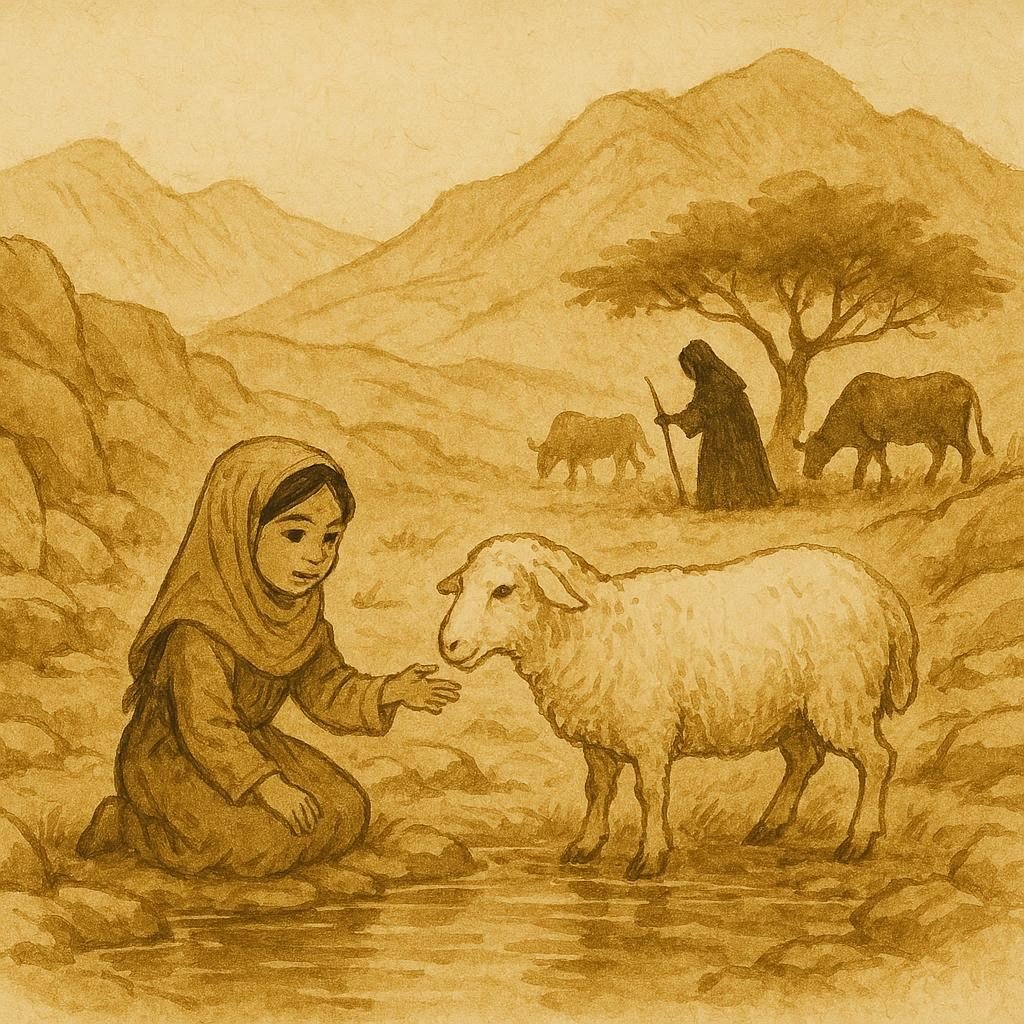
At last, they came upon an old woman tending a herd of cows. Her face was wrinkled like dry bark, and her staff was carved from a single twisted branch. She was not what she seemed, for she was a witch who watched travellers from afar. When the girl pleaded for water, the old woman pointed to a pond glimmering in the hollow of the hills.
Click to read all East Asian Folktales — including beloved stories from China, Japan, Korea, and Mongolia.
“You may drink,” she warned, “but beware. Take only what your mouth can hold. If you drink too deeply, the pond will take its price, you will become a sheep.”
The brother, too parched to think, ran ahead and bent to the water. The girl called out, reminding him of the witch’s words. But thirst was stronger than caution. He drank and drank, until the coolness numbed his senses. At once, the water rippled strangely, and where her brother had stood, a white sheep bleated softly by the pond’s edge.
The girl wept bitterly, her tears darkening the dust. She led the sheep away, speaking to it as though it still understood her. They travelled back toward their village, her heart heavy with grief and loneliness. Villagers whispered when they saw her, a girl wandering with a sheep that never left her side, but she spoke to no one. Each evening she sang beside the sheep, her voice carrying her sorrow across the quiet fields.
One day, she sat beneath a tall tree that shaded a lonely road. She leaned against its trunk and cried silently for her lost brother. Her tears fell upon the leaves and dripped to the ground like pearls.
That same afternoon, a prince rode by with his guards. He paused to rest beneath the same tree, and a single tear fell from above, landing upon his cheek. Startled, he looked up, and there he saw the girl, her face radiant even in sadness, her eyes filled with gentleness and mystery.
The prince asked her story, and she told him all, of the journey, the witch, and her brother’s curse. Moved by her courage and purity, the prince took her home to his palace and made her his wife. The sheep, her silent brother, was kept in the royal gardens, grazing under watchful care.
For a time, all was peace. The prince loved her dearly, and soon she was expecting a child. Yet envy crept through the palace walls. Some of the jealous women whispered that the new princess was only a peasant girl with a sheep for kin. When the prince departed for a distant war, they conspired against her.
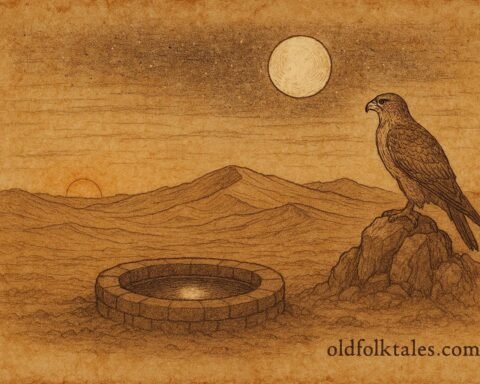
One moonless night, they seized her and threw her into a dry well crawling with snakes. But the hand of fate, or mercy, did not abandon her. The well had a narrow ledge halfway down, and she caught herself there. The snakes slithered below, but none touched her. There she gave birth to her child, her strength nourished by prayer and by hope.
Days passed before a passing shepherd heard the faint cry of an infant. He lowered a rope and found the young mother, pale but alive, clutching her newborn. The shepherd took her to a secret hut and cared for her. In time, her son grew strong and handsome.
When the prince finally returned and learned his wife was missing, he was overcome with grief and rage. Yet he refused to remarry, holding to the belief that she still lived. One day, while hunting, he strayed near the hut of the shepherd. Hearing the laughter of a child so like his own, he stopped and entered. There before him stood his lost wife, tears of joy shining in her eyes, their son in her arms.
The truth soon followed. The wicked women were punished, and the girl was restored to her place as princess of Dhofar. Her brother, the sheep, was brought forth, and she begged the prince to summon wise men to break the spell. Prayers were offered, incense burned, and blessings spoken. The sheep bowed its head and bleated once and before their eyes, it changed back into the young man she had lost so long ago.
Brother and sister embraced; husband and wife rejoiced. The people celebrated for seven days, praising the mercy that turns sorrow into peace.
Moral Lesson
The tale of The Girl and the Sheep teaches the power of loyalty, faith, and restraint. True devotion endures hardship, while wisdom and purity lead even the cursed back to redemption. Every act of kindness, patience, and courage becomes a path toward divine mercy.
Knowledge Check
1. Who are the main characters in “The Girl and the Sheep”?
The story centres on a devoted sister, her cursed brother turned into a sheep, and the prince who marries her.
2. What caused the brother to turn into a sheep?
He disobeyed the witch’s warning and drank too much water from the enchanted pond.
3. What is the main moral of this Omani folktale?
It teaches faith, patience, and loyalty in the face of hardship.
4. Where does this folktale originate?
It comes from Dhofar, a region in southern Oman, rich in oral storytelling traditions.
5. How is the witch significant in the story?
She represents temptation and the testing of human self-control.
6. What cultural values are reflected in “The Girl and the Sheep”?
The story highlights honour, endurance, family devotion, and divine justice, key themes in Omani folklore.
Source: Adapted from the Omani folktale “The Girl and the Sheep” in My Grandmother’s Stories: Folktales from Dhofar, collected and translated by Mohammed bin Musallam Al Mahri. Sultan Qaboos Cultural Center, Muscat (ROP.gov.om).
Cultural Origin: Oman (Dhofari folklore)