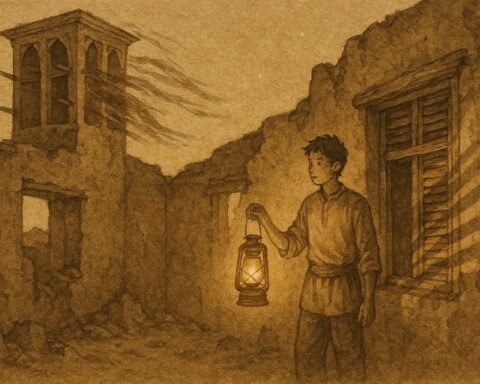
In the quiet days when Kuwait’s shoreline still echoed with the creak of wooden dhows and the scent of salt drifted inland with the wind, there lived a young woman known throughout the Faiha district for her beauty and kindness. She was not praised only for her face, which was gentle and radiant, but for her character, soft-spoken, respectful, and guided by a heart that valued honesty over wealth.
Her home stood among modest houses near the coast, where the rhythm of life followed the sea. Each morning, she helped her family and greeted neighbors with warmth, and each evening, she watched the sun dissolve into the water beyond the horizon. From that same sea came the man she loved: a humble dhow sailor whose livelihood depended on courage, patience, and trust in God. He owned little more than his vessel and his skill, yet his integrity made him rich in spirit. Their affection grew quietly, rooted in mutual respect rather than promises of luxury.
However, their peace did not go unnoticed.
A wealthy merchant, feared more than admired, also desired the girl from Faiha. His riches came from trade and influence, but his heart was hardened by pride. Accustomed to taking whatever he wanted, he believed his wealth gave him the right to claim her hand. When his advances were politely refused, his desire curdled into resentment. To him, the sailor was an obstacle, one that could be removed.
The merchant soon learned that the sailor was preparing for a journey at sea. Concealing his intentions behind polite smiles, he arranged for men loyal to him to tamper with the sailor’s dhow under the cover of night. Ropes were weakened, and vital parts of the vessel were subtly damaged, so that no one would suspect foul play. The merchant believed that the sea itself would finish what he had begun.
As the sailor set out, unaware of the danger beneath his feet, the girl’s heart grew restless. She felt an unease she could not explain, as if the wind itself carried a warning. Unable to quiet her fears, she walked to the Al-Kout fortress, a place of strength and refuge known to the people of Kuwait. There, within its solid walls, she raised her hands in prayer—not for wealth or revenge, but for protection and justice.
The sky darkened as her prayers rose. Clouds gathered swiftly over the sea, and the calm waters transformed into churning waves. A sudden storm (عاصفة) broke upon the coast with fierce winds and pounding rain. Fishermen rushed to secure their boats, and families closed their doors as thunder rolled across the sky.
Out at sea, the sailor felt the storm seize his damaged dhow. Yet where the merchant expected destruction, something else unfolded. The violent winds forced the sailor to alter his course, steering him away from deeper waters. Though the voyage was perilous, the sailor survived, guided back toward safety by the very storm meant to destroy him.
Meanwhile, the merchant’s plans unraveled. Ships carrying his goods were caught unprepared by the storm. His wealth suffered great losses, and whispers spread through the community about divine justice. People spoke of the girl’s prayer at Al-Kout fortress and how the storm seemed to answer her plea.
When calm finally returned, the sailor came ashore shaken but alive. The truth of the sabotage eventually surfaced, and the merchant’s reputation crumbled. Stripped of respect and humbled by loss, he could no longer impose his will on others.
The girl from Faiha and the sailor were reunited, their bond strengthened by hardship and faith. Their story became one spoken softly in courtyards and told to children at night—a reminder that justice may arrive in unexpected ways, and that sincerity and prayer can withstand even the darkest intentions.
Moral Lesson
This folktale teaches that humility, love, and faith carry greater power than wealth and cruelty. Those who act with pure intentions are protected, while injustice ultimately turns against itself.
Knowledge Check
1. Who is the main heroine of the folktale?
The main heroine is a kind and beautiful girl from the Faiha district of Kuwait.
2. Why does the rich merchant oppose the sailor?
He desires the girl for himself and resents her love for a humble sailor.
3. What act of wrongdoing does the merchant commit?
He secretly sabotages the sailor’s dhow to endanger his life at sea.
4. What role does Al-Kout fortress play in the story?
It is a place of refuge and prayer where the girl seeks divine protection and justice.
5. How does the storm function symbolically in the folktale?
The storm represents divine intervention and moral justice.
6. What central lesson does the story convey?
Faith, sincerity, and humility ultimately overcome greed and abuse of power.
Cultural Source
Source: Collected by Mohammed Al-Banai in Al-Bayan magazine (Issue 143, 1988). Also preserved in Kuwaiti oral history collections.