In the fertile stretch of the Jordan Valley, known locally as Al-Ghor, the people lived close to the soil, relying on its gifts and fearing its scarcities. Among the crops that defined their existence, none carried deeper meaning than the palm tree, a symbol of life, shade, sustenance, and endurance against the desert sun. It was said that some palm trees held ancient spirits, born from the breath of the earth itself.
Long ago, in a quiet corner of the valley, two tall palm trees stood side by side. Their trunks were straight, their fronds broad, and their clusters of dates heavy with sweetness. Villagers often paused to rest beneath them, marveling at how they seemed almost alive, as if listening. Few dared disturb them, believing they guarded a secret.
One spring, when the valley was waking from winter’s cool embrace, a shepherd passing by heard an infant’s cry. He dropped his sack of fodder and approached cautiously. There, nestled between the two palms, lay a beautiful baby girl, wrapped in woven palm fibers that had fallen naturally from the trees. There were no footprints, no mother in sight, only the two palm trees leaning protectively over her, their fronds swaying although no wind blew.
The shepherd took this as a sign of blessing. He lifted the child gently and carried her to the village, where an elderly widow agreed to raise her. The villagers called her Bint al-Nakhlatayn, the Girl of the Two Palm Trees, believing the trees were her guardians.
Years passed, and the girl grew into a young woman of extraordinary grace and kindness. Her eyes were dark like the rich valley soil, and her hair shone like date syrup in the sun. Everyone loved her, not only for her beauty but for her gentle spirit. Whenever she walked near the two palm trees, their fronds rustled softly, shading her from the heat and dropping the ripest dates at her feet as if offering gifts.
But purity often draws envy. Across the valley lived a jealous witch, feared for her knowledge of hidden magic. She heard tales of the girl’s beauty and the villagers’ affection, and her heart twisted with bitterness. Another version of the tale spoke of a powerful emir whose desire threatened the girl’s safety, but in this telling, it is the witch whose envy darkened the days to come.
One evening, the witch crept near the two palm trees. The air grew heavy, and even the crickets fell silent. She whispered curses into the soil and tried to weaken the trees with her spells. But the palm trees sensed her malice; their fronds lifted like spears, shimmering with an unseen force. Unable to strike directly, the witch plotted another path.
She disguised herself as an old traveler and visited the girl at the widow’s home.
“My child,” she croaked, “I have wandered far and am weary. Could you fetch me some dates from the grove so that I may regain my strength?”
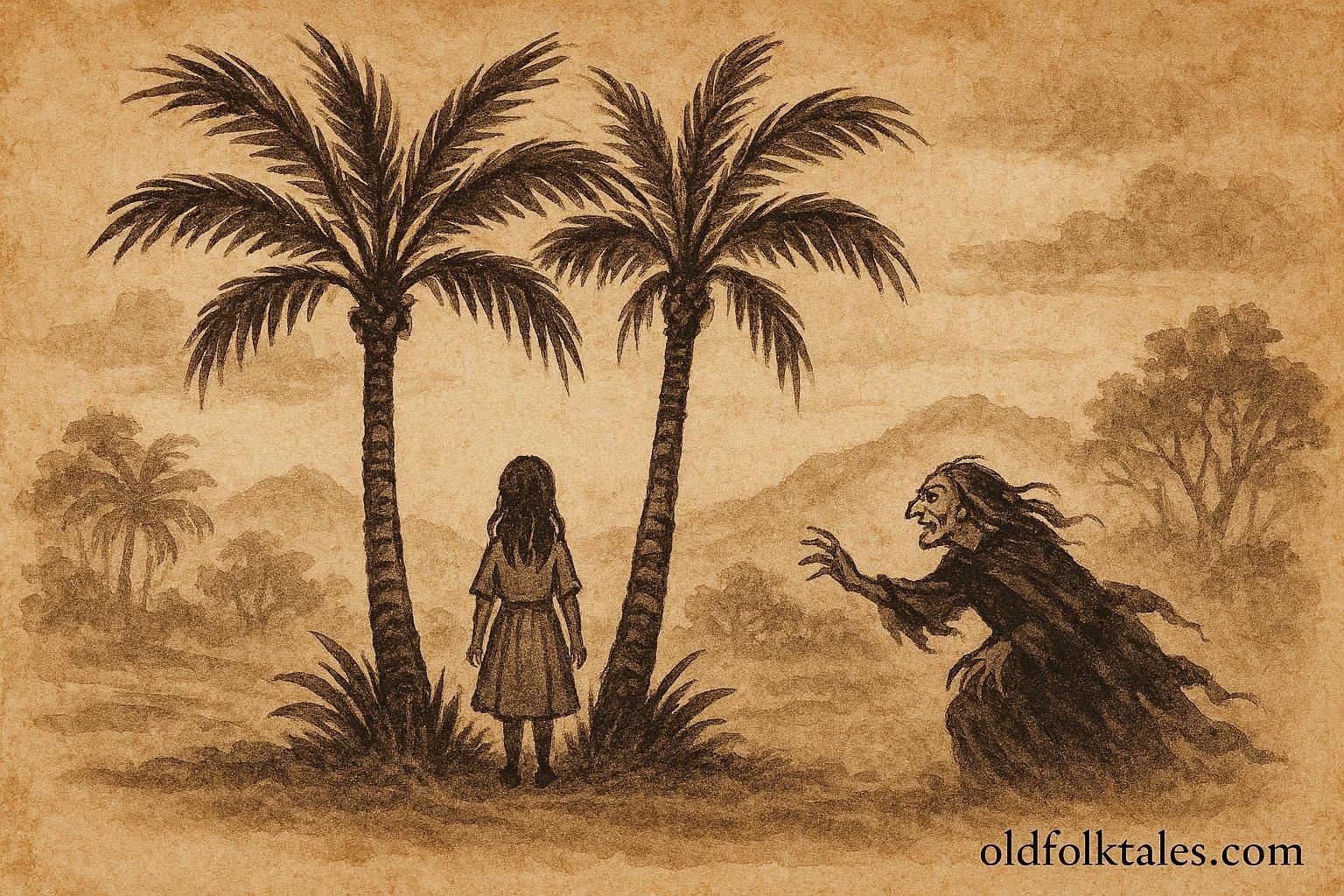
The girl, pure of heart, agreed at once. She walked to the two palm trees, unaware of the trap woven around her. When she stepped beneath their shade, the witch leaped from behind the rocks, her true form revealed, wild hair, burning eyes, and hands twisted with dark power.
The girl stumbled back in terror. But before the witch could strike, the palm trees awoke.
Their trunks groaned like ancient drums, and their fronds whipped down like blades, forming a living barrier around the girl. The wind rose suddenly, swirling sand in a fierce circle. Dates rained down, not gently, but like stones, pummeling the witch as she screamed and shielded herself.
The witch hurled her spells, but the palm trees absorbed them, their bark glowing with a warm, protective light. The girl stood unharmed at the center of this living fortress. With a final surge, the two palm trees thrust their fronds outward, driving the witch back. She fled shrieking into the hills, never daring to return.
When the winds softened, the palm trees relaxed their fronds and dropped a small cluster of golden dates at the girl’s feet, as if reassuring her. She touched their trunks with gratitude, feeling the deep heartbeat of the land within them.
From that day on, the villagers regarded the two palm trees as sacred guardians. The girl spent her life among her people, embodying the virtue and purity the trees had protected. And the palm trees stood watch over her until her final days, their fronds whispering her name for generations.
Moral Lesson
True innocence is never unprotected; nature itself rises to defend purity, reminding us that harmony with the land is both a blessing and a shield.
Knowledge Check
1. Who is the main character in “The Girl of the Two Palm Trees”?
The story centers on a virtuous girl protected by two ancient palm trees in the Jordan Valley.
2. What symbolizes protection in this Jordanian folktale?
The twin palm trees, whose living fronds defend the girl against danger.
3. Who threatens the girl in the story?
A jealous witch who envies the girl’s beauty and goodness.
4. How do the palm trees protect the girl?
Their fronds act as weapons, and they drop dates like stones to drive away the witch.
5. What cultural value does the tale reflect?
A deep, almost animistic belief in nature’s loyalty and the life-giving spirit of palm trees in the Jordan Valley.
6. What is the central theme of the folktale?
The protection of innocence and the sacred bond between people and their land.
Source
Adapted from the Jordan Valley (Al-Ghor) folktale “Bint al-Nakhlatayn (The Girl of the Two Palm Trees),” reflecting ancient agricultural and animistic traditions.